The Trump administration said on Monday that it would provide an initial $2 billion next year to fund humanitarian aid coordinated by the United Nations but urged humanitarian agencies to deeply overhaul the way they deliver assistance.
The move will likely keep the United States as the biggest international aid donor in 2026, even as it drastically scales back the level of support traditionally provided by American administrations.
The announcement was a relief for underfunded agencies that provide food, shelter, medicine and other types of aid around the globe, and it was welcomed with cautious optimism by some prominent international humanitarian organizations that have been dismayed by President Trump’s push to slash aid.
But the United States also issued a stark warning: “The agreement requires the U.N. to consolidate humanitarian functions to reduce bureaucratic overhead, unnecessary duplication, and ideological creep,” the State Department said in a statement on Monday. “Individual U.N. agencies will need to adapt, shrink, or die.”
The United States was the leading funder of the U.N.’s humanitarian efforts in 2025 with about $3.38 billion, or about 14.6 percent of the global sum, according to U.N. data. That was down sharply from previous years over the past decade, when it regularly contributed a third or more of the total yearly funding.
President Trump has often criticized foreign aid as wasteful and rife with fraud. His administration has dismantled the United States Agency for International Development and cut support for foreign assistance programs — disrupting earthquake response in Myanmar, clinical trials in South Africa, malaria programs in Cameroon and more.
American funding is especially critical for the U.N. Its refugee agency alone received $2 billion from the United States in 2024.
The agreement announced on Monday creates an arrangement under which the United States will channel money into an umbrella fund run by the U.N. Office for the Coordination of Humanitarian Affairs, or OCHA.
OCHA will distribute that aid to 17 priority countries grappling with the fallout from wars, famine and natural disasters, the State Department said on Monday.
Jeremy Lewin, the State Department’s senior official in charge of foreign assistance, humanitarian affairs and religious freedom, said those priority countries included Sudan, Syria and Haiti; he described the funding as “an initial anchor commitment.”
“There are other countries that we will add, as we continue to get more funding into this mechanism,” he said at a news conference at the U.S. Mission in Geneva, adding that the hope is for the $2 billion to be “only the beginning” of a new partnership and funding model for U.N. humanitarian aid.
The 17 countries include some prioritized by the U.N. as facing acute humanitarian challenges, such as Ukraine, Myanmar, Chad, Democratic Republic of Congo and South Sudan, but also some of interest mainly to the United States, such as Guatemala, Honduras and El Salvador. It omits several countries of particular U.N. concern, like Afghanistan and Yemen.
By channeling aid through a consolidated fund instead of through hundreds of sometimes overlapping project grants, the United States expects to save close to $2 billion and improve aid delivery efficiency, Mr. Lewin said.
Secretary of State Marco Rubio said on social media that the new model would “better share the burden of U.N. humanitarian work with other developed countries” and “require the U.N. to cut bloat, remove duplication, and commit to powerful new impact, accountability and oversight mechanisms.”
Tom Fletcher, who leads OCHA, had already committed the U.N. to many reforms demanded by the United States. Earlier this month, in a global appeal that he began after close consultation with the Trump administration, Mr. Fletcher stressed the need to cut costs by providing more aid through local organizations or cash assistance.
On Monday, Mr. Fletcher called the U.S. announcement a “landmark contribution,” and said the money would anchor OCHA’s plans to reach 87 million people with emergency assistance in 2026.
Jan Egeland, a former head of OCHA who leads the Norwegian Refugee Council, called the U.S. announcement “good news” that gave much-needed predictability to underfunded operations and that was a “big boost” toward reforming the humanitarian sector.
“I expect this to be a first signal that the Trump administration is back as a real and reliable contributor to global compassion and solidarity,” Mr. Egeland said.
Still, the U.S. contribution represents only a fraction of the $23 billion that Mr. Fletcher wants to raise for emergency relief programs next year — a figure that is roughly 50 percent less than in 2025.
That is unlikely to fix the funding crisis overshadowing international relief agencies, which face cuts by other leading Western donor governments.
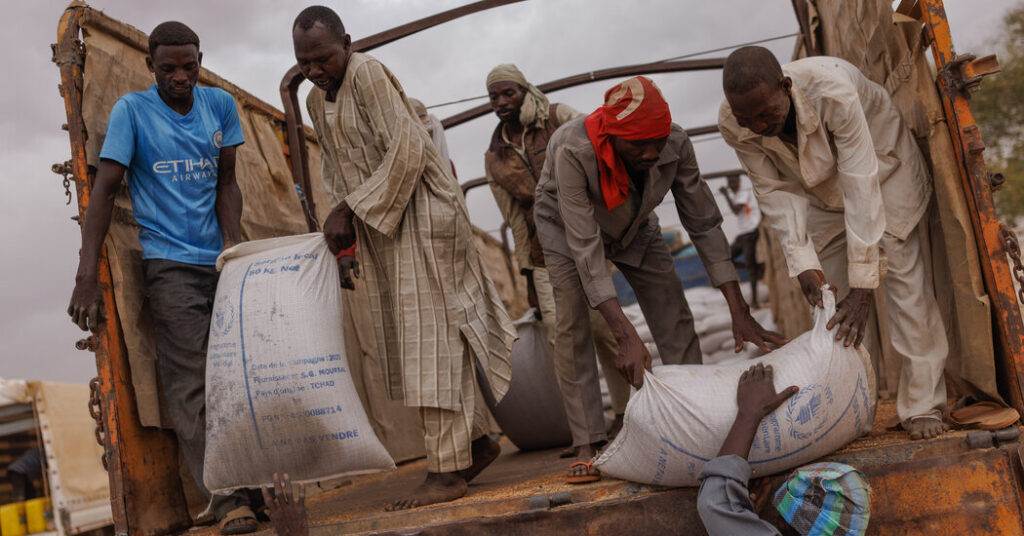
In Sudan, where three years of civil war have displaced millions and left large areas gripped by famine, the World Food Program reported in December that it had raised only 12 percent of the funding requested for 2025. International relief agencies have reported similarly crippling shortfalls in anti-hunger efforts in Afghanistan and Yemen.
“The catastrophic underfunding of humanitarian work is the worst I have seen in 40 years,” Mr. Egeland said. “Never has the gap between recorded need and available funding been so severe.”
The post U.S. Pledges $2 Billion for U.N. Aid but Tells Agencies to ‘Adapt, Shrink, or Die’ appeared first on New York Times.