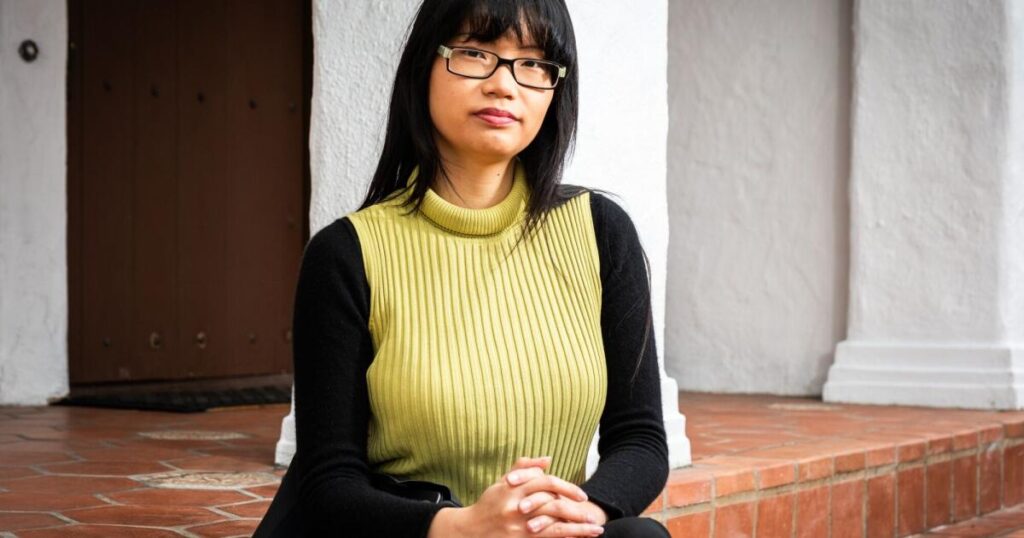
Most people use dating apps to find love. Tiffany Chau used one to hunt for a summer internship.
This fall, the 20-year-old junior at California College of the Arts tailored her Hinge profile to connect with people who could offer job referrals or interviews. One match brought her to a Halloween party, where she networked in hopes of landing a product-design internship for the summer. While there, she got some tips from someone who had recently interviewed at Accenture. As for the connection with her date? Not so much.
“I feel like my approach to the dating apps is it being another networking platform like everything else, like Instagram or LinkedIn,” Chau said.
Chau is among a cadre of workers who are using dating apps to boost their job searches. They’re recognizing that the online job hunt is broken as unemployed workers flood the system, AI screens out resumes and many job matching programs are overwhelmed. Automation has squeezed human contact out of hiring, which has pushed applicants to seek any path to a live hiring manager, no matter the means.
The overall U.S. unemployment rate continued to climb throughout 2025, reaching 4.6%, according to the Bureau of Labor Statistics. And while the number of unemployed high school graduates held steady at about 4.4% in November, the rate for workers with a bachelor’s degree rose to 2.9% from 2.5% a year ago.
About a third of dating app users said they had sought matches for job hook-ups, according to a ResumeBuilder.com survey of about 2,200 U.S. dating site customers in October. Two-thirds targeted potential paramours who worked at a desirable employer. Three-quarters said they matched with people working in roles they wanted.
The idea isn’t just for Gen Z digital natives. Almost half of the job-hunting cupids reported incomes of more than $200,000, suggesting they are more experienced, senior employees, said Stacie Haller, ResumeBuilder.com’s chief career advisor.
“People are doing it to expand their networks, make connections, because the best way to get a job today is who you know,” she said. “Networking is the only way people are rising above the horror show that the job search is today.”
Alex Xiao is an 18-year-old first-year student at UC Berkeley majoring in analytics, and a director at Ditto AI, a dating app startup exclusively for college students. He said he’s had multiple matches who wanted job help, not a date.
“A lot of connection in general just boils down to: ‘How can you help me further my career?’ ” Xiao said, adding that people, upon seeing his job title, outright asked him for a job. “And I’m like: ‘Bro.’ ”
Dating companies have taken note, said AJ Balance, chief product officer at Grindr Inc., the LGBTQ-focused dating app. The platform was originally designed for casual dating, but now attracts about 15 million monthly average users also seeking serious relationships, friendships, travel companions — and for about a quarter of users — networking.
Some companies want users to stay focused. A spokesperson for Bumble Inc. told Bloomberg News that using Bumble Date or BFF primarily to seek job opportunities “isn’t aligned with our mission and doesn’t create an authentic experience for our community.” A representative for Match Group Inc., which operates the dating apps Match, Tinder, Hinge and OKCupid, had no comment, but the guidelines on its sites discourage deviation from dating. OKCupid admonishes users that the app is for “bona fide relationship seeking purposes,” and Hinge says on its app that it’s in the business of “intentional dating,” not “commerce.” Tinder says participants should “make personal connections, not biz ones.”
Grindr is probably more open to users who find networking value amid the flirting because of the unique nature of the LGBTQ community, where people often face discrimination or even legal ramifications of being out in the non-digital world, Balance said.
It’s not likely that job hunting on dating apps will become a mainstream function, said Jeffrey Hall, a professor for communication studies at the University of Kansas, where he directs the Relationships and Technology Lab. It will probably remain an example of how a “clever subset of users become thoughtful and creative in the adaptability of different sites, for different goals.”
Repurposing a dating app is just an extension of the ways AI is teaching workers to rethink technology in general, said Constance Hadley, a research associate professor at Boston University Questrom School of Business and a founder of the Institute for Life at Work, where she collaborates on AI research and other topics. Workers will take any tools they have and amplify them, she said.
“In times of great uncertainty, when people’s jobs are threatened, people will do whatever it takes to survive,” Hadley said. “People are savvy enough to be anticipating there’s a lot of upheaval ahead and a lot of uncertainty about their futures.”
Los Angeles-area makeup artist Alaina Davenport, 26, tried a few dating sites and stumbled across some employment leads early this summer. On Hinge, a match requested her portfolio, and the connection led to a one-day job on a social media video shoot. She appreciated the gig, but said in this case, she would have preferred a date. The two did end up getting together, but it didn’t last too long. That’s in line with one of the findings from ResumeBuilder.com, where 38% of the dating site off-label users also had a physical relationship with a person they connected with for job-related reasons.
“I did really need that job at the time that I got it, so I’m grateful for that,” Davenport said.
Kait O’Neill turned to Hinge in June for job tips when she was itching to leave her role as a teacher. The 28-year-old wanted to combine her previous experience in sports public relations with her skills working with kids. She applied to positions for months and struggled to land an interview. That’s when she decided the traditional approach wasn’t working and explicitly stated on her dating app profile that she was there to try to find a job.
During her three-month experiment, O’Neill said some men did ask what type of job she was seeking, or chatted her up about job opportunities. But she started to feel remorse about matching with men solely based on their profession.
“It was just adding to the stress of trying to find a job because it was one more method that wasn’t working,” she said. She’s back on LinkedIn.
Hall and Green write for Bloomberg.
The post Tough job market has people using dating apps to get interviews appeared first on Los Angeles Times.