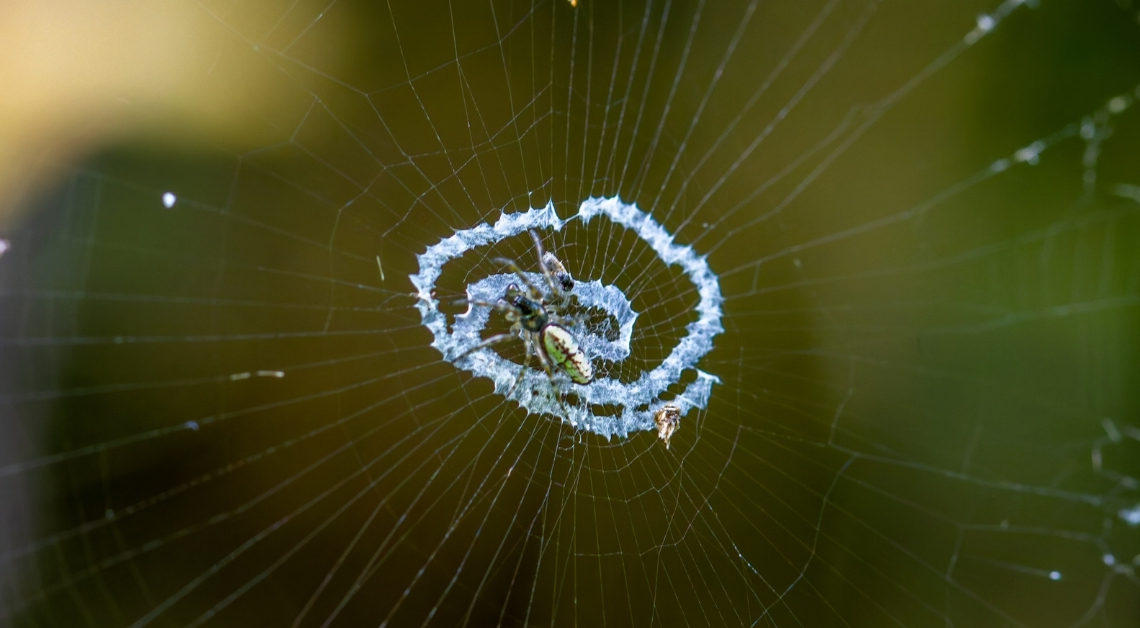
A new study published in Ecology and Evolution documents that orb-weaving Cyclosa spiders build large, spider-shaped decoys into their webs to deter predators. Specifically, orb-weaving Cyclosa spiders build large, spider-shaped decoys directly into their webs that are convincing enough that they convince anything that wants to eat them to find something else to munch on.
As if spiders couldn’t get any creepier.
Observed in the Amazon rainforest of Peru and on Mount Kanlaon in the Philippines, these web-mounted “doppelgängers” appear to be a deliberate survival strategy. That means it’s not just an accident or humans finding patterns in nature that aren’t really there.
Researchers watched Cyclosa spiders assemble replicas using silk and a mix of leaf fragments, insect remains, old prey, and soil. The finished decoys are often situated at the center of the web and are noticeably larger than the spiders themselves.
Meanwhile, the real spider positions its body nearby, standing in the shadows, while predators focus on the wrong target. Clever girl.
Spiders Are Building Decoys of Themselves, Which Feels Like Cheating
If you see them up close, thanks to photos supplied by the Australian National University, you’ll notice that the replicas are surprisingly accurate. Each includes a central body mass and leg-like limbs, mirroring the spider’s proportions closely enough to pass at a glance.
The spiders don’t abandon the structures once built. They maintain and adjust them over time, suggesting the decoys are an active part of the web. If you’re wondering what they could be creating the things to protect themselves from, one such spider villain comes in the form of helicopter damselflies.
They hover in front of webs and prey on small spiders. Birds and lizards are also a common thread, which can sometimes be fooled or discouraged by the giant spider dummy, which may pose too significant a threat of retaliation and/or seem like too much of a hassle to deal with.
Similar decoys were found in multiple Cyclosa species across distant regions, suggesting that this is a more widespread evolutionary development and may not be limited to a single species in a particular pocket of the world.
Cyclosa spiders don’t build these to survive. Incredibly, these spiders know what they look like and can replicate it with webs and various bits of odds and ends. Survival has turned them into artists who can, in a weird way, self-reflect.
The post Some Spiders Build Fake Versions of Themselves to Trick Predators appeared first on VICE.