As hundreds of thousands of people amass in Times Square for the annual New Year’s Eve ball drop, a much smaller gathering of historical importance will begin underground at a long-abandoned subway station.
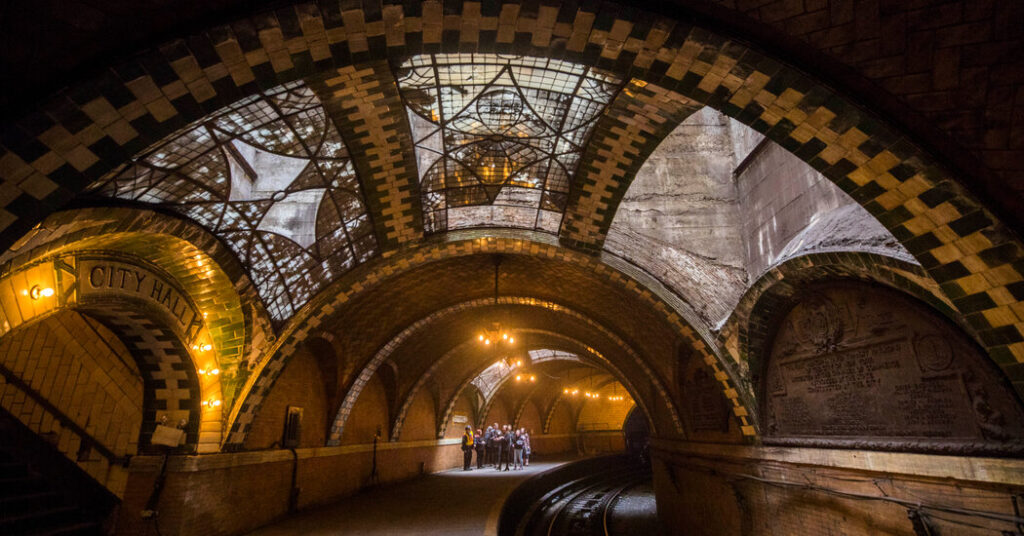
Mayor-elect Zohran Mamdani will be sworn into office at the old City Hall subway station, its tiled arches, chandeliers and vaulted ceilings emblematic of a Gilded Age civic ambition that Mr. Mamdani is seeking to honor in spirit.
“When Old City Hall Station first opened in 1904 — one of New York’s 28 original subway stations — it was a physical monument to a city that dared to be both beautiful and build great things that would transform working peoples’ lives,” Mr. Mamdani said in a statement. “That ambition need not be a memory confined only to our past, nor must it be isolated only to the tunnels beneath City Hall: it will be the purpose of the administration fortunate enough to serve New Yorkers from the building above.”
Letitia James, the New York attorney general, who has become a close ally of the mayor-elect’s, will perform the swearing-in during a small private ceremony with Mr. Mamdani’s family and a few close advisers. The news was first reported by Streetsblog NYC.
That Mr. Mamdani chose the location of his private swearing-in based on his vision for working New Yorkers is no surprise. The mayor-elect, who is a democratic socialist, overcame a lack of name recognition largely through his relentless focus on affordability. His platform of creating universal child care, making public buses fast and free and freezing the rent for one million rent-stabilized apartments was remarkably popular.
Ms. James said that the location was fitting, considering that the subway is the “lifeblood” of the city and a “great equalizer” for all New Yorkers.
“For all of our strengths and weaknesses as individuals, we ride together on the train, to places far and wide,” Ms. James said in a statement. “Zohran is our next mayor because he understands how important it is that New Yorkers living side by side all deserve a city that we can thrive in, no matter what subway line you use.”
Roughly 13 hours after he takes the oath of office in the station, Mr. Mamdani will hold a ceremonial inauguration outside City Hall, an event that also reflects his ties to the working class. Senator Bernie Sanders of Vermont will swear in Mr. Mamdani, with portions of Broadway closed off to accommodate as many as 40,000 attendees.
The City Hall station, which opened in 1904, was closed down on New Year’s Day in 1945 because its curved platform did not line up with the doors of newer trains, leaving dangerous gaps. The station can now only be seen during official tours or if riders stay on the No. 6 train after its last stop at the Brooklyn Bridge station as it loops around to begin its voyage uptown.
When Mayor George B. McClellan Jr. pulled the lever to lead the first train out of City Hall station on Oct. 27, 1904, it helped signal that New York had joined the ranks of other world-class cities such as Paris or London, said Polly Desjarlais, the content and research manager at the New York Transit Museum. Mr. McClellan didn’t relinquish control of the train until 103rd Street.
The station was considered the glamorous anchor of the subway system, which comprised 28 stations set along 9.1 miles of track that ran up to West 145th Street in Harlem. The Interborough Rapid Transit Company built the system in four years and seven months for $35 million — close to $1.2 billion today.
The tiled arches at the City Hall station were created by the Spanish architects Rafael Guastavino Moreno and his son, Rafael Guastavino Esposito, whose work can also be found at Cathedral Church of St. John the Divine and Grand Central Terminal. Commemorative bronze plaques on the wall were created by Gutzon Borglum, who would go on to sculpt the presidential faces on Mount Rushmore.
The I.R.T. considered the station an example of the City Beautiful Movement, which sought to join design with social issues and to create civic pride.
“It was a big showcase for the I.R.T., who wanted to appeal to better angels and raise moral and civic virtues. It was trying to say to people that we care enough about how the system looks because we care about you and your experience,” Ms. Desjarlais said in an interview. “They were trying to make passengers of the system care about the environment and care about the city.”
Over time, the station saw less use. Only local trains ran there, and passengers could catch express trains at the adjacent Brooklyn Bridge station.
Mr. Mamdani is counting on the location to provide inspiration as he begins his term.
“When I take my oath from the station at the dawn of the new year,” he said in the statement, “I will do so humbled by the opportunity to lead millions of New Yorkers into a new era of opportunity, and honored to carry forward our city’s legacy of greatness.”
Jeffery C. Mays is a Times reporter covering politics with a focus on New York City Hall.
The post Mamdani Will Be Sworn In at Abandoned Subway Station Beneath City Hall appeared first on New York Times.