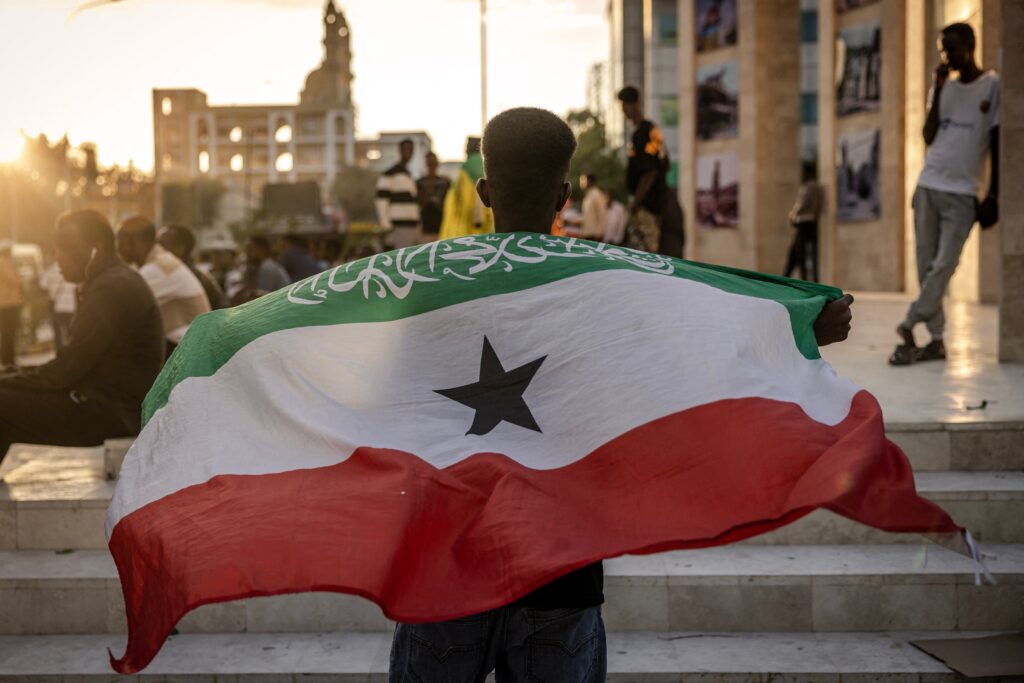
The United Nations Security Council convened an emergency meeting Monday afternoon following Israel’s recognition of the autonomous region of Somaliland. The unprecedented move makes Israel an outlier among the international community and prompted outcry from around the world.
No other countries currently recognize Somaliland, a breakaway region bordered by Ethiopia, Somalia and Djibouti that seceded from Somalia in 1991.
In a declaration signed by Israeli Prime Minister Benjamin Netanyahu and Foreign Minister Gideon Saar, the government of Israel said it recognized the Republic of Somaliland as a sovereign and independent state, following a “formal appeal” conveyed by Somaliland’s president to Netanyahu.
Israel made the decision in light of “shared values, strategic interests, and the spirit of mutual respect to bind our peoples,” the document reads, declaring that Israel and the Republic of Somaliland will establish “full diplomatic relations.”
Somaliland President Abdirahman Mohamed Abdullahi called Israel’s decision “historic.”
In May, the Associated Press reported that Somaliland was among three countries contacted by Israeli and U.S. officials to discuss serving as a destination for Palestinians expelled from Gaza. Israeli and U.S. plans to forcibly relocate Palestinians from Gaza have drawn broad condemnation from the international community, including from steadfast Israeli allies in Europe.
Somaliland, which sits across the Gulf of Aden from Yemen, could also serve as a useful staging ground for Israeli operations against the Houthis, who, during the war in Gaza, attacked ships in the Red Sea bound for Israeli ports. Abdulmalik al-Houthi, one of the leaders of the Houthis in Yemen, said in a statement Sunday that an Israeli presence in Somaliland would pose a “direct threat” to regional stability.
President Donald Trump told the New York Post on Friday that he would “study” Israel’s recognition of Somaliland, declining to immediately follow Netanyahu’s lead.
“We’ll study it,” Trump said. “I study a lot of things and always make great decisions and they turn out to be correct.”
Tammy Bruce, the deputy representative of the United States to the United Nations, told the Security Council on Monday that the country’s policy toward Somaliland and Somalia had not changed. The U.S. has historically followed the lead of the African Union, which represents 55 states on the continent, on decisions regarding Somalia and Somaliland.
Israel’s recognition of Somaliland comes at a febrile moment for the Middle East, with a ceasefire in Gaza barely holding fast amid dueling accusations of violations by both sides. Though the diplomatic maneuver by Israel expands recognition of the Jewish state in the Muslim world, the move stands to frustrate numerous Arab states with which Israel has sought closer relations — most of which offer greater prospective economic and diplomatic boons to Israel than Somaliland.
Countries including Saudi Arabia, Egypt, Turkey, Jordan, Qatar and China, among many others, signaled their disapproval of the move. The African Union said in a statement that the action would “undermine the unity, sovereignty, and territorial integrity of Somalia.”
The diplomatic service of the European Union called on Somalia and the government of Somaliland to resolve its issues through dialogue.
Somalia is on the United Nations Security Council and is set to assume the rotating presidency in January. The country’s leadership has condemned Israel’s recognition of Somaliland.
“The illegal aggression of PM Netanyahu in recognising a part of Somalia’s Northern region is against international law,” Somalia’s president, Hassan Sheikh Mohamud, wrote on the social media platform X on Saturday. “Meddling with Somalia’s internal affairs is contrary to established legal & diplomatic rules. Somalia & its people are one: inseparable by division from a far.”
Israel’s recognition of Somaliland — and the resultant outcry — mirrors the global drive to recognize a Palestinian state, which Israeli officials have decried as counterproductive. Bruce, the U.S. deputy representative to the U.N., drew a direct link between Israel’s actions and the embrace of Palestinian statehood in remarks on Monday.
“Earlier this year, several countries, including members of this Council, made the unilateral decision to recognize a nonexistent Palestinian state. And yet, no emergency meeting was called to express this Council’s outrage,” Bruce said. “This Council’s persistent double standards and misdirection of focus distract from its mission of maintaining international peace and security.”
The United States had previously vetoed a U.N. resolution to recognize Palestinian statehood.
“The attacks on Israel’s recognition of Somaliland are hypocritical,” wrote Saar, Israel’s foreign minister, in a statement Sunday. “Only Israel will decide who to recognize and with who to maintain diplomatic relations.”
Taiwan, which is also largely unrecognized as an independent state by the international community, welcomed Israel’s decision. Somaliland and Taiwan both opened representative offices in each other’s capitals in 2020.
The post Israeli recognition of Somaliland prompts global outcry, emergency U.N. meeting appeared first on Washington Post.