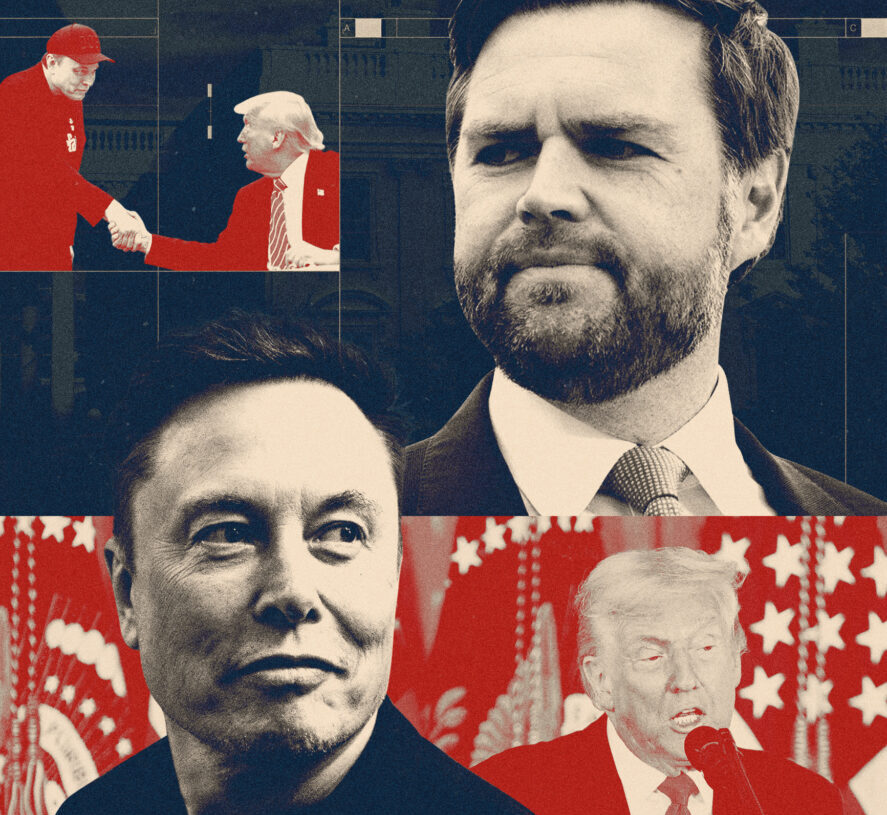
Vice President JD Vance was doggedly working the phones, trying to quell a rebellion in his midst. Elon Musk had just declared his intention to form a third party this spring, turning a simmering feud into an all-out war against the MAGA movement.
Backlash to Musk’s radical government cost-cutting campaign, the U.S. DOGE Service, along with his public swipes at President Donald Trump on social media — had damaged the relationship between the president and his billionaire backer. Now, Vance and those around him feared a new party could hurt the GOP in the 2026 midterms and beyond, according to two people familiar with his thinking, who spoke on the condition of anonymity to describe private conversations.
Vance already had appealed to Musk directly. This time, he urged Musk allies to push him to back off his third party plans. And Vance would later personally lobby lawmakers to support restoring the nomination of Musk ally Jared Isaacman to head NASA, the agency that funds Musk’s space exploration businesses SpaceX, said the two people.
The months-long offensive by Vance and other White House officials, the details of which have not been previously reported, has worked. Having scrapped his third party project, Musk appeared at the White House in November, attending a dinner for Crown Prince Mohammed bin Salman of Saudi Arabia. The killing of conservative activist Charlie Kirk spurred Musk to put support behind GOP campaigns in the midterms, said a person directly familiar with his political operation, who spoke on the condition of anonymity to discuss its inner workings. Privately, Musk is considering reworking his donations by seeding existing groups with cash rather than wielding his own super PAC, the person added.
But though Trump and Musk are once again on good terms, their truce is fragile, allies of both men say.
This story is based on interviews with more than a dozen people familiar with the relationship between Musk and the White House and DOGE’s ongoing influence, most of whom spoke on the condition of anonymity to describe the private deliberations.
The reconciliation offers a glimpse into the next phase of the singular political partnership — one that carries both risk and reward for all involved. Musk and Trump forged their relationship around a set of shared aims: winning an election and trimming back what they saw as government largesse. But there were deep gaps in their mutual understanding, six of the people said. Trump’s camp was surprised at the speed and brazenness with which Musk inserted himself into government, commandeering computer systems and email servers to briskly uproot federal agencies, moved to dismantle the U.S. Agency for International Development, and his willingness to take shots at anyone — including other Cabinet members.
Though Musk is unpredictable, he is also a formidable ally. With his nearly unlimited resources and unmatched digital megaphone, Musk could prove a powerful asset to the MAGA movement once Trump leaves the stage.
Vance in particular stands to benefit. Though the falling out between Trump and Musk dominated the headlines, Vance’s role in the reunion highlights his own relationship with the billionaire. He talks regularly with Musk, who sees Vance as a viable 2028 candidate, according to one of the people. Musk and Vance, a former Silicon Valley investor, share not just a tech-infused worldview but a fondness for online performance — especially on Musk’s social media platform, X, where Vance has embraced a sharp, “own-the-libs” style that can mirror Musk’s own taste for provocation. Their alliance could further entrench the influence of tech titans in the White House, extending the authority of private entrepreneurs.
But Vance, who has been dogged by criticism dating back to his 2021 Senate campaign that his close ties to billionaires undermine his populist bona fides, may have to tread carefully. Ties to a tech billionaire of Musk’s stature carry political risk at a moment when skepticism of Silicon Valley runs deep among many Americans — and even within the MAGA movement itself.
And advisers to both Trump and Vance understand that Musk’s support comes with baggage beyond the usual demands of deep-pocketed donors, with Musk eager at times to command the spotlight — and drive policy toward his own worldview. Republican officials eager for Musk’s financial help are aware of that reality.
“Obviously, we would love to see [Musk] contribute generously,” said Oscar Brock, a member of the Republican National Committee from Tennessee. “But he brings with him a lot of media attention, and so we want to be careful that he’s spreading the right word … we don’t want him taking sides on issues that aren’t aligned with the party right now.”
But if a year ago the culture clash between a billionaire used to controlling his corporate fiefdom and a new administration attuned to public opinion came as a shock, now everyone involved understands the stakes.
“He enjoys kind of that kingmaker role,” said the person familiar with Musk’s political operation. “Part of being a kingmaker is making sure everybody in the world knows you’re the king.”
Vance and White House AI czar David Sacks, who is close to Vance and Musk, declined to comment. Musk did not respond to requests for comment.
“President Trump pledged to cut the waste, fraud, and abuse in our bloated government, and the Administration is committed to delivering on this pledge for the American people,” said White House spokesman Davis Ingle.
Trump officials, including Vance, Sacks, White House Chief of Staff Susie Wiles and Taylor Budowich, a former White House deputy chief of staff, sought a reconciliation on the grounds that it would be better for the country if the right’s two most prominent figures got along, the people interviewed for this story said.
Musk, for his part, has emerged having learned some lessons, including understanding that the government doesn’t run like his businesses. “Best to avoid politics where possible,” he told podcaster Nikhil Kamath recently, describing it as a “blood sport.”
Musk has said he is unlikely to take on another project like the U.S. DOGE Service, his signature cost-cutting venture, which fell far short of its promise to cut $2 trillion from the federal budget. The program continues in decentralized form, Trump administration officials and Musk allies have said, with a small number of people in the White House working on streamlining the design of government services — and former DOGE members embedded as full-time workers within an array of federal agencies.
To some veterans of government reform, Musk’s DOGE is not a failed experiment, but a lasting wound. “The entire development world: crushed,” said Max Stier, the chief executive of the Partnership for Public Service, who described the effort as “Godzilla rampaging through the city.”
Focusing on the gap between promised savings and actual results, he argued, misses the deeper damage. “It’s the wrong idea to say he promised $2 trillion and didn’t make it,” Stier said. “He promised $2 trillion and blew up the place. … He slammed our whole government into reverse.”
Yet Musk is buoyed by a chorus in Silicon Valley and among remaining government allies, who argue that his effort achieved a higher goal: fundamentally reforming the workings of government, according to five of the people.
The effort, they argue, helped eradicate taboos in Washington, normalizing aggressive hiring and firing, expanding the use of untested technologies and lowering resistance to boundary-pushing start-ups seeking federal contracts. In short, he made it possible for the government to run more like a company.
“That’s the cultural shift, the shift in the Overton window,” said Isaiah Taylor, CEO of the nuclear company Valar Atomics, referring to the political theory describing how a radical idea can become acceptable.
The result, said Taylor, who was close to aspects of DOGE, is “a new urgency injected into government agencies. … We can actually allow American builders to move.”
From first buddy to falling out
Soon after Trump’s victory, Musk, who put more than $288 million toward electing GOP candidates during the 2024 cycle, began spending his days in Palm Beach, Florida. The billionaire traipsed around Mar-a-Lago, referring to himself as the first buddy while plotting the future Department of Government Efficiency, an effort Trump hailed as the potential “’Manhattan Project’ of our time.”
The outside group would be run by Musk and biotech entrepreneur Vivek Ramaswamy and report to budget office director Russell Vought, a White House official who had long advocated for radical government cuts. DOGE was the culmination of an ethos Musk had brought to his companies, where he’d cut large numbers of employees briskly — sometimes achieving wildly ambitious goals as he drew lawsuits and skirted regulatory guardrails.
Despite that track record, seasoned operators in Washington were skeptical that DOGE could have the same slash-and-burn effect, assuming that Musk would be bogged down by bureaucratic processes and red tape.
They were wrong. Swiftly after inauguration, DOGE began an unprecedented sweep through federal agencies, culling the federal workforce, hoovering up data and dismantling entire organizations, including the U.S. Agency for International Development. It turned to creative methods: To end some federal grants, it stopped payments from going out. In February, Musk brandished a chainsaw at the Conservative Political Action Conference to brag about his cost-cutting strategy.
But the Tesla CEO’s work proved deeply unpopular and the company’s stock price plunged amid protests in front of its showrooms. Musk’s hard-charging style alienated those around him, including some of his DOGE recruits, who felt he had gone too far, particularly in breaking policies around extracting and manipulating government information, according to two of the people familiar with the workings of DOGE. His efforts to persuade Congress to issue legislation to support his changes were largely rebuffed.
“He’s used to being the emperor,” said another Musk associate, speaking on the condition of anonymity to describe the billionaire’s thinking. “But he wasn’t treated with much respect in Congress. And he doesn’t do politicking.”
He clashed repeatedly with administration officials, some of whom resented Musk’s taking command of personnel and other decisions within their agencies. By the time he left the White House at the end of May, Musk’s private spats with administration officials had leached into the public, with a roster of adversaries including Treasury Secretary Scott Bessent, Secretary of State Marco Rubio, Transportation Secretary Sean P. Duffy, Trade Adviser Peter Navarro, and White House aide Sergio Gor.
The Gor dynamic would prove the most troublesome. On Musk’s final day as a special government employee, Gor, a White House aide involved in personnel matters provided Trump with printouts showing that Jared Isaacman, a billionaire with ties to SpaceX whom Musk had pushed to lead NASA, had donated to Democrats, said a person familiar with Musk and Trump’s falling out. Gor was aware that Trump was sensitive to hires that did not share his political ideology, the person said.
Trump pulled Isaacman’s nomination, announcing the decision in a Saturday night post on Truth Social. Three days later, Musk railed on X against Trump’s signature tax and immigration legislation, the “One Big Beautiful Bill.”
Privately, both Wiles and Vance began to back channel to Musk to de-escalate the situation, said two people with knowledge of the conversations. Vance and Musk were friends before the election, but the men had become closer since the billionaire came to Washington for DOGE, three people said. Days into the new administration, Vance invited Musk over for dinner with his family at the Naval Observatory in February, and the two talked multiple times a week in the months that followed. They had shared mutual friends in Silicon Valley, including Sacks, who had introduced the men years earlier. Musk had also lobbied Trump to pick Vance as his running mate, three people said.
But Musk was undeterred. In June, he accused Trump on X of being in files related to the deceased convicted sex offender Jeffrey Epstein. In July, when Trump’s bill appeared headed for passage, Musk said he would start a new political party “to give you back your freedom.” He dubbed his new venture the “America Party.”
The third party declaration sent shock waves through MAGA world. Musk’s funding of a party to rival the GOP could splinter the base, White House officials worried, delivering wins to Democrats.
Vance began making calls to people in Musk’s circle in an effort to get him to back off of the plans, said three people familiar with the calls. Sacks stepped in too, sharing with Musk his view that a splintering between the right’s two most prominent figures was bad for the country, one of the people said.
But Musk’s associates say he doesn’t make empty threats. “Whenever Elon talks, there are only two possibilities,” said a longtime associate. “He’s either telling you what he wants you to do — or what he is going to do — or he is trying to be funny.”
“I didn’t interpret [the third party announcement] as funny,” the person added.
But a few factors altered Musk’s plans. The political operatives in Musk’s orbit were reluctant to start working on a third party — an effort that they saw as unlikely to be successful and one that could sabotage their own careers which, unlike Musk’s, were rooted in the GOP, according to the person directly familiar with his operation.
Then in early September,Charlie Kirk was killed during an appearance on a Utah college campus. Musk compelled to act by what happened, the person familiar with his operation said. He has increasingly engaged with Republican operatives in recent months, even expressing a desire to return to politics for the 2026 Midterm elections.
Meanwhile, the White House began discussing ways to bring Musk back into the fold. Vance and others knew a top priority for Musk was the confirmation of his friend Isaacman as NASA administrator. Vance pushed for Isaacman to have the position again, speaking with relevant members on the Senate Commerce Committee to make sure Isaacman had the support he needed and would receive a quick confirmation. Wiles also worked behind the scenes to get Isaacman’s nomination restored, despite objections from acting NASA administrator Duffy, the people said.
Then the White House reassigned Gor, the official who had intervened against Isaacman, to a foreign posting.
“[Gor’s ouster] made it easier for everyone to go back to liking each other,” said one of the people familiar with the dynamic.
Before long, Musk was back.
The bloodstream of the government
In late November, Musk gathered former DOGE operatives for a reunion of sorts in Bastrop, Texas, home of the Boring Company and other Musk ventures. Beaming in from a videoconferencing screen — Musk said he couldn’t be there in person because he feared an assassination attempt — he predicted the start of a “great 12-year-span” of Trump’s first term followed by eight years of a Vance presidency, according to Politico.
In Washington, people debated what had become of DOGE. “DOGE doesn’t exist anymore,” Scott Kupor, a Silicon Valley venture capitalist serving as director of the White House’s Office of Personnel Management, told Reuters in November.
But as the headline zinged across the capital, Kupor clarified. Though it no longer had centralized leadership, “the principles of DOGE remain alive and well,” Kupor wrote on X. He named “deregulation; eliminating fraud, waste and abuse; reshaping the federal workforce; making efficiency a first-class citizen” as the principles that were carried forward.
“DOGE catalyzed these changes,” he added. His team and the agencies would now “institutionalize them.”
He listed other shifts, such as changes to the federal hiring process and such as a new “Merit Hiring Plan,” being carried out by his team. Kupor did not reply to request for comment.
Many of Musk’s DOGE hires have burrowed throughout government, where they still occupy key positions within federal agencies. And while DOGE must be evaluated based on its financial aims, focusing only on dollars saved misses a broader point, said several Silicon Valley executives with close ties to Vance, Musk and DOGE.
To Musk and his deputy, Steve Davis, DOGE was primarily about changing the government, not about curtailing costs, said one person. Another said that administration officials deeply misunderstood the lengths that Musk would go when he sought to destroy the “deep state.”
“We would never have gotten reusable rockets if Elon hadn’t set a goal to occupy Mars. You have to set an audacious goal to make any incremental steps at all, and Elon is a master of that strategy,” the person said. “If you go in with a soft approach, you will be defeated by a bureaucratic leviathan.”
Musk set the stage for his protégés as he stepped back from his government work last spring.
“Is Buddha needed for Buddhism?” he asked then. “Was it not stronger after he passed away?”
Cat Zakrzewski contributed to this report.
The post How Vance brokered a truce between Trump and Musk appeared first on Washington Post.