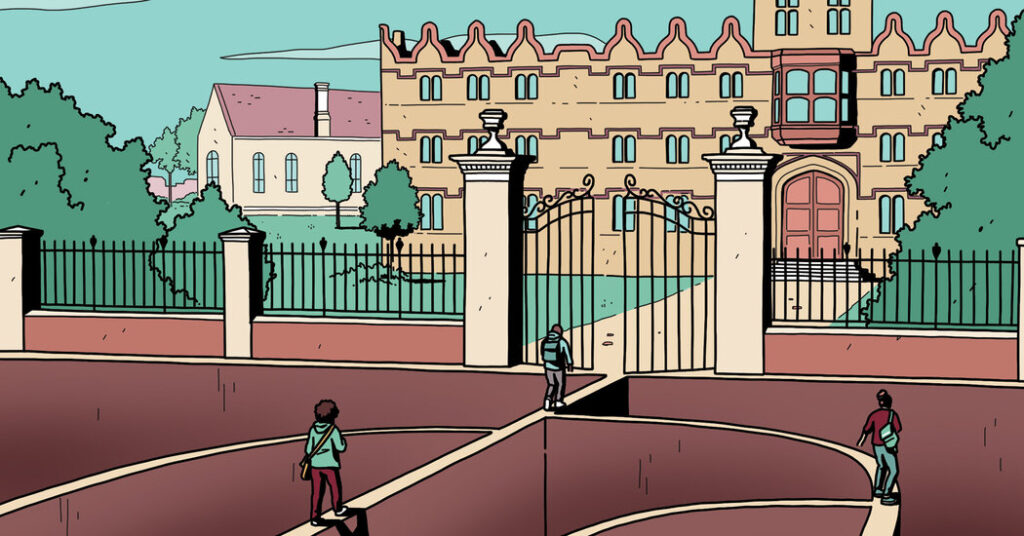
This past spring, under intense pressure from the Trump administration, Harvard University pulled the plug on diversity, equity and inclusion. The administrator who had overseen D.E.I. operations announced that the university was now focused instead on helping students more freely express their views. The Office of Equity, Diversity, Inclusion and Belonging would henceforth be the Office of Community and Campus Life, dedicated to “fostering connections across difference” and “creating spaces for dialogue.”
It was the realization of a longtime conservative dream. The right had seethed about the sensitivity trainings, safe spaces, speech policing and inclusion statements of the D.E.I. industry, and nowhere more so than at elite academic institutions. Getting Harvard to concede was a huge victory. Conservatives could at last usher in a golden age of academic freedom.
That’s not how it’s playing out. Under federal pressure, Harvard and other universities around the country now police academic inquiry according to murkier standards of fairness. The goal, it seems, is to avoid offending anyone, anywhere, across an ever-expanding matrix of identities and standpoints. Rather than dismantling the excesses of the woke era, the new Trump-friendly programs and policies simply repurposed them to serve a different ideological agenda. The result is a new orthodoxy even more stifling than the last.
Before I was allowed to register for classes this semester, I had to complete a newly designed training video and corresponding online test about Harvard’s nondiscrimination and sexual harassment policies. The video informed me that Harvard uses the definition of antisemitism “endorsed by the International Holocaust Remembrance Alliance” and that the university “considers the examples that accompany the I.H.R.A. definition to the extent that those examples might be useful in determining discriminatory intent.” Some of those examples are preposterously broad, including political arguments about Israel that apply what the group considers to be “double standards.” The Foundation for Individual Rights and Expression, a free-speech advocacy group, has warned that the definition is “vague and overbroad” and that it pressures “schools to police speech.” Double standards? FIRE points out that it’s unclear what constitutes an acceptable single standard.
In a climate of uncertainty and anxiety, students tiptoe around the issue, afraid of saying the wrong thing. Faculty do, too.
The day after President Trump’s inauguration, Harvard Medical School canceled an optional guest lecture for “Essentials of the Profession,” a required course for all first-year medical and dental students. The lecture was to be delivered by Barry S. Levy, a Tufts scholar who studies the health effects of war. A subsequent panel featuring Gazan patients receiving treatment for their wartime injuries in Boston was also scrapped. Administrators who had approved both events now said they were inappropriate for a topic that “continues to inflame passions.” The statement continued, “It is our aim to ensure that H.M.S. provides a constructive, nonpolarized educational environment for students of all backgrounds and beliefs.” But if the bar for acceptable speech is that it’s not polarizing, then speech has no guaranteed place on campus.
Mandatory sensitivity trainings and the policing of academic inquiry to protect feelings are hardly the only tools of the “peak woke” era being repurposed in the new political climate. Last year, Harvard’s largest academic division scrapped the requirement that prospective hires write diversity statements, which conservatives had widely criticized as ideological litmus tests designed to favor liberals. Yet Mr. Trump actually demanded that the university undergo an audit of “viewpoint diversity” among faculty and hire additional professors as needed to fill in any gaps — which is to say, give preference to applicants who have the right (in this case, conservative) politics. Wasn’t that the thing universities were supposed to stop doing?
Ryan D. Enos, a professor of government at Harvard, told me these changes are “essentially institutionalizing cancel culture,” and that “students’ willingness to talk about things and to make their voices heard about things is actually more repressed than, in many ways, it’s ever been.”
Steven Levitsky, a Harvard political scientist and co-author of the book “How Democracies Die,” said it all amounts to “a tragic and very effective use of the previous decade’s standards around what we call ‘safe spaces’ and ‘wokeness.’”
Harvard is in good company. In February, Northwestern University announced that, to comply with a new executive order, students would be required to complete a sensitivity training module titled “Building a Community of Respect and Breaking Down Bias.”
One slide of the training displays four quotations from “anti-Israel activists” alongside four from David Duke, the former leader of the Ku Klux Klan. One quotation, attributed to an activist, reads: “I condemn the conflation of Zionism, a political identity, and Judaism, a religious identity. The state of Israel has attempted to conflate both in order to garner support for its apartheid policies.” One of Mr. Duke’s quotes, meanwhile, denounces what he labels “Jewish group behavior.”
The narrator concludes: “To most Jewish people, they feel the same, because they are the same.”
One may reasonably disagree with the activist’s statement, but equating it with Mr. Duke’s neo-Nazism is a staggering breach of reasoned judgment. And the idea that speech should be judged by how it feels to protected groups, rather than by its truth or falsehood, is exactly the standard the right spent a decade railing against.
Mandatory sensitivity training is precisely the sort of exercise that anti-D.E.I. laws in many red states specifically ban at public universities. Maybe anticipating such conflicts, Ohio’s anti-D.E.I. bill, which took effect this year, includes an apparent loophole permitting mandatory D.E.I. training as long as it is required to comply with unspecified “state and federal laws or regulations.” Texas’ anti-D.E.I. statute, Senate Bill 17, includes a similar carve-out. So not all D.E.I. is off-limits — just the kind that’s out of political favor.
As the Trump administration’s Compact for Academic Excellence explains, “Academic freedom is not absolute.” Universities, it says, can and should prevent “threatening” speech. Conservatives once mocked this logic as coddling snowflakes, equating hurt feelings with physical danger. It served as pretext for firings and cancellations over minor transgressions. Conservatives were once fond of repeating that “speech is not violence.” They were right. But now that they hold the reins, many no longer seem so sure.
A student at Texas A&M recently filmed herself objecting to her instructor’s lecture on gender identity, saying that she was “not entirely sure this is legal to be teaching” because it violated Mr. Trump’s executive order asserting the existence of only two genders. A Republican state legislator amplified the video, and in short order the lecturer was fired. After snippets of a speech that a tenured Texas State University professor gave at a socialist conference circulated online, the university fired him — skipping over the protocol for reviewing charges against tenured faculty — on the charge of inciting violence. Perhaps seeking to stay ahead of the new conservative cancel culture, some universities have moved swiftly to police syllabuses and disinvite lecturers, all while enforcing ever-stricter bans on unauthorized dissent.
A movement that once vowed to rescue higher education from ideological excesses is now perfecting and entrenching them. You don’t have to take my word for it. On a podcast released on Sept. 15, shortly after the murder of Charlie Kirk, Attorney General Pam Bondi appeared to claim the existence of a “hate speech” exception to the First Amendment. She quickly walked back her comments, but in early October, during a White House “Roundtable on Antifa,” Mr. Trump explained his administration’s approach more pithily: “We took the freedom of speech away.”
Alex Bronzini-Vender is a sophomore at Harvard University.
The Times is committed to publishing a diversity of letters to the editor. We’d like to hear what you think about this or any of our articles. Here are some tips. And here’s our email: [email protected].
Follow the New York Times Opinion section on Facebook, Instagram, TikTok, Bluesky, WhatsApp and Threads.
The post Harvard’s New Campus Orthodoxy Is Even More Stifling Than the Old appeared first on New York Times.