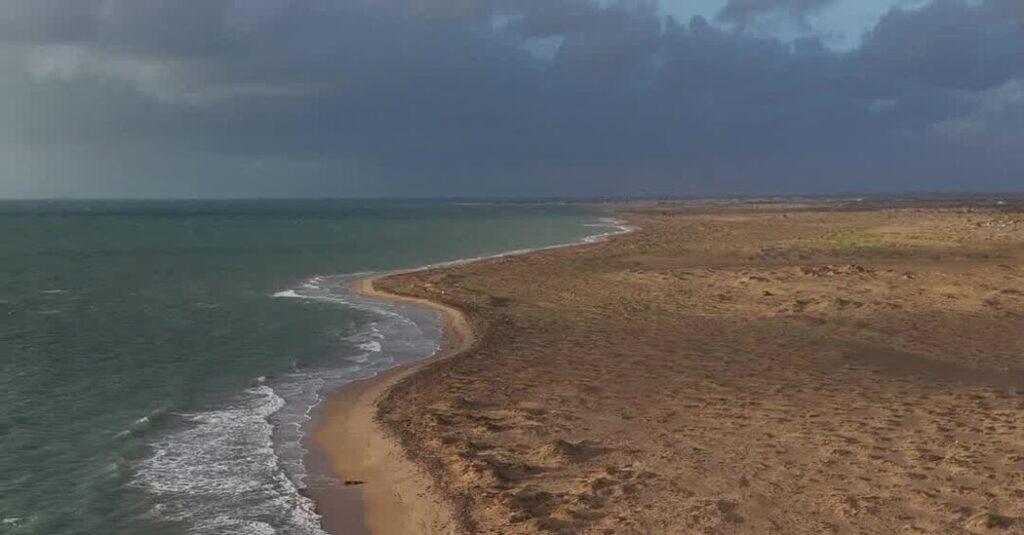
A thunderous boom rang out through the windless late-afternoon air. Seconds later, smoke began rising out of the sea as if the horizon were on fire.
Watching from the shore on Nov. 6, Erika Palacio Fernández whipped out her phone, she said, unwittingly recording the only verified and independent video known to date of the aftermath of an airstrike in the Trump administration’s campaign against what it calls “narco-terrorists.”
Two days later, on that same shore, a scorched 30-foot-long boat itself would wash up. Then, two mangled bodies. Then charred jerrycans, life jackets and dozens of packets that were observed by The New York Times and were similar to others that have been found after anti-narcotics operations in the region. Most packets were empty, though traces of a substance that looked and smelled like marijuana were found in the lining of a few.
The assortment of singed flotsam appears to be the first physical evidence of the U.S. campaign, which has destroyed 29 vessels and killed more than 100 people in the Caribbean and eastern Pacific. Every other struck boat is presumed to have sunk along with its crew and cargo. The U.S. military has offered no evidence that the boats it has destroyed were transporting illicit substances or belong to criminal networks.
A Times analysis matched the wreckage of the boat to the one in a video posted by Defense Secretary Pete Hegseth on the night of Nov. 6, hours after Ms. Palacio took her video. Mr. Hegseth described the strike as having targeted a vessel in the Caribbean operated by an unnamed “designated terrorist organization.” He said the strike killed three people and took place in international waters.
The Times analysis of Ms. Palacio’s video indicates the strike took place in the Gulf of Venezuela, where Colombia and Venezuela have long disputed their maritime boundary. The analysis could not determine the exact location of the strike.
The shape of the wreckage, a slender design typical of speedboats, matches that of the boat targeted in the video shared by the Defense Department, The Times analysis found, and shows, damage to the boat’s hull and interior structure consistent with the impact of an airstrike. The military video shows the boat exploding and on fire beneath a large plume of smoke.
That such rare, tangible evidence is coming to light nearly two months after the early November strike is a testament both to the remoteness of the Guajira Peninsula, where the wreckage was found, and the lack of a sizable presence of the Colombian state in the area. The region is governed semiautonomously by an Indigenous community, the Wayuu, whose more than half a million people straddle the border between Colombia and Venezuela.
The U.S. military’s campaign against boats that the Trump administration claims are smuggling drugs has shifted largely to the Pacific since November. The Nov. 6 strike off the Guajira Peninsula took place during an earlier phase, when the campaign seemed to be aimed at Venezuelan, rather than Colombian, vessels.
A wide range of legal experts say the U.S. strikes are illegal because the military is prohibited from deliberately targeting civilians, even if they are believed to have committed a crime, unless they pose an immediate threat. Venezuela plays a smaller role in the global drug trade than other countries in the region. In private, Trump administration officials say their main goal is to drive Venezuela’s leader, Nicolás Maduro, from power.
The arid Guajira Peninsula is South America’s northernmost jut of land, and has long been known as a smuggler’s launchpad for various contraband, from coffee to electronics to illicit drugs. Reaching it by land requires traversing a labyrinth of rutted dirt tracks that are entirely unmarked, making passage without a local guide impossible. Vultures prowl the sky and rattlesnakes hide in the scrub.
The speedboat’s wreckage and then the two bodies were found on Nov. 8 by fishermen who called Aristótele Palmar García, a Wayuu police inspector responsible for that stretch of beach. Mr. Palmar said he has little training or tools and when he arrived on the beach he had medical gloves only because his sister worked at a local clinic.
“The boat itself smelled like burned meat,” Mr. Palmar, 31, recalled. “And the bodies — we had to bury them because the vultures and stray dogs were beginning to eat them.”
He said he called the regional police, “but nothing happened for days, or even weeks.”
One body had been reduced to skin and bones, Mr. Palmar said. He described the other as bloated, sun bleached and significantly burned, with no ears and one arm severed at the elbow.
Mr. Palmar said he and local fishermen used sticks to push the remains toward five-foot-deep graves they had dug on the beach. In keeping with Wayuu tradition, they sprinkled chirrinchi, a local liquor distilled from cane, over the graves. Then they laid thorny cactus over them to keep dogs from digging them up.
The regional director of Medicina Legal, which is Colombia’s national government-run network of forensic laboratories, Erika Patricia Vargas Sánchez, told The Times that the remains of two people had been disinterred from the same area described by Mr. Palmar and were transferred into Medicina Legal’s custody in the city of Barranquilla on Dec. 16 and 17, five weeks after they washed ashore. She said an autopsy had not yet been performed on either body.
The plastic packets that washed up in Castilletes, a beach community a few miles south of the wreckage that sits right on the Venezuelan border, left locals confused. Most of those seen by Times journalists who traveled to the area had been partly burned or melted and were empty except for sand. They were reinforced with packing tape and appeared to have had labels that had faded.
Several packets had traces of marijuana inside their lining, including a packet that was lodged inside a burned life vest. An official with Colombia’s anti-narcotics police in the capital, Bogotá, who asked to remain anonymous because she was not authorized to speak with the press, said neither she nor counterparts in La Guajira whom she had spoken to had any knowledge of the packets.
Experts on the local drug trade said smuggling marijuana and cocaine together was common on the Guajira Peninsula and in other areas along Colombia’s coastline. Transporting the two drugs together, they said, often indicated that the smugglers were operating on a smaller scale, rather than as part of large cartels. At least half a dozen interdictions of smuggling boats by the Colombian authorities in the past year have found both drugs, according to local news reports.
“The cocaine and marijuana market in La Guajira is operated by small community-based ventures as much as it is by armed groups,” said Estefanía Ciro, who leads a Colombian research institute studying narcotics trafficking. “This narrative of cartels, of Pablo Escobar, doesn’t allow us to see that in many places this is everyday life. One day they carry marijuana, another cocaine, another fish.”
Most people in La Guajira, however, are not tied to the drug trade, but instead fish and herd livestock for a living. Mexi Misael Rincón, a fisherman, uses a boat nearly identical to the vessel struck on Nov. 6 that was anchored just a few yards from where the wreckage lay on the beach. Since the attack, he has dared to venture only into shallow waters, where he traps lobster.
Mr. Rincón’s mother, Carmelena González, 76, said that since the boat strike four of her other sons, who also fish, had left Guajira for distant urban centers to find other ways to make money. That’s in part because fish essential to making a living are farther out.
“In normal times we’d go out eight, 10, 12 miles for the tuna that fetches a better price,” said Vicente Fernández, another fisherman from the area, and uncle to Ms. Palacio, who took the video of the strike’s aftermath. “We’ve left our nets out there for weeks because we’re too afraid to retrieve them.”
Mr. Fernández said the price of seafood in the local markets had plummeted because locals, owing to superstitions, were afraid of consuming any animal that might have eaten human flesh.
Nor, he added, was he going to risk sailing farther than a few miles from shore. He said that in the weeks since the November strike, he’d occasionally seen drones flying above his boat.
“They look like avioncitos,” he said, using a colloquial term for little airplanes. “They look like birds tracking down prey.”
Max Bearak is a reporter for The Times based in Bogotá, Colombia.
The post Grim Evidence of Trump’s Airstrikes Washes Ashore on a Colombian Peninsula appeared first on New York Times.