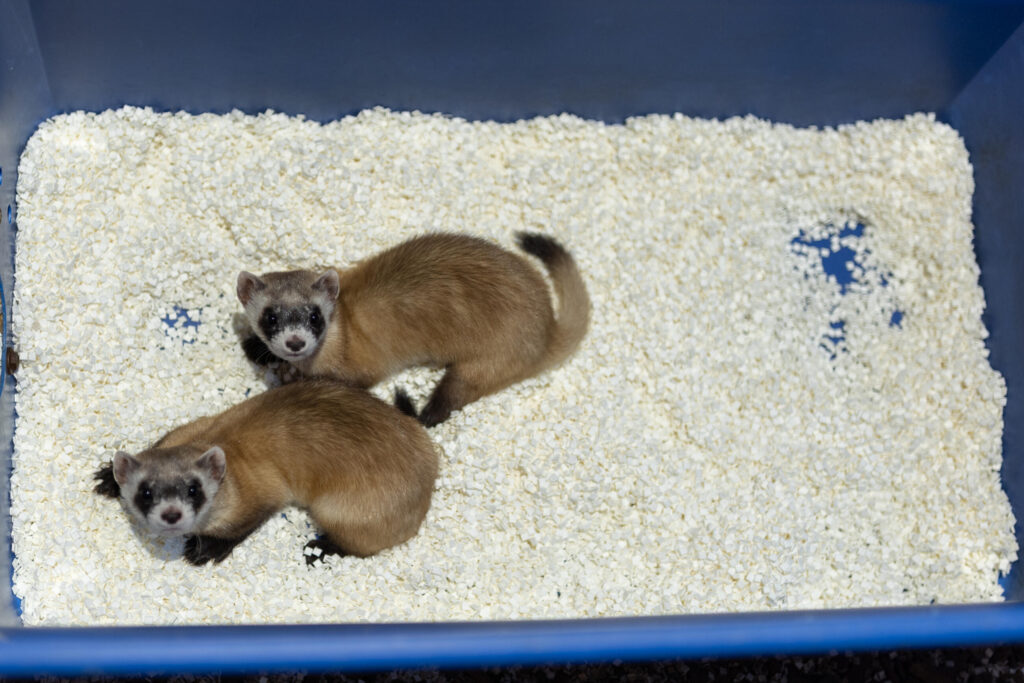
Black-footed ferrets, once widespread across western North America, were thought to be extinct in the 20th century. But after a ranch dog’s chance find in the 1980s and advances in modern science, 12 baby ferrets were born this summer, descended from clones made from cells frozen nearly four decades ago.
Their births — 11 kits from three litters at the Smithsonian’s National Zoo and Conservation Biology Institute in Front Royal, Virginia, and one at a conservation facility in Colorado — represent a milestone in a decades-long effort to revive one of North America’s most endangered mammals.
Experts said the current wild ferret population comes from just seven individuals, which is such a limited gene pool that it could hinder the species’s survival. Now scientists have successfully cloned ferrets, and those clones have produced offspring, which could help boost the population.
“What’s exciting is that with these births, we’re getting new, unique genetic diversity in this population,” said Justin Chuven, deputy coordinator for the U.S. Fish and Wildlife Service’s National Black-Footed Ferret Conservation Center in Carr, Colorado. “If you have a more genetically diverse population, it’s more likely they’ll be able to overcome challenges of disease and drought and have the ability to survive in the wild.”
In the late 1800s, there may have been about a million black-footed ferrets, according to the Fish and Wildlife Service. But their numbers plummeted in the 20th century. They lost their habitat to farms. A plague decimated them. And the poisoning of prairie dogs, their main source of food, pushed them toward extinction.
By the 1970s, no one could find black-footed ferrets in the wild, and there were none in captivity, according to Chuven.
Then came Shep.
The dog on a cattle ranch in Meeteetse, Wyoming, brought a dead black-footed ferret to his owner’s porch in 1981. Recognizing it, Shep’s humans called local wildlife officials. They realized Shep had found what was probably the last population of the species living in the wild.
Experts monitored the population of about 130 ferrets linked to the one Shep had found, but when the animals continued to decline from disease, they captured 18 of those ferrets and took them into captivity so biologists could start breeding them. But it was a small gene pool to work with.
One of the ferrets taken from the wild, Willa, died in 1988 — before she reproduced. But scientists collected her cells for storage at the San Diego Zoo Wildlife Alliance’s Frozen Zoo, a repository of living cell lines of more than 1,000 species.
“They preserved her tissue in hopes they’d someday have the technology,” Chuven said.
In 2020, more than 30 years after Willa died, the first clone from her stored tissue samples was born — Elizabeth Ann. But she was not bred because of problems with her uterus that led to her having a hysterectomy. Two years ago, two more cloned ferrets were born — Noreen and Antonia — made by implanting Willa’s cells into an egg from a domesticated ferret.
The family tree grew.
In 2024, one of the clones, Antonia, bred and raised two kits — Sibert and Red Cloud. They were the first offspring to be born from a cloned endangered animal.
“We’ve brought back genetic diversity, and that fundamentally shifts the thought process of how to save a species like this,” said Ben Novak, lead scientist at Revive and Restore, a California biotech group that was a partner on the cloning project.
This summer, six females and six males were born, including the 11 at the Smithsonian’s Front Royal facility and one born to Noreen at the National Black-Footed Ferret Conservation Center. Officials said Noreen and Elizabeth Ann died in June.
The kits look adorable, but experts described them as feisty, fast-moving carnivores that bite.
Officials at the Smithsonian’s conservation institute said because of the “highly valuable genetics” of Antonia’s descendants, there’s no plan to release any ferrets related to her into the wild.
The clones and their offspring show, scientists said, how conservation efforts can work to save an endangered species. More than 50 partners — including federal and state wildlife agencies and conservation and genetic research groups — have been involved in the project.
Experts said there are now an estimated 500 ferrets in the wild, but the population faces constant threats from drought and plague. Many of Willa’s descendants have been released into the wild on the ancestral homelands of Native American tribes — including the Crow, Cheyenne River Sioux and Fort Belknap Indian Community. These tribal areas of the Great Plains offer the ferrets an ideal habitat and diet, with vast, open space and large, healthy colonies of prairie dogs.
“Black-footed ferrets were at a bottleneck because we’d gotten down to so few that could breed and produce offspring,” said Adrienne Crosier, curator of carnivores at the National Zoo and Conservation Biology Institute. “It was a very tiny genetic population, but by bringing back some of those genes and cloning, it’s reinvigorating the population with new genes, and that makes the overall population healthier.”
The post Frozen cells, clones and a new generation of endangered ferrets appeared first on Washington Post.