Over 15 days in February 2023, Uber received three increasingly alarming reports about one of its drivers in Pennsylvania. One passenger said that the driver “called me the N word.” Another said he made her feel uncomfortable by asking if she wanted a drink and whether she lived alone. A third reported being “scared out of my mind” after the driver stopped the car to ask for her phone number and where to get marijuana.
Uber told two of the passengers that it was reviewing the driver’s account, court records show. “Let me assure you that the driver’s access to the Uber app will be evaluated accordingly,” both messages said.
The driver, who had been with Uber for less than two months, was ultimately sent a warning and educational materials on how to behave appropriately.
At 10:36 p.m. on March 13, less than two weeks after the last complaint, the driver arrived at a Wendy’s in Allentown to pick up a 16-year-old girl who had finished her shift, according to a lawsuit against Uber. He insisted that she sit in the front seat. She didn’t want to but did anyway because she was scared and just wanted to get home.
The driver groped her inner thighs when they were on the road, she said in the lawsuit, then forcibly kissed her when they pulled up to her house.
As Uber upended the business of transporting people, it sold the public on the idea that technology would replace outdated safeguards, with a system smart enough to intervene before someone’s safety was in jeopardy. By allowing customers to submit complaints or poor ratings via its app after a trip, and by using GPS tracking, among other measures, Uber says it can move quickly to weed out problem drivers.
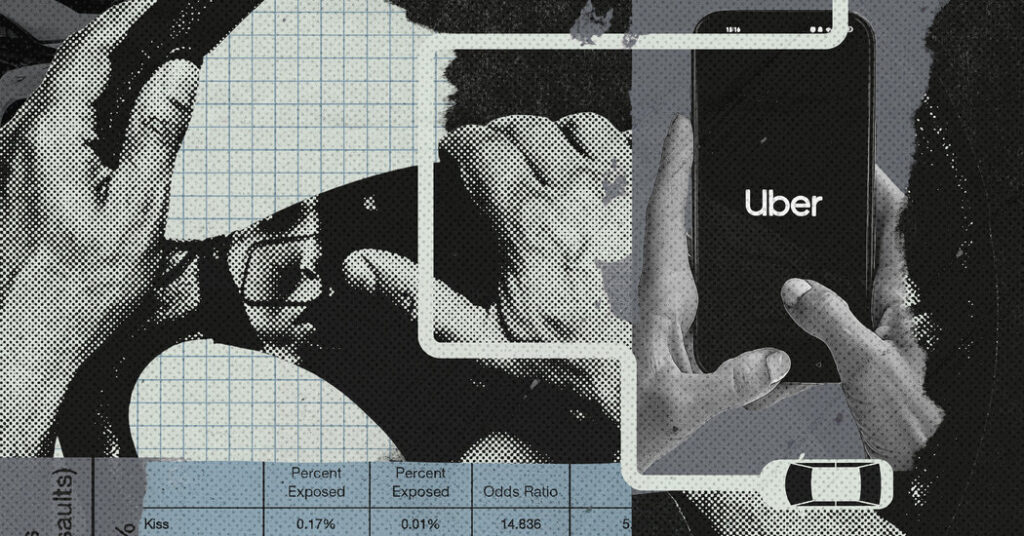
That technology has recorded patterns that the company’s own data scientists have used to identify warning signs for sexual violence. In 2017, they found that drivers were far likelier to commit sexual assault if passenger feedback included words like “kiss,” “sex,” “flirt” and “creepy,” according to an internal report titled “Sexual Assaults: Trends + Correlates.” Incidents were 12 times more likely if a driver had previous reports to the company of sexual misconduct.
Yet Uber has left many drivers with records of complaints on the road — until passengers accused them of serious sexual assault, according to a New York Times investigation based on lawsuits, previously unreported internal company documents, court records and interviews with more than a dozen current and former employees. That’s despite a company policy that explicitly prohibits sexual assault and sexual misconduct.
The teenager in Pennsylvania is now suing the company, accusing it of negligence. Her case is one of more than 3,000 sexual assault lawsuits that Uber is facing in state and federal courts across the country, part of a growing reckoning over sexual misconduct and sexual assault during Uber rides. A central question is whether Uber is responsible for the misconduct of its drivers.
The Times has previously reported that sexual violence happens at a level far greater than what the company has publicly disclosed, and that its background checks approve aspiring drivers with many types of criminal convictions, including violent felonies.
Uber’s monitoring system for drivers already on the network is a cornerstone of its approach to safety, aiming to minimize harm through constant scrutiny. But the company’s disciplinary efforts are at times handcuffed by how it built its business, according to the internal documents and current and former employees. Drivers are contractors and not employees, which helps Uber avoid paying employee benefits, minimum wage or overtime. In turn, Uber has limited what it requires of drivers. It does not, for example, mandate audio or video recording — which could not only help deter bad behavior but also provide concrete evidence to support or refute accusations.
The system is also complicated by fraudulent complaints that Uber receives from passengers seeking a free ride, making it hard for the company to filter for legitimate warning signs, current and former employees said in interviews.
In a statement, Hannah Nilles, Uber’s head of safety for the Americas, said that Uber takes action on reports based on their specificity and severity.
“We know that sexual assault is a deeply traumatic experience, which is why we handle every report with the highest level of care,” she said.
The company, Ms. Nilles added, receives many “one-word or extremely vague reports” that make it difficult to understand what happened, as well as many fake claims angling for a refund.
“When it comes to investigating safety-related reports and making the decision to ban someone from Uber, we are constantly balancing our commitment to safety with legitimate fairness concerns,” she said. “Our decision not to mandate video recording was mostly about the real practical challenges and privacy concerns,” she added.
In Georgia, Uber had received at least seven allegations about a driver’s behavior — including complaints of sexual misconduct, carrying guns and driving under the influence — before a passenger accused him of rape in 2022, according to a lawsuit against the company.
In Texas, Uber’s monitoring systems flagged a driver to be barred in June 2024 for repeatedly violating company policies, according to an internal Uber investigation. But Uber never sent him a warning, and he continued to drive. A month later, he was accused of picking up a 12-year-old girl from a pediatric health facility for an Uber trip and forcing her to perform oral sex on him in a church parking lot. A Texas jury recently found him guilty of aggravated sexual assault of a child, sentencing him to eight years in prison.
“This man should have never been allowed to be driving for Uber at the time of this assault,” said Robert Greening, a lawyer for the girl.
Ms. Nilles said the driver in Texas was flagged to be barred because of several complaints about an extra person in his vehicle. She said that the company gave drivers extra leeway for those reports because they could happen when passengers thought they booked a private ride but mistakenly booked a shared trip.
“In the interest of fairness, we always aim to give drivers a final warning when they are approaching deactivation for nonserious reports like this,” she said.
Ms. Nilles added that the trip violated Uber rules that require minors to be accompanied by an adult, with the exception of the company’s special service for teenagers, which has stricter standards for drivers.
She said that the driver in the Georgia incident had received one complaint for flirting in 2019, for which he was given a warning and follow-up educational materials on appropriate behavior. She said that the driver denied some of the other allegations, which Uber investigated and deemed fraudulent.
She added that although reports against the driver in Pennsylvania later accused of assaulting the 16-year-old were “noted on his account,” at least one was from a customer Uber had identified for repeated fraudulent claims. The 16-year-old was not using the company’s teen service.
The company has long maintained that the vast majority of its trips in the United States — 99.9 percent — occur without an incident of any kind. “Painting Uber drivers as potential sexual predators — especially when Uber is leading the transportation industry in safeguards — seems unfair and needlessly harmful to the many people who rely on driving for Uber to make a living,” Bella Dinh-Zarr, a member of Uber’s safety advisory board, said in a statement.
Ms. Nilles said that “no company or organization akin to ours tracks and responds to reports like Uber.”
“What would happen if someone reported an incident of staring or leering to a bar, hotel, restaurant, transit agency or even to the police? Likely nothing,” she said. “Uber takes action on these reports, including warning the reported-against party and making a note in their account, so that their history of reports will be factored into any future deactivation decisions.”
He Said, She Said
Inside Uber, executives have acknowledged that dangerous activities could be significantly underreported. Passengers rated drivers on only 46 percent of trips, according to a 2021 presentation. “That means that more than half of the time, we don’t even know if it was a good or bad experience,” notes for one slide read.
The presentation made the case that educating drivers about appropriate behavior was critical to safety and its business. “We can address the root cause of high severity and large loss claims,” another slide read, referring to instances when the company would be held financially responsible for incidents that occurred.
When Uber receives complaints about drivers, it often follows one of two paths.
A team inside the company investigates claims that the company considers to be more serious, including nonconsensual sexual penetration, kissing or touching. Agents start by identifying the person accused of misconduct and temporarily revoking that driver’s access to the Uber app during the review. The investigators then try to speak with both parties and collect evidence about what happened, including GPS information as well as video or audio footage, if passengers or drivers recorded the trip.
But a majority of complaints — including leering, flirting and other categories of sexual misconduct that Uber has deemed “less serious” — are not typically investigated by an employee, according to the company’s sexual assault sexual misconduct policy. Instead, those reports are logged into Uber’s systems, and drivers receive automated warnings and trainings that they are not required to acknowledge.
In August 2022, a woman in Florida reported that her Uber driver made her feel uncomfortable during a ride to the gym, court records show. He asked to follow her on Instagram, then appeared to wait in the area so that he would be the one to pick her up for a return trip, she said.
Uber classified the incident as flirting, then sent the driver, who had recently been released from prison for armed robbery, an email with educational videos. “NO RESPONSE REQUIRED,” the email said. The next week, another passenger accused the driver of rape. She later sued the company.
The driver, who admitted to having sex with the passenger but said it was consensual, said in a deposition for the lawsuit that he had not gone through any training before driving for Uber. Uber’s policies prohibit drivers from having sex with passengers.
Through the reporting system, drivers accumulate “notations” for sexual misconduct or other issues. The number of notations for a given incident depends on the severity of the report and the amount of evidence Uber gathers. Drivers are barred from the app after three notations.
Uber’s service for teenagers requires drivers to have no reports of sexual misconduct whatsoever, and includes a number of additional safety precautions. Parents or guardians can receive real-time updates about the trip and are able to contact the driver via the app.
The company bars drivers for reports of “serious sexual assault,” Ms. Nilles said, if investigators are able to obtain a statement from passengers reporting an incident or other corroborating information, including GPS data, photos, audio recording, video recording or notification from law enforcement. People who make fake claims can be denied refunds or be barred from Uber.
Conclusive evidence like audio or video can be difficult to come by.
Through its app, Uber offers the option for drivers and passengers to record audio, and for drivers to record video. Over the years, executives expressed fears that, in addition to privacy concerns, mandating recordings could impose a level of supervision or control that would lead to a reclassification of drivers as employees rather than contractors, which would increase costs and jeopardize the financial structure of the company. “Because of our independent contractor model, there are very specific constraints in the amount of mandated training and interventions that can be imposed,” read a 2017 document titled “Sexual Assault/Misconduct Reduction Strategy.”
Ms. Nilles said that Uber requires drivers in the United States to complete trainings for sexual assault and sexual misconduct that the company developed with RAINN, the anti-sexual-violence organization.
Accusations can sometimes devolve into he-said, she-said situations.
Soon after Victor Huynh Le began driving for Uber in Texas in 2020, a passenger said that he had offered to go into her house and give her a massage. Uber said it conducted an investigation, and Mr. Le denied the allegation. Uber ultimately described the incident as “resolved sexual misconduct” and noted it on his record.
“We spoke to the driver, who denied the reported incident, and were unable to speak to the rider,” Ms. Nilles said. “When the driver was reactivated, he was warned and provided education on appropriate behavior.”
Months later, a passenger accused Mr. Le of forcing her to perform oral sex on him during an Uber trip while he was driving 70 miles per hour on a highway in the middle of the night. A jury later found him guilty of the sexual assault, sentencing him to 11 years in prison.
A lawyer for Mr. Le could not be reached for comment.
In 2017, before Mr. Le joined Uber, a woman had reported him to the police in Fort Worth, saying he impersonated an Uber driver to lure her into his car and sexually assault her, according to a copy of the report. The woman told the police that she had called Uber to report what had happened, but Ms. Nilles said that Uber had not found any records regarding the incident.
In a Garage She Didn’t Recognize
Before Timothy Alexander Greene’s final ride in Oklahoma, passengers had complained about him on three occasions. He was able to stay on the road for a different reason each time.
Mr. Greene was driving for Lyft in 2019 when a passenger accused him of rape. She reported the incident to Lyft and the police.
Mr. Greene was barred from Lyft but by the next year, he had switched to Uber. That June, he picked up a woman who had been out drinking. Her cousin had ordered her a ride home. The woman said that she woke up in a car, parked in a garage she didn’t recognize. Mr. Greene had driven her north to his house, instead of south toward hers, according to court records. The cousin reported the incident to Uber, which said it would restrict Mr. Greene from the app while it investigated the incident.
Ms. Nilles said that investigation, which involved speaking with the passenger, the cousin and Mr. Greene, found that “the driver asked to use the restroom and get more coffee, as the trip was expected to be 40+ minutes.”
“Despite the initial report from the account holder, when we got in touch with the rider herself, she stated she did not feel threatened,” she said. “Both parties indicated there was no unwanted behavior.” Ms. Nilles declined to provide a transcript of the investigation.
After its investigation, Uber sent Mr. Greene a warning and materials about appropriate behavior, then allowed him to pick up passengers again.
In January 2021, a female passenger reported feeling unsafe with Mr. Greene, stating that she thought he was a “trafficker who was going to kidnap her,” court records show. Ms. Nilles said the report was deemed fraudulent.
That March, Uber and Lyft announced a new joint safety program designed to share information about drivers and delivery people who had been barred for sexual assault and physical violence, to prevent them from simply changing companies.
Yet Mr. Greene continued driving. Uber said it “received no notice from Lyft” about Mr. Greene; Lyft declined to comment. Two months later, in May, he picked up a woman who had been celebrating her niece’s engagement at a bar in Edmond, Okla., and was intoxicated. Her niece had ordered her an Uber.
The next thing the woman remembered was waking up behind a steering wheel in a garage that she had never seen before. She was barefoot, her jeans were disheveled, and her underwear was in her purse. Her wallet and phone were missing. She walked to a neighbor’s house, called 911 and later underwent a sexual assault forensic exam at the hospital. A nurse documented bruises and abrasions all over her body, and debris and grass in her vaginal area.
A jury later convicted Mr. Greene of sexual battery, and he was sentenced to 10 years in prison. Separately, he was charged with rape for the 2019 Lyft incident and is now awaiting trial. “He maintains his innocence and looks forward to his day in court to be judged by a jury of his peers,” said Ronald Jones II, a lawyer for Mr. Greene.
The woman from the May 2021 incident sued both Uber and Lyft. She settled with Lyft, but her case with Uber is still pending. Uber has said in court filings that it was not responsible for the incident.
Kirsten Noyes contributed research.
Emily Steel is an investigative reporter covering business for The Times. She has uncovered sexual misconduct at major companies and recently has focused on the ride-hailing industry.
The post Flagged for Sexual Misconduct, Many Uber Drivers Stay on the Road appeared first on New York Times.