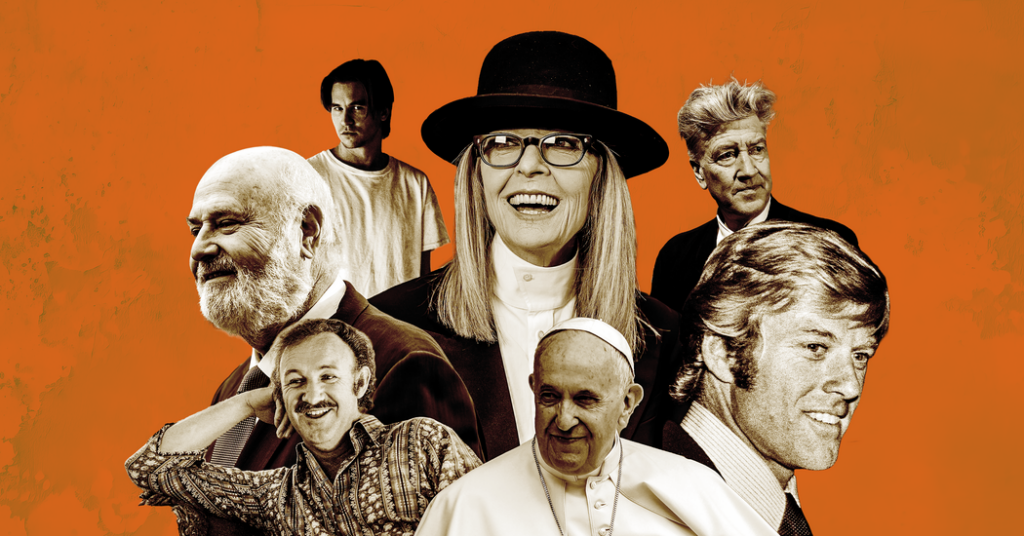
One after another they fell, towering names that needed no introduction. Pope Francis. Robert Redford. Diane Keaton. Dick Cheney. Brian Wilson. Gene Hackman. Ozzy Osbourne. Jane Goodall. Roberta Flack. George Foreman. Tom Stoppard. Frank Gehry. Rob Reiner.
The obituary pages track the deaths of the famous and the mighty in any given year, of course, but in 2025 we witnessed a seemingly unending procession of them, many from the worlds of music, movies and television. Marquee names, all.
The deaths of screen idols summoned shared memories of unforgettable performances. We recalled Mr. Redford, a serious-minded matinee idol, embracing Barbra Streisand in “The Way We Were” or leaping off a riverside cliff with Paul Newman in the irreverent western buddy movie “Butch Cassidy and the Sundance Kid.” We recalled Ms. Keaton, wise, witty and fashion-forward in her idiosyncratic way, bantering with Woody Allen in “Annie Hall” or with Jack Nicholson in “Something’s Gotta Give.”
The circumstances of Mr. Hackman’s death were grim. At 95, afflicted by Alzheimer’s disease, he collapsed from a heart malady in his home in Santa Fe, N.M., in February, most likely a week after his wife, the classical musician Betsy Arakawa, died there as well, from a rare virus. Another week would pass before their bodies were discovered.
But those tragic details could not tarnish Mr. Hackman’s film legacy: two Oscar statuettes among five nominations for intense, unglamorous performances in now-classic films like “Bonnie and Clyde,” “The French Connection” and “Unforgiven.”
If the deaths at the Hackman home were unsettling, those at the Reiner residence in Los Angeles were shocking. On a Sunday in December came the news that the actor and director Rob Reiner and his wife, Michele Reiner, had been the victims of a double homicide. (Their troubled son Nick was later charged with the murders.) Mr. Reiner’s crowd-pleasing movies from the 1980s and ’90s will continue to be watched, but now with a mournful eye.
The director David Lynch, too, was associated with era-defining films, though of a more visionary sort — off-kilter classics like the surrealist horror flick “Eraserhead,” the haunting historical portrait “The Elephant Man,” the neo-noir mystery “Mulholland Drive” and the creepy psychological thriller “Blue Velvet,” whose offspring, the TV series “Twin Peaks,” was just as strange.
Val Kilmer was remembered for, among other juicy roles, his uncanny impersonation of Jim Morrison of the Doors and his brooding reinterpretation of Batman as a conflicted middle-aged guy. If Mr. Kilmer never quite achieved the star power of some of his Hollywood peers, you would not have known that from the public’s response to his death, at 65. His obituary in The New York Times generated more “page views,” in internet parlance — 4.8 million — than that of anyone else in 2025.
Familiar Faces and Sounds
The movie world lost a firmament of other stars, including two femme fatales of the 1960s: Brigitte Bardot, who redefined sex symbolism in France, and her more down-to-earth counterpart in Italy, Claudia Cardinale. Tony Roberts, Woody Allen’s perennial onscreen pal and sounding board, was gone, and so was Terence Stamp, the chameleonic British award-winner who was as comfortable in the sensitive role of a naïve but doomed seaman in “Billy Budd” as he was, decades later, as a sinister alien in two “Superman” movies.
The television landscape was stripped of a host of familiar faces, actors who were practically defined by their characters in popular shows: Richard Chamberlain, the steady hospital surgeon in “Dr. Kildare” and the lovelorn priest in the mini-series “The Thorn Birds”; Loretta Swit, the temperamental Army major in “M*A*S*H”; Malcolm-Jamal Warner, the Huxtables’ teenage son with growing pains on “The Cosby Show”; George Wendt, a barfly on “Cheers”; Loni Anderson, the platinum-blond receptionist on “WKRP in Cincinnati”; Michelle Trachtenberg, the title character’s agitated little sister in “Buffy the Vampire Slayer” and a bad influence on “Gossip Girl”; and June Lockhart, the reassuring mom on “Lassie” and “Lost in Space.”
In another precinct of the performing arts, one of the greatest playwrights of our time, Mr. Stoppard, ended his long run at 88. In works that future generations will study, he “entwined erudition with imagination, verbal pyrotechnics with arch cleverness, and philosophical probing with heartache and lust,” as the former Times theater critic Bruce Weber wrote in his Stoppard obituary. Dead, too, were Athol Fugard, the searing South African playwright, and Robert Wilson, one of the most imaginative stage directors of the last half-century.
Pop music was bereft with the loss of headliners who had produced much of the soundtracks of recent decades. Brian Wilson, the emotionally troubled genius who founded the Beach Boys, had celebrated the carefree Southern California youth culture of the ’60s while also acknowledging the heartache and loneliness of teenage life in songs so startlingly new in their harmonies and arrangements that the Beatles, half a world away, studied them in awe.
Mr. Wilson died at 82 in June, within days of the death, at the same age, of Sly Stone, another pop music innovator who had led a discordant personal life, riddled for a time by drug use and clouded by a long retreat from public view. In his heyday, as the leader of the mixed-race and genre-crossing band Sly and the Family Stone, he created a joyful sound that had audiences up and dancing from the late 1960s into the ’70s.
Mr. Wilson and Mr. Stone were just two of a bevy of music stars who departed in 2025. Mr. Osbourne gained renown as a heavy-metal pioneer and sometime stomach-turner (oh, that poor decapitated bat) with his group Black Sabbath, only to become an unlikely genial family man in a hit reality TV show. D’Angelo and Angie Stone reinvented 1970s soul music for audiences born too late to have heard it when new. Back then, it was performed by artists like Sam Moore, the tenor half of the hitmaking duo Sam & Dave (Prater), and Ms. Flack, who added threads of jazz and folk in weaving her distinctive musical tapestry.
And speaking of folk, that genre had no more recognizable voice than that of Peter Yarrow, singing in sweet three-part harmony with Paul and Mary through the 1960s. It was a decade that began with the balladeer Connie Francis ruling the charts with heartfelt tunes like “Who’s Sorry Now” and “Where the Boys Are.” Mr. Yarrow was 86; Ms. Francis, 87.
Giants of other genres died as well. The pianist, composer and bandleader Eddie Palmieri was not only a father of salsa in the United States but also one of the most creative musical synthesizers of the last half of the 20th century, blending Latin sounds with other strands of popular music and even modern classical styles.
Jazz lost Chuck Mangione, who found a place for the mellow fluegelhorn amid the usual brass; Roy Ayers, who became one of the most sampled jazz vibraphonists in hip-hop; and Jack DeJohnette, a peerless drummer who kept the beat behind Miles Davis and Keith Jarrett.
The classical scene was emptier with the deaths of Alfred Brendel, a largely self-taught pianist who breathed new life into old concert standbys; Christoph von Dohnanyi, a conductor whose baton had international reach; and Sofia Gubaidulina, a composer who defied Soviet censors while presenting her fervent, spiritual music as an antidote to what she called the “staccato of life.”
Hers was an ambition that Pope Francis, perhaps the world’s most prominent spiritual leader, would no doubt have understood. But this Argentine-born prelate, the first Latin American pontiff, focused as much on worldly matters, championing the humanity of migrants and the marginalized, and reminding us of the fragility of the planet’s health.
The international arena was further emptied with the deaths of the Aga Khan IV (born Prince Karim Al-Hussaini), the leader of the world’s Ismaili Muslims, who lived as lavishly as he did piously, while pouring much of his immense wealth into a host of philanthropic causes; Violeta Barrios de Chamorro, the first woman to be elected president of a Latin American country, Nicaragua; Sam Nujoma, who threw off the shackles of a white-ruled South Africa to become the founding president of an independent Namibia; and Jean-Marie Le Pen, the obdurate founder of a still-growing far-right political movement in France.
A Bipartisan Funeral
In Washington, Dick Cheney drew a funeral crowd that no one might have expected during his political heyday, when he served President George W. Bush as possibly the most powerful vice president in American history and, in Mr. Bush’s words, “the Darth Vader” of their administration. A remarkably bipartisan assemblage filled the pews, many finding common ground with one another — and with Mr. Cheney himself, an otherwise rock-ribbed Republican — in their antipathy toward President Trump. (It was a sentiment shared by David Gergen, the former adviser to four presidents from both parties and later a familiar TV talking head. He might well have been in the cathedral with them had he lived long enough.)
David Souter’s remains, by contrast, remained far from the capital, as he had wished. For 19 years he sat on the Supreme Court, arriving as a conservative — or so the right wing thought — only to ally himself frequently with its liberal justices. When his tenure was done, he was done with Washington, retreating to the solitude of his beloved New Hampshire.
Voices that once rang out in the halls of Congress were stilled, among them those of David Boren, who as a senator was the kind of politician in short supply in Oklahoma nowadays — a liberal Democrat; Harlem’s own Charles B. Rangel, the first Black chairman of the mighty House Ways and Means Committee; Alan K. Simpson, the folksy if sometimes cantankerous conservative senator from Wyoming; and Carolyn McCarthy, whose grief over the murder of her husband and the wounding of her son on a Long Island commuter train was the catalyst for a gun-control crusade that took her to the floor of the House, where she served nine terms as what one observer called “a citizen-politician.”
If Ms. McCarthy’s widowhood thrust her into politics, two other women landed in the limelight, welcome or not, as political wives: Joan Kennedy, who married into a political dynasty when she walked down the aisle with Senator Edward M. Kennedy; and Kitty Dukakis, who hit the campaign trail alongside the presidential nominee Michael S. Dukakis. Both women were later candid about their struggles with addiction, while promoting charitable causes.
Athletes are eager for the spotlight, of course, and none basked in it more than George Foreman, a bruising and durable heavyweight champion who competed from the 1960s into the ’90s, battling Joe Frazier and Muhammad Ali along the way, and then returned to the ring after a 10-year absence to recapture the crown at age 45. (For his last act, he took to TV as an amiable pitchman for his own line of barbecue grills.)
Another ring — this one for professional wrestling — lost one of its most charismatic stars, the shirt-ripping Hulk Hogan. More than any other member of that sport’s musclebound cast, he transformed a once-low-budget attraction into a multibillion-dollar entertainment juggernaut.
Japan mourned the death of Shigeo Nagashima, its revered “Mr. Baseball” and a symbol of the nation’s postwar restoration. The National Hockey League said farewell to three Hall of Fame goalies, Ken Dryden of the Montreal Canadiens, Eddie Giacomin (New York Rangers) and Bernie Parent (Philadelphia Flyers).
And speaking of halls of fame, Lenny Wilkens was inducted into basketball’s twice, as a player and a coach.
Others figures loomed so large that they will assuredly be enshrined in the pantheons of their various fields.
The architect Frank Gehry enriched the world with stunningly original buildings, many resembling abstract sculpture on a monumental scale.
Giorgio Armani reinvented the men’s (and later women’s) power suit, turning his label into a synonym for sophisticated elegance.
Bill Moyers left Lyndon Johnson’s White House to become one of the most thoughtful interlocutors in public television history.
Mario Vargas Llosa dissected the political corruption and moral failures of his native Peru with a body of fiction that earned him a Nobel Prize.
Fred Smith revolutionized a workaday industry, freight transport, in founding the globe-girdling FedEx.
The fire-and-brimstone televangelist Jimmy Swaggart had international reach, too, building an audience of millions before being undone by a sex scandal, acknowledged in a shower of tears.
Jane Goodall gained worldwide celebrity as well, by revealing the astonishingly advanced social lives of chimpanzees in East Africa.
And James D. Watson scored one of the major breakthroughs in the history of science when he helped decode DNA, the genetic blueprint for life, only to come under fire later in life for his penchant for bigoted outspokenness.
Of Past and the Present
Many of the year’s deceased evoked times gone by. But there were two abrupt and wrenching deaths that spoke more pointedly to the present moment in American life.
In April came the death of Virginia Giuffre, the most prominent victim of Jeffrey Epstein’s sex-trafficking ring. “Passed around,” as she put it, “like a platter of fruit” to rich and powerful men as an underage teenager, she became the first of Mr. Epstein’s former prey to go public with her story. Her account was matched by an increasing number of women in a cascading scandal that has reached from Palm Beach, Fla., to Buckingham Palace and beyond, leading to lawsuits, criminal charges, public shamings and the death, ruled a suicide, of Mr. Epstein himself.
Ms. Giuffre, suffering from renal failure after a terrible car crash, also died by her own hand.
Months later, Charlie Kirk, the young, charismatic, hard-core conservative activist at the head of a growing youth movement, was assassinated while speaking to an outdoor campus crowd in Utah. Shock on both sides of the political divide was followed by finger-pointing grief on the right, hastily placing the murder at the feet of the left and leaving an already polarized nation even more so.
Then there were those who might have gone unnoticed by the wider world had they not emerged from the sidelines to play a part in three momentously violent episodes.
Dr. Joseph Giordano, the lead trauma surgeon at George Washington University Hospital in Washington, happened to be on duty on the afternoon of March 30, 1981, when he was urgently summoned to the emergency room. He went on to help save the life of President Ronald Reagan, who had been shot outside a Hilton Hotel.
Sara Jane Moore gained infamy in 1975 (and later became a character in a Stephen Sondheim musical) when she walked onto the political stage from its darker fringes and fired a revolver at President Gerald R. Ford. She missed, and when she raised the gun for a second shot, a former Marine knocked it out of her hands.
Ruth Paine had befriended Lee and Marina Oswald, opening her suburban Dallas home to them in the weeks leading up to Mr. Oswald’s assassination of President John F. Kennedy in 1963. It was in her garage that Mr. Oswald stashed what would be his murder weapon, a rifle, in a rolled-up blanket. Ms. Paine became a valuable witness in subsequent investigations.
And on the day of the assassination, the Secret Service agent Clint Hill was trailing the open-top presidential limousine when the shots were fired. He sprang onto the car, pushing a scrambling Jacqueline Kennedy back into her seat and possibly saving her life.
The moment was captured by photographers — an indelible image of bravery at a time of national calamity. It continues to haunt: A man in a dark suit standing on a bumper in a frantic scene as the limo heads toward a highway overpass, soon to drive under it and speed off, around a sharp bend, into history.
William McDonald is the obituaries editor of The Times.
The post Deaths in 2025: A Yearlong Procession of Giants appeared first on New York Times.