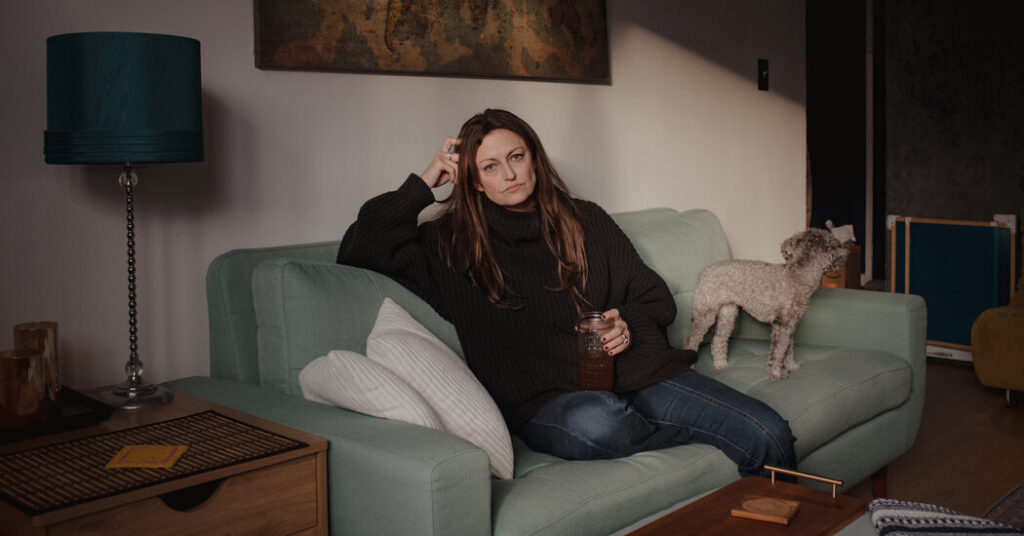
Claire Brosseau is desperate to die.
She is 48 years old and has had a life she calls an “an embarrassment of riches.” She has a vast network of friends, a devoted family, the steadfast adoration of a small dog. She has performed to raucous laughter in some of North America’s most prestigious comedy clubs and festivals, acted in movies, written brutally funny television shows. She has traveled, shopped, danced and known herself to be deeply loved.
She also suffers from debilitating mental illness that decades of treatment have not tamed. Sometimes she is so crushingly sad that she sobs until her bones ache. Sometimes she feels as if she were standing on a ledge, flipping minute by minute between being sure that if she jumped she would actually fly, and wanting to hurl herself as hard as she can onto the ground.
She has tried more times than she can count to die by suicide. She has overdosed on drugs and cut her wrists. Once she deliberately ate peanuts to trigger her severe allergy, hoping to die of anaphylaxis.
In 2021, Ms. Brosseau, who lives in Toronto, learned of a coming change to Canadian law that would allow people who suffered with an incurable medical condition but were not near death to ask a doctor to end their life.
And she felt a small, tentative, tendril of relief. She could die in a way that did not involve pain or violence, or horror for the people who love her.
Nearly five years later, she’s still alive — an inadvertent central player in an often-bitter public debate over who has the right to a medically assisted death in Canada. It is a controversy playing out with variations as more countries legalize assisted death and face the question of whether, and how, to expand it beyond people who are terminally ill.
The mental illness exception
Thirty-four years ago, Ms. Brosseau was a 14-year-old honors student in Montreal with a wild streak, drinking, using drugs, having sex, and also sometimes turning abruptly cruel. Her alarmed parents took her to a psychotherapist who diagnosed manic depression. That was the start of the diagnoses: eating disorder, anxiety disorder, personality disorder, substance abuse disorder, chronic suicidal ideation and a whole plethora of other mental health issues. (“Not to brag,” Ms. Brosseau says, the kind of deadpan, devastating aside that peppers her conversations.)
She tried at least 25 medications; two dozen different talk, art and behavioral therapies; dozens of rounds of electroconvulsive therapy (ECT); and guided psychedelics. She felt better, sometimes — for a while. But, relentlessly, they would return, the monsters that stalked her when she was awake and then moved into her dreams.
Despite everything she has put her body through, she is physically healthy. She might live decades more.
The change in the Canadian law meant she could have another option. In 2019, three years after the country legalized assisted death for people with a “reasonably foreseeable natural death,” two people with chronic conditions went to court. They argued that to exclude people with great suffering from incurable conditions who were not imminently dying was a violation of their right to equality before the law. The courts agreed, and a new law in 2021 made eligible those people who were not at end of life.
Except for people whose sole chronic condition was mental illness. The government said it would delay including them for two years in order to draft special guidelines for assessing their eligibility. Of the nine countries that allow assisted death for people not at end of life, only Canada made this distinction for people with mental illness.
The exclusion was to end on March 17, 2023, and Ms. Brosseau planned to apply for an assisted death that day. But as that date drew close, the government announced a further yearlong delay. Then, last year, another.
I met Ms. Brosseau a few months after the first delay was announced in 2023. I was in the early stages of reporting a series of articles on medically assisted death around the world. As many countries introduced access to the procedure, I wanted to examine challenges that had emerged in places where it had been legal for a while and largely accepted.
In Canada, assisted death for people with mental illness was fast becoming a highly charged issue. I spoke to psychiatrists and other experts, and sought out patients who were considering applying once the procedure was legal for them. That’s how I met Ms. Brosseau. Every conversation I had with her — wrenchingly sad, wildly funny — illuminated another complicated aspect of this question.
Ms. Brosseau is unusual both as a hyper-articulate narrator of her own struggle, and because, her suffering is not shadowed by other layers of vulnerability such as homelessness or lack of access to care, that clouded the picture with some other patients I met.
She agreed to let me be a close observer as she navigated the medical and emotional pathway to trying to have an assisted death. She connected me with her family and with friends she had cut off in the course of her illness.
And she shared her medical records and authorized me to speak with her two psychiatrists. Both are veteran clinicians, affiliated with Canada’s top university and one of its most prominent hospitals; both have seen Ms. Brosseau at least once a week for years. Both have obvious affection for her.
But when it came to whether she should have an assisted death, they disagreed. They were the national debate writ small.
Dr. Gail Robinson, a professor of psychiatry at the University of Toronto, says Ms. Brosseau’s wish to die with the help of a doctor is a reasonable choice for her.
“I would love her to change her mind,” Dr. Robinson told me. “I would hope that she would not have to do this. But I will support her.”
For Dr. Robinson, it is a clear case of discrimination: Ms. Brosseau is being denied medical care that is available to other Canadians purely because her chronic condition is a mental illness, not a physical one.
But for Dr. Mark Fefergrad, Ms. Brosseau’s other psychiatrist, the nature of mental illness means assisted death must be considered differently. He knows Ms. Brosseau has endured periods of intense suffering, but he has also seen her improve, for a time, with some treatments.
“I believe she can get well,” he said. Using the common Canadian acronym for medical assistance in dying, he added, “I don’t think MAID is the best or only choice for her.”
This debate has simmered in Canada for years. It has roiled the field of psychiatry, and the larger circle of professionals who care for people with mental illness. It has become a public flashpoint, in a country where there is broad support for medically assisted death but also an underlying unease with the procedure’s increased use in the decade since legalization.
And it has yanked back the possibility of relief that Ms. Brosseau felt in 2021, and left her in a tortured, liminal space of waiting.
Public success, private desperation
In hindsight, Ms. Brosseau and her family believe she was ill from the time she was a small child, when she would cycle in and out of periods of rage and desperation. She would go out to sit on the train tracks, calmly certain that “it would be better for me and for everyone else if I weren’t here.” At 8, she wrote in her Hello Kitty diary that she wanted to die.
At home, she was an agent of chaos. “I was just always nervous, riddled with anxiety when Claire was anywhere around,” said her sister, Melissa Morris, who is two years older. Ms. Morris used earnings from her first job, at age 12, to hire a locksmith one day when her parents were out, installing a lock on the inside of her bedroom door to block out the mayhem her sister created.
Still, at school, Ms. Brosseau was popular and a top student, although she skipped class and smoked pot out back. She starred in school plays and was recruited to an elite theater program. After high school, she went to theater school in New York, and began to get acting parts in film and musical theater. But she struggled with eating, and sometimes she stayed in bed for a week and cried. She did her best to blot out her feelings with alcohol and drugs.
In her early 20s, she moved back to Montreal and there she had a manic-depressive episode so severe that she was hospitalized for months. “But she got better,” her sister said.
Ms. Brosseau signed with a major chain of comedy clubs and performed in English and French. She went to Los Angeles, she acted in commercials, she got writing gigs. She made a lot of money, and bought expensive jeans and boots made of butter-soft leather. And sometimes she became manic, and friends had to put her on a plane home for help. She had her first rounds of electroconvulsive therapy at 34; then she flew right back to L.A.
She had a couple of serious relationships and a lot of hookups with other comics and actors. There were a lot of drugs around and she loved taking them. She sold the rights to her life story and was working on a series based on her life on stages.
None of it shook what Ms. Brosseau calls “The Crazy.” In her late 20s, she was cast in a major role in a film shooting in Europe. “It was a lot of money,” she said. “I loved the actors. It was the dream part. I had a great place to stay and I was doing well on the film and I was having fun on set, and every night I would go back to my hotel and I would bawl and scream and rip my clothes apart. And cry and just — I wanted to kill myself and I couldn’t wait to get out of there. And then the next day at work, I’d be fine and I’d have so much fun.”
In 2021, she was in what she describes as a remission. Her career had taken a hit in her last bad patches, but she was doing some writing and had connected with friends. Then during a dip, her mother feared she might attempt suicide and called the police, who committed her involuntarily to a psychiatric hospital.
Hospital records show that no medical personnel took the standard step of speaking with her psychiatrist for nearly two days. Twice they placed her in full physical restraints, normally reserved for only the most violent patients. The doctors’ notes show that Ms. Brosseau was agitated, hit a wall and slammed a door — but do not record any threat to herself or others. She found the experience of being pinioned by two male orderlies profoundly traumatic, and it brought memories of a sexual assault rushing back.
She pursued a complaint process against the hospital and the doctors who had ordered her restrained. An Ontario medical review panel did not find the hospital or doctors at fault. Her longtime psychiatrists and outside experts she had asked to evaluate the situation called that decision egregious. “They really screwed up,” Dr. Robinson said.
The decision was final, and it was a blow that, Ms. Brosseau said, ended any desire she had to try to get well. She felt she could no longer trust the mental health care system. And she was not willing to try to work through the post-traumatic stress.
A national debate
By the time Ms. Brosseau and I began talking, two years later, she had withdrawn from the world. She saw only her parents and her sister, and them only rarely; she never left her apartment, had everything delivered, spoke to her psychiatrists by Zoom. “I’m not a person,” she told me. “I can’t be in the world.”
It was jarring to have someone who was chatty, witty, warm and empathetic also calmly tell me she was a nonperson incapable of living. Over time, I came to see that anything beyond her circumscribed world brought the risk of feelings — and she is destabilized by feelings, good or bad. I caught glimpses of periods of explosive darkness when she would send screeds of hateful messages to her family. No one in her life with whom I spoke, friends or family, regretted pitching in during those difficult times. But when Ms. Brosseau was on the other side of those episodes, the humiliation she felt made it impossible for her to stay connected to those people.
So she was largely alone as she waited, while out in the world, people she’d never met debated her future. A handful of psychiatrists took their concerns to the news media. It’s clear, they argued, when a late-stage brain cancer or a disease like ALS is irremediable, but there are no such signposts in psychiatry: drugs or therapies work for one person may not work for others. It was a requirement for assisted death that the condition causing the patient’s suffering was incurable — but, they asked, who could say that about a mental disorder?
Dr. Fefergrad, one of Ms. Brosseau’s two longtime psychiatrists, understood that concern. “People get better in ways that we don’t expect — and surprising, unexpected things happen every day,” he said. “That doesn’t really happen with a big brain cancer.”
He told me about a patient he had treated for a decade who was deeply unwell and who would have most likely qualified for an assisted death under the guidelines for eligibility that were then proposed. That patient found connection in an unexpected romantic relationship. “And their life was completely different thereafter,” he said.
New treatments and medications come along, he said, and they make a difference for some of his patients who previously didn’t make progress. What if Ms. Brosseau chose to die and then a new drug or procedure was developed that might have been transformative for her. “That weighs on me as a philosophical question,” he said.
Dr. Fefergrad, a soft-spoken 50-year-old who favors cardigans and striped socks, respects the autonomy of Ms. Brosseau and other patients to make decisions about their own treatment. But what if their resistance was a symptom of the illness itself — of hopelessness or anxiety about how something would work — and they did not try and instead opted for an assisted death?
Dr. Robinson, the other of Ms. Brosseau’s longtime psychiatrists, found those arguments exasperating. Petite and steely at 82, she has been in practice since the early 1980s. And that long experience has given her perspective on what she sees as the limits of her field. “Every psychiatrist who’s been around for a long time has one or two patients — not a lot, but one or two — that they have carried over the years who have been miserable, unhappy, have a treatment-resistant depression, maybe have made some suicide attempts,” she said. “I can’t do anything more for this person. I can still keep seeing them, but it’s not changing anything for them.”
The question of assessing irremediability was irrelevant in her view: “If you have cancer and you’ve tried every treatment there is and they say there’s nothing more we can do, do they then say, ‘But you can’t have MAID because maybe in five years we’ll have another treatment’?”
Ms. Brosseau has had suicidal ideation throughout the 15 years they have been working together, Dr. Robinson said, but her desire to have an assisted death is clearly something different that should be evident to a psychiatrist. “This is a clearheaded decision from somebody who says: My disorder has affected my relationship with my family, it’s affected my ability to have a good relationship with a partner and it’s just dominated my life, and I’ve tried many times to kill myself, unsuccessfully. And I still want to die, but if I could die in a nice, gentle fashion, I would prefer that.”
Two very different deaths
In 2021, when Ms. Brosseau first believed that medically assisted death would soon be available to someone like her, she told her parents and her sister that she wanted to apply. They were initially aghast. Her sister (the person Ms. Brosseau most often turns to for help in her dark hours, and who calls her “the funniest, smartest, most wonderful person I’ve ever met”) was furious.
“I really saw it as giving up,” Ms. Morris said. But her view shifted after she thought about it for a few weeks: It’s not if Claire dies, but how, she said. “Is it going to be compassionately or violently?”
Her parents said that they did not want it to happen, but, reluctantly, that they would support her if she insisted on proceeding. “No mother ever wants to lose a child before them, but no mother wants to see incredible suffering,” her mother, Mary Louise Kinahan, told me, adding softly, “My Clairey.”
Ms. Brosseau became focused on the March 2023 date — and when the delay was announced, she reeled. She wasn’t sure she could hold on through another year. Dr. Fefergrad tried to help her focus on things she could to make her life more tolerable in the meantime. She would not try any of it.
“Every day I don’t know if I’ll get through the day,” she told me that summer.
But she made it through the year. Then, weeks before eligibility for people with mental disorders was supposed to change, in 2024, the government said the country was still not ready to handle this issue. Ms. Brosseau’s potential access to assisted death was delayed until 2027.
That timeline was infinite and impossible from her perspective. And yet it was hard to let go of the idea of a peaceful death at home, with her parents and her dog by her side, when she had imagined it so often. So hard to return to the idea of taking her own life.
Late at night, she read the news coverage and the opinion pieces and the message board comments, and she fumed: “They say, ‘Are you in your right mind to make this decision?’ If you aren’t, then you can’t have it. And if you are, then you’re well, so you don’t get it.”
Ms. Brosseau understood the concerns of some people with mental illness, who feared that struggling patients might opt for assisted deaths because wait times to see a psychiatrist could be years long, and meager social benefits kept them below the poverty line. She volunteered for more than two decades at homeless shelters, serving meals to people in whom she saw her own illness mirrored. She knew her family’s middle-class status — the rent her parents paid on her apartment, the credit card or allowance they sometimes funded for her — and their ability and her own to advocate as bilingual, educated white people helped get her good care.
But nothing in the delay of access for mental health patients came with a plan to improve access to services. And no patient who had not had access to a full range of treatments would be approved for an assisted death under the existing law.
A couple of years into our conversations, I had come to see both the pain of Ms. Brosseau’s period of illness, and the pain that stayed with her even when she was relatively well.
She could do things, sometimes. Ms. Brosseau’s mother got her a puppy, a Maltipoo she named Olive, and Ms. Brosseau was almost paralyzed by her cuteness. And now she had to leave the house to walk Olive. In July, she left her apartment, for the polar opposite experience of isolation: She went with her father to see her beloved Toronto Blue Jays play on Canada Day, a longtime tradition. But she kept herself cut off from the friends who missed her badly. She was not willing to do more.
I could see the roots of Dr. Fefergrad’s belief that her life could be different. And I could understand why he reluctantly concluded that maybe his opinion didn’t matter.
“I am constantly torn,” he said one day, when we met in his softly lit office in the psychiatric wing of the hospital. “I value autonomy. I value equality. And I really think her life could be different. And I don’t know how to resolve those legislatively.”
In April 2024, Ms. Brosseau got an email from Dying With Dignity Canada, an advocacy organization, with a question. The group was planning to go to the courts to argue that the exclusion of people with mental illness from access to assisted death was discriminatory. They had one plaintiff — a war correspondent whose last 30 years had been a hellscape of PTSD. They wanted to know if Ms. Brosseau — who had been in touch with them from time to time for updates on the law — would be another.
She agreed immediately.
She assembled thousands of pages of medical files. She labored, with her fractured memory, to tell the lawyers preparing the case the story of her 34 years of illness.
Two physicians she had never met, but who already routinely conducted assessments for people seeking assisted deaths, one of them a psychiatrist, were assigned by the legal team to assess her. Both concluded that she would be eligible under the guidelines for chronic conditions — as a person with an irremediable illness that caused her persistent, intolerable suffering, who had the capacity to make sound medical decisions — if she were not excluded by her diagnosis.
Now when we talked, there was new energy in her voice. She had a new focus.
But still, each time, she told me that she wants to die.
The case is sitting in the courts, and Ms. Brosseau says it is more likely all the time that she will die by suicide.
The other death, the one where she is surrounded by love, stays out of reach. She would swallow her hatred of hospitals to go in one last time so that she could donate her organs. She wants Dr. Robinson and Dr. Fefergrad to be there. “They have cared for me so much through all of this.” She wants her dog, Olive, and Melissa and her parents.
After she says goodbye, she wants them to wait in another room. It will be painful to watch her go.
“And it’s been too much already,” she said. “It’s enough.”
Stephanie Nolen is a global health reporter for The Times.
The post Claire Brosseau Wants to Die. Will Canada Let Her? appeared first on New York Times.