Dahlak Brathwaite was on the rise. He had just graduated from the University of California, Davis, and he had appeared twice as a spoken-word poet on HBO’s “Def Poetry Jam.” Then he was pulled over by a police officer, who found hallucinogenic mushrooms in his car and arrested him.
Facing a possible prison sentence, Brathwaite entered a court-ordered drug rehabilitation program. This was in 2008, and he’s been processing that turn in his life ever since, through music and storytelling.
First came “Spiritrials,” an album and one-man show that Brathwaite toured for years. Eventually, he expanded it into “Try/Step/Trip,” a group version which is having its New York debut at A.R.T./New York Theaters, Jan. 8-25, as part of the Under the Radar festival.
“At first, I was so ashamed of my experience, I could barely talk about it,” Brathwaite, 40, said after a recent rehearsal. “But I felt the need to take this story and make something of it. The process of writing, developing and sharing my story has allowed me to transcend that shame.”
“Try/Step/Trip” differs from “Spiritrials” in adding actors to portray other characters, especially the rehab group members who offer Brathwaite a range of perspectives: the preacher type, the Black Power rebel, the privileged white guy with a cocaine habit.
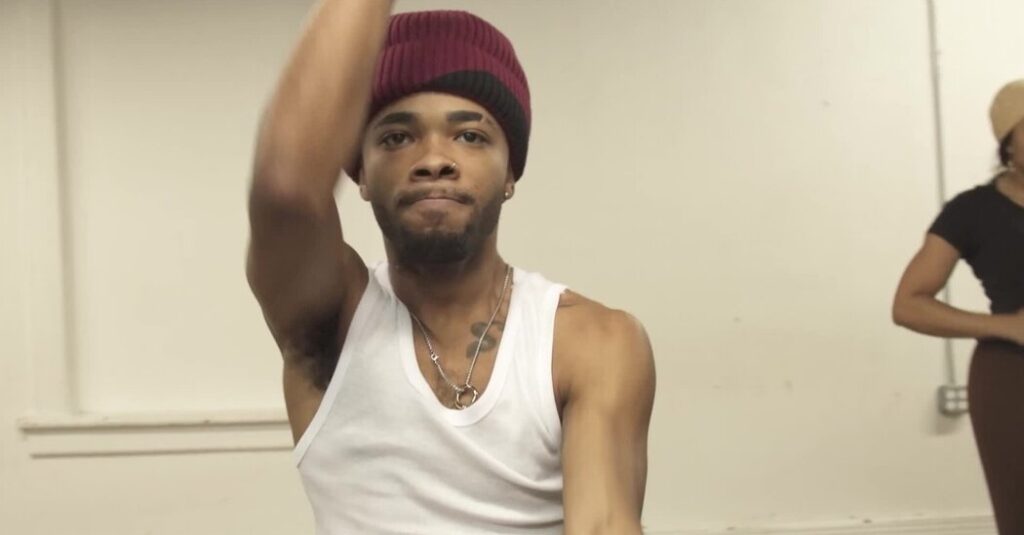
More than that, though, “Try/Step/Trip” has a different physical language: step, the percussive dance form developed in historically Black colleges and universities. “The play mostly takes place in a court-ordered drug rehabilitation program, which we call the Group,” he said. “And step is such a group art form, all about unity and precision.”
In the show, Brathwaite plays a narrator figure called the Conductor, who mans a sampling machine as he guides the audience and a younger version of himself called Anonymous (Tyrese Shawn Avery) through his story. With little more than folding chairs and bodies, the production samples modes of theater, from courtroom re-enactment and spoken-word soliloquies to realism.
Step, integrated with the music, becomes an embodied metaphor for the structures and rituals of the court system and group rehabilitation. It’s another vehicle for expressing how Anonymous both resists and submits to being part of a group.
Finding this form was the latest in a long series of discoveries for Brathwaite. As a teenager in Sacramento, he gravitated to hip-hop, writing rap lyrics, freestyling during lunch periods and making music with friends who shared his background in church. He was also attracted to theater, but he said he was “a closeted theater kid,” taking classes but not participating in school plays.
“I didn’t feel like these were two worlds I could blend,” he said. That was before he heard about spoken word. He started participating in open mic sessions and joined a spoken-word collective in college. He met Marc Bamuthi Joseph, a slam poetry champion who was developing a form of hip-hop theater, and he began to perform in Joseph’s works.
“I found a medium,” Brathwaite said. Then came the flashing lights in his rearview mirror.
Joseph helped him put together “Spiritrials,” but adding step was the veteran director Roberta Uno’s idea. At the California Institute of the Arts, she was working with Toran Xavier Moore, a student who had learned step as a member of the Alpha Phi Alpha fraternity at Alabama State University. When the CalArts Center for New Performance invited Uno to make a project in 2016, she thought of Moore and of Brathwaite, whose work she had heard about from colleagues and seen on YouTube.
“Before the first rehearsal,” Uno recalled, “I told Dahlak: ‘This is not just about stepping as a transition from one location to another. This is about the body as the battleground.’”
With Uno as director and Moore as choreographer, “Try/Step/Trip” took shape. “We started looking into how step fits into so many facets of the carceral system, fraternities, the church,” Moore said. “It doesn’t sound the same when it’s done alone.”
As “Try/Step/Trip” acknowledges, the story it tells is in some ways an often told one. Brathwaite’s tale had become old to even to himself. Incorporating step was a way to make it new, but it took some courage on Brathwaite’s part. “In high school, I was the Black kid who couldn’t dance,” he said.
In “Try/Step/Trip,” this struggle is mined for humor. It also feeds into Brathwaite’s identity as what he calls “immigrant Black” — his parents are from Africa and the Caribbean. American Blackness, he says in the show, is something he learned, “sometimes by choice, sometimes by force.”
“Try/Step/Trip” isn’t a dance show, per se, though dance flows throughout it, including a doo-wop number in the style of Gladys Knight and the Pips. Everything is in service of the story. “We tried to make it seamless,” Uno said. The creative process — across many residencies, showings and runs — was also communal, she said, “open to everyone’s contribution.”
Working with Uno and Moore and the cast, some of whom have been with the project from the beginning, was “like making music,” Brathwaite said. “We were just jamming, and everybody’s adding their own sounds, their own ideas.”
Braithwaite first connected to step as music, “as a kind of breakbeat to the samples I use,” he said. “But in collaboration it started to develop into something else, a rite of passage” — trying and tripping and trying again.
Step added another layer to his understanding of the show as an exploration of different kinds of sampling. “There are traditions and rituals that are worth keeping as helpful guides to us, but there are parts that can become oppressive and limiting,” he said. “How do you sample what’s good?”
His attitude toward his experience with the criminal justice system is ambivalent. “It made me so much better and so much worse,” he said. “I can see that somebody without the strong family I had could be remade into whatever they say you are, because it’s so persuasive and confusing.”
But he values what he learned about himself and about the lives of others. After serving his court-mandated term in the rehabilitation program, he went to other programs of his own volition. “It was a place where I could safely heal myself,” he said. And he’s continued that process through his art.
This idea takes cathartic shape at the end of “Try/Step/Trip.” Anonymous has nearly given in to the attitude that if the world is going to see him as a drug addict and felon, he might as well enjoy the perks. While the ensemble sings, “I lost myself when I became ‘It don’t matter,’” Brathwaite as the Conductor tells his younger self that it’s OK to want to burn down the structures, but that he must build one, too, “or we default back into theirs.”
What follows is the only full-out step routine in the show, one that folds in all the work’s motifs in an intricate pattern of words and music, stomping and clapping, under the legs and behind the back, everyone together.
“It’s how you take all those little moments and build a true house,” Brathwaite said. It’s what he and his collaborators have accomplished in “Try/Step/Trip” concentrated in physical form.
The post A Story of Hip-Hop Rehabilitation With the Body as Battleground appeared first on New York Times.