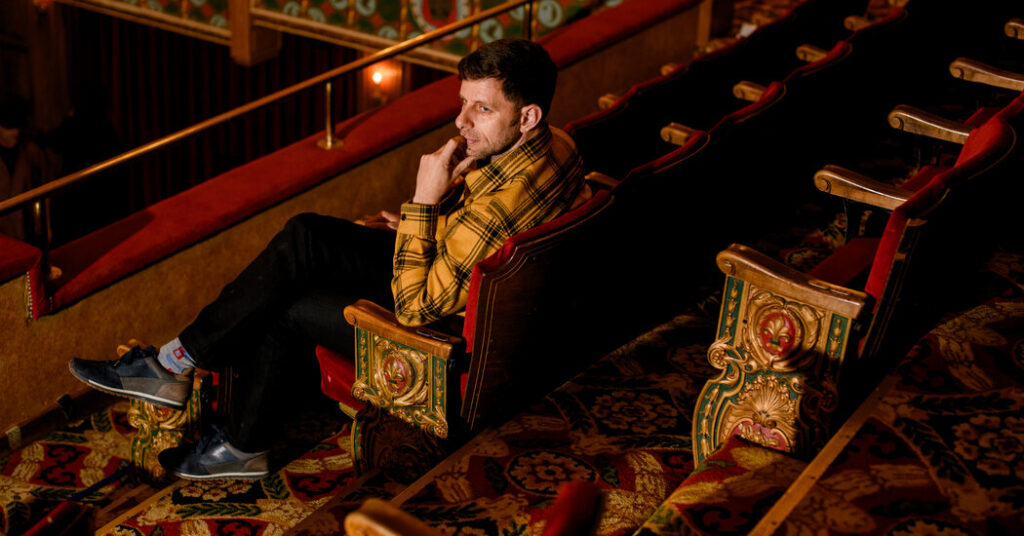
Yuval Sharon was appointed artistic director of the Detroit Opera on a wave of anticipation in a city eager to raise its cultural profile. Here was an acclaimed director who had built a career with new and wildly reinvented operas, ready to establish himself in Detroit.
Sharon, 46, who took the job in 2020, proceeded to transform opera in Detroit. He offered a drive-through presentation of “Twilight: Gods,” an adaptation of Wagner’s “Götterdämmerung,” in an abandoned parking garage during the coronavirus lockdown. At the Detroit Opera House, he staged Puccini’s “La Bohème” backward — opening with Act 4 and Mimi’s death. He directed a revival of “X: The Life and Times of Malcolm X,” by Anthony Davis, which went on to the Metropolitan Opera.
Detroit, a city that has been enjoying a cultural resurgence after years of struggling for respect and recognition, embraced Sharon. The Detroit Free Press said his arrival would propel the city “to international relevance in the opera world and brings to Detroit the kind of innovative artistic leader unique among the city’s cultural institutions.” His hiring, the Free Press wrote, was “a bold but risky choice for a company with a largely conservative artistic profile that has historically lived on razor-thin financial margins.”
Last week, Detroit and Sharon announced a parting of the ways as the opera agreed to cut Sharon’s contract by two years. He will leave at the end of the 2025-2026 season.
The company, which has a $16.4 million annual budget, cited severe financial strains, including retrenchment by some of its major donors, the end of federal assistance received during the Covid shutdown and declining ticket sales during the shutdown.
Detroit canceled this season’s opener, Puccini’s “La Fanciulla del West,” imported from the English National Opera; drastically cut the budget for other planned operas this year; and told Sharon he would be unable to mount new productions in the coming years, including a staging of “The Gospel at Colonus” planned for next year.
“Given the changing, shifting philanthropic state, we couldn’t do it,” said Patty Isacson Sabee, the president of Detroit Opera. “We took a sober look at what next year looks like. It will take us some time to achieve the funding we need.”
Sharon said Sabee informed him in June about the “Fanciulla” cancellation and other programming cutbacks; after months of discussion, he decided to step down.
“They really tried to make it work,” Sharon said in an interview in New York. “But it was just not the artistic vision that I agreed to. I would just feel like kind of a lame duck artistic director — at which point I’m not serving the organization. I’m certainly not serving myself.”
The upheaval in Detroit demonstrated the tenuous financial state of the performing arts at a time of shifting priorities by donors, cuts in governmental arts money and lagging attendance in the wake of the pandemic. But it also illustrated the challenges faced by a new generation of composers, conductors and directors — led by Sharon — attempting to reinvigorate opera’s appeal and audiences.
The end of Sharon’s Detroit tenure comes as his vision for opera is about to get tested on America’s grandest opera stage — the Metropolitan Opera in New York — as he directs two of the highest-profile productions in the Met’s repertoire. Sharon makes his Met debut in March with a new staging of Wagner’s “Tristan und Isolde” and he will direct a new production of Wagner’s “Ring” cycle, starting in the 2027-2028 season.
In Detroit, unlike at the Met, Sharon was working for an opera company operating on a relatively small budget that was strained by his costly vision, although his productions were hailed by critics. Without providing figures, the Detroit Opera said it saw its best attendance last year since the Covid shutdown, buoyed by a surge of first-time attendees.
But his vision was not embraced by everyone. The Detroit Music Hall, a block away from the Detroit Opera House, announced in October that it would start a “Classic Opera Series” in February with a concert performance of Puccini’s “Turandot.” It will feature, among others, the soprano Christine Goerke, who lives in Detroit and who stepped down as associate music director of the Detroit Opera in 2024 after three years in the position.
Vince Paul, the president and artistic director of the Music Hall, said he initiated the series in response to complaints from traditional opera lovers in Detroit. “When Yuval came in, he had this great creative infrastructure to do modern ideas and modern approaches to opera — which was great,” Paul said. “But you had a lot of traditional opera lovers who were not so thrilled.”
“They wanted their ‘Barber of Seville,” he added. “And they were getting ‘La Bohème’ backward.”
Goerke said the Detroit Opera was filling a demand of part of its audience — but not all. “People like different things: There was a very clear path to create something new, a new direction at Detroit Opera,” she said. “And some people loved it and some people did not love it.”
“I want the innovation,” she added. “But I am not for throwing out 400 years of magic. I am greedy. I want all of it.”
Sabee said that she was not concerned about the Music Hall series and that Detroit audiences had embraced the programming championed by Sharon.
“Malcolm X” and “La Bohème” were “among the best-selling productions in the company’s history,” she said in an email. About the Music Hall series, she added: “There is so much great opera repertoire, and we are delighted that these incredible artists will be enjoyed by our community.”
The depth of Detroit Opera’s financial difficulties was underlined when the Andrew W. Mellon Foundation, which had long been one of its biggest supporters, informed the company it would stop funding it at the end of this season, in June, Sabee said.
Another major supporter, the William Davidson Foundation, whose treasurer is Ethan Davidson, the chair of the board at the Detroit Opera, has only pledged funding through the end of 2027. About 60 percent of the opera’s financial support comes from institutional, corporate and individual donors, along with state and federal grants. These reductions in foundational grants came as the company was grappling with a $4 million loss caused by, among other things, the end of Covid grants and a drop in ticket sales caused by the shutdown of the hall during the pandemic.
Officials at the Mellon and William Davidson foundations did not return calls asking for comment about their decision.
“This is indicative of an ongoing shift in funding patterns,” Sabee said. “It’s time to take control of the future of the organization,” through spending cuts and a search for new funding.
Sharon said he was encouraged by the reaction of Detroit operagoers to his programming, which he said was evidence of an appetite for new works. Still, he acknowledged that it was “a learning process for the audience.”
“It was hardest for traditional operagoers, but it was part of my process at Detroit Opera, which was helping the audience understand that a part of a director’s responsibility is an interpretational one,” Sharon said, “that we can get in on these pieces and recreate them.”
Adam Nagourney is a Times reporter covering cultural, government and political stories in New York and California.
The post A Bold Alliance Ends as Innovative Opera Director Bows Out in Detroit appeared first on New York Times.