Zero Hour for the Middle East
Dec. 28, 2025
From the rubble and the ruin, the torture and the terror, the dust and the debris, something is stirring in the Middle East, a spirit that says no to endless cycles of violence and values a future for the region’s children above past feuds.
This sentiment is tenuous, contested and vulnerable. But with more than a half-million killed in Syria’s 13-year civil war and 70,000 Palestinians killed in the two-year Gaza war, alongside close to 2,000 Israelis, exhaustion is widespread. Shun retribution, murmur the war-weary, and think again.
“There is no other solution but finding a solution,” said Hassan Smadi, 48, a hospital worker in the battered southern Syrian town of Busra. He lost a younger brother, killed in the relentless bombing by Bashar al-Assad, the dictator ousted last year; his family fled to Jordan. “We are tired of war and bored of war, and want only to live peacefully.”
A sign close to where Mr. Smadi stood, installed recently by the local authorities outside a remarkably preserved Roman amphitheater, says, “On this earth, there exists that which deserves life,” a line from the Palestinian poet Mahmoud Darwish.
If there is a refrain heard across war-shattered Syria, where even the gray-green wilting trees look shellshocked, it is, “We just want to live.”
If there is an ambition in Saudi Arabia, it is to become a major power representing a modern Islam, open and technologically advanced, far from any aggressive Pan-Arab ideology.
If there is a buzzword among the Sunni Gulf monarchies, once driven to paroxysms of fear and rage by the Shiite mullahs of Iran, it is “pragmatism.”
Still, the region remains combustible. The United States responded to the killing of two U.S. soldiers and an American interpreter this month by hitting the Islamic State in Syria with punishing airstrikes that Defense Secretary Pete Hegseth called “a declaration of vengeance.”
The strikes came soon after the Trump administration said in its National Security Strategy that the region was “emerging as a place of partnership, friendship and investment,” adding that the days when “the Middle East dominated American foreign policy” were “thankfully over.”
Such optimism, based in large part on the Gaza peace agreement signed in Sharm el Sheikh, Egypt, on Oct. 13, looks overblown, much like President Trump’s claim that day that it took 3,000 years to reach a breakthrough of this kind.
Not everything has been solved overnight by a presidential signature.
In Syria, sectarianism competes with a desire for unity and violence flares. War festers in Yemen. In Iran, the regime is weak, but its determination to destroy the state of Israel is undimmed. Israeli settlers claw land away from Palestinians in the West Bank, backed by an extreme right-wing Israeli government.
Already, the Gaza accord looks frayed. Israel and Hamas skirmish for advantage. Everything about the peace plan’s next phase — the planned international stabilization force, disarming Hamas, an Israeli withdrawal and the role of the Palestinian Authority — appears contentious.
Sequencing, or what concessions from which side come first, is the new battleground.
Even so, very few want a return to war. During repeated visits over several months across the region, hope alternated with horror. What was perhaps most striking was a quiet resolve among many people to side with promise over despair and destruction.
“The Gaza war violated the basic Israeli principle of fighting short wars,” said Gershom Gorenberg, an Israeli author and historian. “There is complete exhaustion in Israel, the military is exhausted and there’s been entirely too much reserve duty. These factors weigh against renewed fighting.”
Imagine
Exhaustion can offer space to talk, especially when accompanied by a shuffling of the Middle Eastern deck so far-reaching that it seems to contain at least the possibility of changed mind-sets.
Iran was hit hard by Israel’s 12-day war in June. That war helped bring the curtain down on the 20-year rise of the Islamic Republic that followed America’s war in Iraq and bolstered the Tehran-to-Beirut Shiite “axis of resistance” against Israel.
For now, the regime in Iran is not looking much beyond its own survival. Its relative inaction may offer some breathing space for those looking to turn away from endless rounds of conflict, even if the Iranian nuclear program is diminished but not dead, and may one day again be the target of Israeli and American military action.
Tehran’s chief proxy, Hezbollah in Lebanon, is a shadow of its former self. Another Iran ally, Hamas in Gaza, is defiant but also on the defensive, its leaders eliminated by Israel. The group’s weakness may allow devastated Gazans to seek a different future.
The majority Sunnis now lead the government in Syria. Backed by Saudi Arabia and Turkey, most have no interest in continued conflict but instead want to rebuild and seize new economic opportunity.
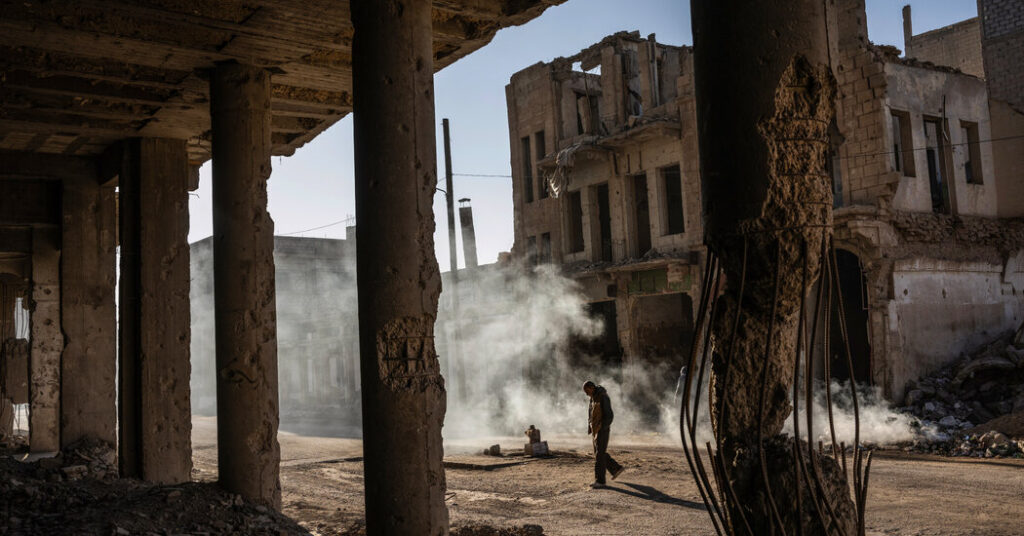
From Gaza to Lebanon’s border with Israel to northern Syria, the procession of ruins feels like a cataclysm suggestive of the ultimate futility of violence, and a fierce rebuke to a colossal human failure.
“We lost our future because Assad bombed all the schools and I couldn’t even get a high school degree,” Bashir Muhammad, 27, a government soldier, told me in Aleppo, the partly flattened second city of Syria. “Now we want our children to have a life.”
In Nabatieh, a city in southern Lebanon reduced in part to rubble, Jihad Wahab, 24, had returned from Turkey, where he completed a degree in computer science, to be with his family during the latest round of fighting with Israel. “My heart is broken,” he told me. “That’s what I feel when I look at the destruction.”
He gestured toward the bombed city hall. “All this, why?” he said. “Why do I have to go outside my country to make my future?”
Ruin, in this way, has bred a longing for renewal. There are many who hope for a coming decade without another Israeli-Palestinian war. Or who hope that Saudi Arabia might eventually normalize relations with Israel, if it can be satisfied that a “credible, irreversible and time-bound” path to a Palestinian state, including a reborn Gaza, has been set.
Or who see the possibility of a security deal between Israel and the Syria of President Ahmed al-Sharaa, who said in Doha, Qatar, this month that his country seeks good relations with all its neighbors and “wants to be a model for the region.”
All those things look remote for now, though not perhaps impossible.
“I think there is an opportunity, and I say that with the caveat that things don’t normally go well in this region,” Espen Barth Eide, the Norwegian foreign minister, who has long been active in Middle Eastern diplomacy, said in an interview. “Does Israel want, like Sparta, to fight forever? Only Palestinian statehood can prevent that.”
But to bring a Palestinian state into being would require an enormous change in Israeli policy, which has been built around a progressive and increasingly aggressive occupation of the West Bank.
“The biggest change in mind-set is probably needed in Israel,” said Anne-Claire Legendre, the top Middle East adviser to President Emmanuel Macron of France. “During two years of violence, the Egyptian peace deal held. The Jordanian peace deal held. The Abraham Accords with the Emirates held. It’s striking! So why would Israel not consider other deals and adopt an approach of greater confidence?”
Just this past week, Israel agreed to a $35 billion deal with Egypt under which it will provide natural gas, boosting economic ties in a relationship that came under extreme strain during the Gaza war.
Zero Hour
It is not easy to bring change, shake old habits and move forward. Wounds are deep, and in the Middle East the myriad war dead demand a consistent price in bloodletting. Amos Elon, an Israeli author, called Jerusalem a necropolis because of the way the past always outweighed the present.
The Syrian Revolution grew in 2011 out of a moment of hope. Part of the great uprising known as the Arab Spring, it began as a fight against more than a half-century of tyranny, in the name of freedom and democracy, a word that the Trump administration generally shuns in statements on the Middle East.
But spring soon turned to winter. Across the Middle East, authoritarianism and extremism struck back.
In Syria, the push to overturn Mr. al-Assad, a Pol Pot of the 21st century, turned into a horrific scrum of forces that long lacerated the Middle East.
Sunni jihadis of Al Qaeda and ISIS set up a base there. Shiite Iranian operatives, Hezbollah fighters and Russian forces lent ruthless support to the old regime. American-backed Kurds fought ISIS and sought to carve out their own territory. Not least, the Syrian people, largely abandoned and forgotten, fled into exile by the millions or eked out survival amid the ruins.
The Germans call the utter devastation of 1945 at the end of World War II “Stunde Null.” It is, similarly, “zero hour” in Syria.
In 2011, the country stopped. More than 100,000 human beings were “disappeared.” The much-loved Syrian novelist Khaled Khalifa called those still alive during the civil war the “pre-dead.”
Today, plastic and garbage skitter past the ragged tents of the displaced across a landscape of utter ruin. Many of the former regime’s cronies removed wire fixtures or rebar from the rubble; it was never too late to seek plunder amid the corpses.
From this mayhem, a leader emerged last year, Mr. al-Sharaa, a former jihadi who set up an affiliate of Al Qaeda in Syria a dozen years ago. Now he says he wants to unite Syria. It is easy to dismiss this ambition from so chameleonic a character.
Armed groups, as well as fighters affiliated with the government, have already been accused of committing atrocities, in coastal regions against Alawite Assad loyalists and in the southern Sweida region of the Druse religious minority, with which Israel has sought ties.
Remarkable progress has, however, also been made in a year. Mr. al-Sharaa has garnered support from the United States, Russia and China. He has secured the lifting of economic sanctions. He has remained steady in the face of repeated military provocations from Israel, and has begun to lay the basis of state institutions. He has been embraced by Mr. Trump and was ushered to the White House last month.
For the first time in more than a half-century, Syria is not part of a bloc — Soviet, Russian or Iranian — that makes it inherently hostile to the West. This is a Middle Eastern sea change.
Over 10 days in Syria in November, I traveled through dozens of checkpoints once used by the Assad regime to collect prisoners or bribes. Not once was I stopped.
The joyous celebrations this month of the toppling of the Assad regime a year ago were a measure of a nation’s liberation and of wide support for the new leader.
“The president wants to succeed for all the dead and the disappeared in our revolution, and there is no other way but to be a bridge to all communities,” Hind Kabawat, the Syrian minister of social affairs and the only woman in the government, said in an interview in Damascus. “We did not inherit Switzerland, but inclusivity is the only way. If we make mistakes, we correct them.”
She looked me in the eye with a steely determination. “Everyone has a past,” she said. “I choose the future.”
An Unpredictable Path
But which future?
This month at the Doha Forum, a regional conference, Donald Trump Jr. said of the president, “What’s great with my father is that you don’t know what he’s going to do.”
This may keep adversaries on their toes, but it can also make the administration’s diplomacy incoherent and render its course especially hard to predict.
Some elements of a changed American policy are clear: Pick leaders and do not worry about systems or values; fast-forward peace through prosperity in the hope that money can be a panacea; do not dream of liberal democracies but give “the region a chance to develop its own architecture,” in the words of Thomas J. Barrack Jr., the American ambassador to Turkey and special envoy to Syria and Lebanon.
Part of that architecture could eventually be the extension of the Abraham Accords, which established diplomatic ties between Israel and two Arab Gulf States in 2020.
In Gaza, the United States believes a strong leader is needed to unify the Palestinian people, someone with the galvanizing charisma of Mr. al-Sharaa of Syria. That, at least, is the message transmitted by the Trump administration to France, which calls it the “Sharaa model.”
With the United States talking directly to Hamas leaders for the first time through Steve Witkoff, President Trump’s envoy, and Jared Kushner, Mr. Trump’s son-in-law, there is evidence of a changed American approach to Islamism. Former hard-line combatants, even those once labeled terrorists, are no longer precluded by the Trump administration from playing important roles.
Bishara Bahbah, a Palestinian American businessman who has helped mediate between the Trump administration and the Palestinian leadership, said there was a “push” from the United States and Europe for the release of Marwan Barghouti, the revered Palestinian leader serving life sentences in Israel for murder and membership in a terrorist organization.
Mr. Barghouti is consistently identified in the West Bank and Gaza as someone with a unique capacity to unite the Palestinian movement for a state. For this reason, Prime Minister Benjamin Netanyahu of Israel seems certain to resist his release.
The Trump administration has offered strong support to Mr. Netanyahu, but it is tempered.
Mr. Trump, who will meet Mr. Netanyahu in the coming days in Florida, has never, as president, been clear on whether he supports a two-state outcome. Still, Article 19 of his 20-point Gaza peace plan speaks of one day attaining “a credible pathway to Palestinian self-determination and statehood, which we recognize as the aspiration of the Palestinian people.”
These are cautious words. But they mention a Palestinian state and reflect the fact that Mr. Trump’s support of Israel is offset by particular closeness to Saudi Arabia, Qatar and other Gulf States. If Mr. Trump wants his deal to hold, he will find it hard to ignore his Arab friends’ demands.
“There is no security or stability for the Middle East without a Palestinian state,” Sheikh Mohammed bin Abdulrahman Al Thani, the Qatari prime minister, said this month.
Mr. Netanyahu’s position is clear: There will be no Palestinian state. He is no Israeli outlier in this view, especially since the Hamas attack of Oct. 7, 2023. A political survivor, he can never be discounted, but he may lack sufficient support to form a new governing coalition after elections to be held within a year.
An eventual successor might find ways to think more creatively about how to usher Israel from eternal war. Neither Palestinians nor Jews are going to leave the contested sliver of land between the Mediterranean and the Jordan River.
Peace, Tense and Tentative
Violence on the Syrian scale does not subside overnight. The country’s sectarian divisions are profound. The population’s exhaustion has dampened but not extinguished them.
In early October, violence shook the sleepy streets of Anaz, a small town in western Syria, situated in the Wadi al-Nasara, or valley of Christians.
Masked gunmen on motorbikes opened fire on Wissam George Mansour and Shafiq Rafiq Mansour as they sat at a cafe smoking a shisha pipe. The men, Christian cousins, died instantly. A third man was seriously injured. Despite official promises of a thorough investigation, nobody has been apprehended.
The Syrian Christians are part of a mosaic of ethnicities and religions that have proved hard to reconcile within arbitrary borders, drawn in straight lines on maps over a century ago by British and French colonialists at the breakup of the Ottoman Empire.
“There is still tension,” said Joseph Sukarieh, a Christian, standing beneath bottles of whiskey and arak in his convenience store at the center of a town full of posters of the dead men. “I used to close the store around 11 p.m. Now I go home around eight o’clock to be safe, which makes my wife happy.”
Early in the Syrian uprising, around 2012, the Assad regime appointed heads of communities to distribute weapons to fight against the rebels. Christians, a minority, often sided with Mr. Assad’s Alawite sect of Islam, another minority. It appears that the cousins were targeted because one of them was particularly aggressive in arming those who killed Sunni protesters, Mr. Sukarieh and others from the area said.
I asked if such vengeance would happen again. “Only God knows,” he said. “We all hope for healing among the communities. We want to live in dignity.”
A roadblock between Anaz and a nearby Muslim village was recently removed. As for the alcohol he sells, Mr. Sukarieh said he had met no objections from Muslims. “Everything is more open now,” he said.
A winding road leads up from Anaz to Crac des Chevaliers, one of the world’s best-preserved Crusader castles, whose origins stretch back to the 11th century. It changed hands several times during the civil war.
Here, European crusaders lived for almost two centuries before the castle fell in the 13th century to the forces of the Muslim world. Today, mildewed walls and faded frescoes, ancient olive presses and winemaking vats convey the whispering of the centuries.
The vaulted room that was a Christian chapel before it became a mosque points east toward the rising sun. Its niche and pulpit were later built facing south toward Mecca. So, on ancient land, have civilizations fought, mingled, found compromise.
Four returnees from wartime exile in Syria sat gazing at the castle. Between them they had lost three brothers. They said they had dared return only after “the big donkey left,” a reference to Mr. Assad.
I asked about the recent violent incident down the hill in Anaz. “It’s quiet now, thank God,” Maher Daboul said. “Our principle going forward is no payback.”
The same principle was evident in Aleppo, the largest city in the north, where shooting erupted in early October between government forces and the Kurdish-led Syrian Democratic Forces. A government soldier and a civilian were killed, and there have been occasional clashes since.
Anger lingers. Nori Shikho, a community leader on the Kurdish side, went through a long list of complaints about Mr. al-Sharaa, calling him “a puppet of regional powers” who insults Kurds as “atheists.”
Even so, he concluded: “We are tired of war. We want to live as others do.”
So, very slowly, does the stench of war dissipate.
Will Fate Obey?
Four years after the Yom Kippur Arab-Israeli war of 1973, the unthinkable happened: Anwar Sadat, the Egyptian president, addressed the Israeli Knesset in Jerusalem. A right-wing Israeli leader, Menachem Begin, who had vowed to retire to a settlement in the Sinai Peninsula, ceded that land in exchange for peace with Egypt. The agreement was signed in 1979.
Mr. Gorenberg, the Israeli author, recalls sitting in a Jerusalem cafe and hearing the announcement of Mr. Sadat’s impending visit. “If Orson Welles had repeated his famous broadcast in 1938 announcing that the Martians had landed, it would have been more credible,” he said.
Given the great well of hatred that persists across the region, any rational argument would probably conclude that Mr. Trump’s “historic dawn” of peace across the region will be stillborn, like so many attempts to resolve the Israeli-Palestinian and other conflicts. Nobody can any more imagine Mr. Barghouti addressing the Knesset than they could Mr. Sadat.
Yet, among the ruins of Syria, the words of the great Tunisian poet Abu al-Qasim al-Shabbi are often repeated: “If the people have the will to live, then fate must obey.”
It was another poet, Victor Hugo, who wrote: “Nothing is more imminent than the impossible.”
Roger Cohen is the Paris Bureau chief for The Times, covering France and beyond. He has reported on wars in Lebanon, Bosnia and Ukraine, and between Israel and Gaza, in more than four decades as a journalist. At The Times, he has been a correspondent, foreign editor and columnist.
The post Zero Hour for the Middle East appeared first on New York Times.