There is a children’s story I used to read to my daughters when they were 3 and 4 years old. It comes from Arnold Lobel’s “Frog and Toad” series and involves a big batch of cookies so delicious that the main characters can’t stop eating them.
“We need willpower,” says Frog.
“What is willpower?” asks Toad.
“Willpower is trying hard not to do something that you really want to do,” says Frog.
Even at their young ages, my daughters nodded in recognition when, earlier in the story, Frog says to Toad, “I think we should stop eating. We will soon be sick.” And both girls smiled sympathetically when we turned the page and watched Frog and Toad declare that they would eat “one last cookie,” only to succumb to temptation, again and again.
Grown-ups, too, understand this struggle. In surveys, American adults have cited lack of willpower as the top barrier to changing behavior. Around the world, when adults have rated themselves on two dozen positive qualities, self-control has ranked dead last. Research also shows that exercising willpower feels pretty awful, whether you are resisting something fun or forcing yourself to do something un-fun.
Especially at this time of year, when holiday treats and year-end sales confront us at every turn, willing ourselves to resist can feel Scrooge-like. So we indulge. Then, come January, millions of us set New Year’s resolutions with fierce determination, only to abandon them by February.
The logical solution seems obvious: Try harder. Strengthen your willpower muscle. “Just say no,” as Nancy Reagan admonished my generation. “Just do it,” as Nike urges. Yet, as a psychologist who studies how people achieve their goals, I see the data leading to the opposite conclusion: Willpower is overrated.
Research shows that achievement has surprisingly little to do with forcing yourself to choose wisely in the heat of the moment. Successful people rarely rely on inner fortitude to resist temptations. Instead, many exercise situational agency, arranging their lives to minimize the need for willpower in the first place.
For example, Zadie Smith and Ed Sheeran both stay off social media by not owning smartphones. Jennifer Lopez stays healthy by carrying a water bottle, fresh fruit and vegetables with her. David Sedaris found it easier to avoid smoking weed when he moved to France: “In New York I got my marijuana through a service. You called a number, recited your code name and 20 minutes later an apple-cheeked N.Y.U. student would show up at your door,” he has written. “In Paris, I had no idea where to find such a college student.”
It can feel embarrassing or even shameful to admit you lack the fortitude to make farsighted choices when temptation beckons. But interviews with some of the most disciplined people on the planet have taught me that you do hard things more consistently when you put yourself in situations that make the pursuit easier.
For instance, Alistair Brownlee, a two-time Olympic gold medalist in the triathlon, makes sure his equipment is in order before a workout and that his shoes are warm, dry and waiting for him at the door. He bought his first house because it was close to the trails and pools where he ran and swam. “My mantra in life has always been to take the first step,” he says. Did all that situational scaffolding erode his grit? Quite the opposite.
You don’t need to be an elite athlete to benefit from situational agency. People are more likely to exercise when the situation makes exercise more fun, research shows. Taking a walk outdoors, rather than on a treadmill at the gym, is the only way I get my steps in. My daughters have discovered that going to the gym is double the fun when they go together. Many other people find it easier to exercise when bundling their workout with a favorite podcast or audiobook.
Situational agency is an especially important concept for young people. Advances in technology mean that every generation confronts more numerous, convenient and alluring temptations than the last. In a recent discussion of the Gen Z mental health crisis, my students laid blame, at least in part, on the temptations of social media and screens. One student declared the infinite scroll the most evil invention of his lifetime.
Instead of admonishing my students to “try harder” to stay off their phones, I confess that I, too, find myself checking my texts, notifications and email far more often than I’d like.
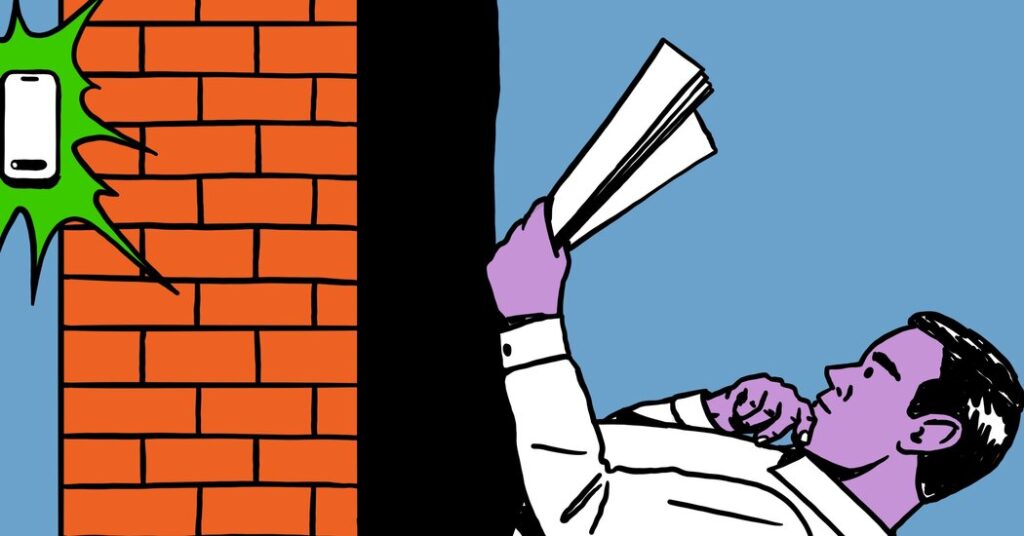
Then I share the findings from a recent study. My colleagues and I asked thousands of teenagers where they put their phones when studying. The options ranged from keeping their phones next to them, with the screen up and sound on, to moving phones to another room. At the end of the school year, the students who kept their phones farther away had earned higher report card grades.
Random-assignment experiments confirm the causal role of putting temptations out of sight and out of reach. Adults encouraged to keep unhealthy foods at a distance ate healthier days later. Students encouraged to apply the same strategy to distractions in their immediate surroundings later reported more success in pursuing their academic goals and felt less tempted while doing so.
Institutions also have the power to change situations for the better. In schools that ask students to keep phones in their hallway lockers, as opposed to in their backpacks or back pockets, teachers report that students make more eye contact with one another. They talk. The lunchroom is louder, the way it should be.
No matter your age, situational agency empowers you to navigate what might be called an ultraprocessed world — an environment saturated with temptations engineered to be irresistible. Junk food is easily available and delivers sugar, fat and flavor in extraordinary concentrations. Social media operates in similar ways. Cal Newport, a computer scientist, calls a TikTok dance mash-up a “digital Dorito,” noting that social media algorithms sift through countless posts to serve us exactly what we find appealing, 24/7.
You cannot change the conditions of modern life, but you are the sovereign ruler of what enters your personal space. Physical distance creates psychological distance: Draw close what you want more of, push away what you want less.
When I tell students that willpower is overrated, one inevitably points out that you need willpower to change your situation. True, I say. Then I tell them the end of the “Frog and Toad” story. After fruitlessly using willpower to stop eating, the two friends take the cookies outside and scatter them on the grass. “Hey birds,” Frog shouts. “Here are cookies!” And the birds come, pick up the cookies in their beaks and fly away.
Angela Duckworth, a professor of psychology at the University of Pennsylvania, is the author of “Grit” and the forthcoming book “Situated: Finding the People and Places That Bring Out Your Best.”
The Times is committed to publishing a diversity of letters to the editor. We’d like to hear what you think about this or any of our articles. Here are some tips. And here’s our email: [email protected].
Follow the New York Times Opinion section on Facebook, Instagram, TikTok, Bluesky, WhatsApp and Threads.
The post Willpower Doesn’t Work. This Does. appeared first on New York Times.