Across the United States, someone is missing.
One year into President Trump’s immigration crackdown, construction firms in Louisiana are scrambling to find carpenters. Hospitals in West Virginia have lost out on doctors and nurses who were planning to come from overseas. A neighborhood soccer league in Memphis cannot field enough teams because immigrant children have stopped showing up.
America is closing its doors to the world, sealing the border, squeezing the legal avenues to entry and sending new arrivals and longtime residents to the exits.
Visa fees have been jacked up, refugee admissions are almost zero and international student admissions have dropped. The rollback of temporary legal statuses granted under the Biden administration has rendered hundreds of thousands more people newly vulnerable to removal at any time. The administration says it has already expelled more than 600,000 people.
Shrinking the foreign-born population won’t happen overnight. Oxford Economics estimates that net immigration is running at about 450,000 people a year under current policies. That is well below the two million to three million a year who came in under the Biden administration. The share of the country’s population that is foreign born hit 14.8 percent in 2024, a high not seen since 1890.
But White House officials have made clear they are aiming for something closer to the immigration shutdown of the 1920s, when Congress, at the crest of a decades-long surge in nativism, barred entry of people from half of the world and brought net immigration down to zero. The share of the foreign-born population bottomed out at 4.7 percent in 1970. Stephen Miller, a top adviser to Mr. Trump, has extolled those decades of low immigration as the last time the United States was “an undisputed global superpower.”
Whether or not restrictions will restore some of what Mr. Miller views as a midcentury idyll, there’s little doubt that major changes are in store. Immigration has woven itself so tightly through the country’s fabric — in classrooms and hospital wards, city parks and concert halls, corporate boardrooms and factory floors — that walling off the country now will profoundly alter daily life for millions of Americans.
Grocery stores and churches are quieter in immigrant neighborhoods. Fewer students show up in Los Angeles and New York City. In South Florida, Billo’s Caracas Boys, a Venezuelan orchestra, puts on an annual holiday concert where generations of families come to dance salsas and paso dobles. This year, the orchestra announced at the last minute that it was canceling the show because so many people are nervous about leaving home.
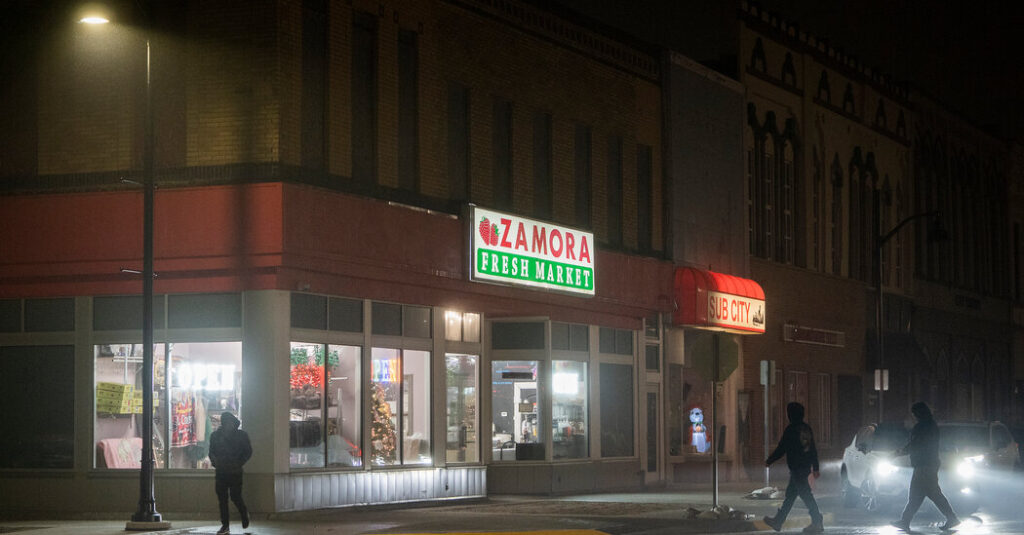
The changes will also be felt hundreds of miles from any ocean or national border, even in the snow-washed streets of Marshalltown, Iowa, a city of 28,000 about an hour’s drive northeast of Des Moines.
First Mexicans, some undocumented, came to Marshalltown in the 1990s to work at the pork processing plant. After a high-profile immigration raid there in 2006, refugees with more solid legal status arrived from Myanmar, Haiti and the Democratic Republic of Congo.
Now, Mexican, Chinese and Vietnamese restaurants dot the blocks around the grand, 19th-century courthouse. The population is 19 percent foreign born, and some 50 dialects are spoken in the public schools. The pews at the Spanish-language Mass at the local Catholic church overflow on Sundays, and, in 2021, a Burmese religious society built a towering statue of Buddha on the outskirts of town.
“You have more energy in the community,” said Michael Ladehoff, Marshalltown’s mayor-elect. “If you stay stagnant, and you don’t have new people coming to your community, you start aging out.”
But with President Trump’s crackdown on immigration gaining strength, local festivals are more thinly attended. Parents pull their children out of school when they hear about people being detained. The supervisor overseeing the construction of a high school sports stadium received a deportation letter, creating a conspicuous absence as the work finished up. The pork plant has let workers go as their work permits have expired.
The insecurity of each immigrant ripples into the wider community. Sergii Fedko and his wife, Tetiana, came to Marshalltown in 2023 along with five other Ukrainian families under an immigration parole program for their war-torn country.
Mr. Fedko, a power plant engineer in Ukraine, was quickly hired at a local architecture firm as a designer and draftsman. Ms. Fedko works at a day care center, where she is beloved by her charges. Their three sons are enrolled in school; the eldest excel at soccer and swimming. They bought two cars and a fixer-upper house.
New immigration policies have loosened their toehold in America. They applied for an extension well before their two-year parole ended, but the White House paused processing and changed the rules. As the weeks ticked by and they didn’t hear back, they got nervous, and decided to apply for asylum as well. In mid-December, Mr. Fedko got notice that his application for the extension had been approved, but it would require a new $1,000 fee. His wife’s application is still in limbo.
If she loses her work permit, it will add to the acute shortage of child care workers that is making it harder for American parents to go to work. Mr. Fedko’s manager, Heidi Hogan, has been doing everything she can to help. Her reasons aren’t entirely selfless; there aren’t many skilled draftsmen in the area.
“If he can’t stay with us,” Ms. Hogan said, “I’m going to have a hard time finding someone else.”
An Echo of the Past
It’s not clear yet what these changes will mean for America. But a past era of immigration crackdowns contains some lessons.
Over the country’s first century, immigration was essentially unrestricted at the federal level. This began to change in the late 1800s, with the “great wave” of immigrants fleeing political oppression or seeking work. Starting in the 1870s and over the decades that followed, Congress barred criminals, anarchists, the indigent and all Chinese laborers.
By the turn of the 20th century, anti-immigrant sentiment was rampant. The lawyer and eugenicist Madison Grant wrote in his 1916 book, “The Passing of the Great Race,” that foreign countries were taking advantage of America’s openness by unloading “the sweepings of their jails and asylums” and that the “whole tone of American life, social, moral and political has been lowered and vulgarized by them.”
Grant was consulted as an expert when Congress began crafting the Immigration Act of 1924, which, along with companion legislation, barred nearly all immigration from Asia, created the U.S. Border Patrol and established quotas from eastern and southern European countries. Net immigration — which accounts for people leaving as well as those coming in — plummeted.
Today’s language echoes that time. President Trump characterizes people from Somalia, Haiti and Afghanistan as coming from “hellholes” and accuses other countries of “emptying out their prisons and their mental institutions into the United States of America.”
The broader debate in the 1920s would be familiar to contemporary ears, too: fears about crime; anxiety about the falling fertility rates of the native born; suspicion about the politics of newcomers; hopes that restrictions would mean higher wages for U.S.-born workers; disputes about assimilation.
Today, some proponents of halting immigration — including Vice President JD Vance — argue that it would help the country absorb those who were already here, decrease competition for scarce goods like housing and strengthen job opportunities for young men who had dropped out of the work force. Reihan Salam, president of the conservative Manhattan Institute, wrote in his 2018 book, “Melting Pot or Civil War?,” that a large and constantly growing population of low-skilled immigrants, many living in working-class ethnic enclaves, risks creating a “permanent underclass.”
Evidence is mixed on the effect of the 1920s restrictions on assimilation. Some researchers have found that, without newcomers arriving from their home countries, immigrants were more likely to marry American-born citizens and less likely to live in ethnically homogenous neighborhoods. Other studies suggest that policies aimed at forcing assimilation backfired, strengthening the determination to maintain ethnic identities.
Regardless, the effects of that period continue to reverberate. Melissa Marinaro, who directs the Italian American Program at the Heinz History Center in Pittsburgh, said that when people who fled Italy in the years around World War II could not join family members in the United States, they went to Australia or Canada instead.
“One hundred years later, we still have Italian American families who are split from their extended families,” she said.
The restrictions passed in the 1920s governed U.S. immigration until international competition in the Cold War, the civil rights movement and a shift in organized labor’s stance led to the end of national origins quotas in 1965.
Although the effects of the 1924 immigration restrictions are difficult to untangle from other developments — wars, technological advancements, the baby boom — wages rose for U.S.-born workers in places affected by the immigrant restrictions. But only briefly. Employers avoided paying more by hiring workers from Mexico and Canada, countries not subject to immigration caps; American-born workers from small towns migrated to urban areas and alleviated shortages. Farms turned to automation to replace the missing labor. The coal mining industry, which was powered by immigrants now barred from entry, shrank.
And today? Construction wages have been rising, even as home building has been sluggish — a potential indication that deportations in the immigrant-heavy industry are bidding up salaries. The union representing workers in the pork processing industry sees an upside, too, even though it opposes deportations and won wage increases after President Joseph R. Biden Jr.’s immigration surge.
“I will certainly bring it up at the bargaining table that the way to solve a labor shortage is to pay more money,” said Mark Lauritsen, head of the meatpacking division at the United Food and Commercial Workers Union International.
The same is true in landscaping. Immigrant crews, working outside, were an easy deportation target over the summer. Come spring, said Kim Hartmann, an executive at a Chicago-area landscaping firm, the labor force could be 10 to 20 percent smaller.
“It’s going to be much more competitive to find that individual who’s been a foreman or a supervisor and has years of experience,” Ms. Hartmann said. “We know that drives costs up.”
But there are limits to how much customers will pay for decorative shrubs, and they may opt to go without. One 2022 study examined the expulsion of tens of thousands of Mexicans from the United States in the early 1930s. Contrary to the policy’s intent, unemployment rose and wages were depressed for native-born workers, possibly because sectors that depended on immigrant labor — agriculture, construction and manufacturing — suffered so much that they contracted.
The lesson of the last period of intense restriction is that employers have an array of ways to adjust, said Leah Boustan, an economics professor at Yale who studies the history of immigration.
“The menu is other sources of labor, and machinery,” she said. “It’s not obvious that you’re going to pick the guy down the street relative to these alternatives.”
Where Hands Still Matter
Today, that menu has expanded. Companies can outsource jobs to other countries. Artificial intelligence is replacing some types of work, and other countries, like Japan, have shown the possibilities of robotics. But many services still require humans, in person.
“If you’re an obstetrician, delivering a baby right in the moment, you need hands to lay on the patient,” said David Goldberg, a vice president of Vandalia Health, a network of hospitals and medical offices in West Virginia. “It’s not the same as a banker, or someone creating code.”
Nearly a fifth of nursing positions are currently vacant in West Virginia — a state that is older, sicker and poorer than most — and the state faces a serious shortage of physicians in the coming years. The answer has been to look abroad. A third of West Virginia’s physicians graduated from medical schools overseas. Now that option is narrowing.
“We lost two cardiologists because of their concern that they wouldn’t get their visa and, if they did, that they would not be able to stay here permanently,” Mr. Goldberg said. “They went elsewhere.”
Similarly, nobody has figured out how to harvest delicate crops with machines. During the low-immigration 1970s, some crops, like green onions, disappeared from shelves or were imported instead.
“It’s not going to hop from the ground into a package without somebody’s hands being involved somewhere along the way,” said Luke Brubaker, who runs a dairy farm with his sons and a grandson in Pennsylvania. To milk cows, feed them and deliver calves, he relies on more than a dozen foreign-born workers, most of them Mexican. He is not optimistic that he will be able to replace them.
“You can put an ad in the paper,” he said. “Maybe you would have one American-born applying for that job if you need 10 people. And that’s a maybe.”
For now, Mr. Brubaker can still find staff. The surge of immigrants who entered the United States under President Biden — more than eight million people — means that many foreign-born workers are still available.
That surge helped create an anti-immigrant backlash, inflaming fears about crime and jobs. It also stung immigrants who felt they had faced higher barriers than newer ones from places like Venezuela.
“The Mexican population felt that it was not fair,” said Alfonso Medina, who owns La Carreta, a Tex-Mex restaurant in Marshalltown started by his father, a Mexican immigrant, in 2000. “Imagine you’re here for 20, 30 years contributing. And all of a sudden here comes this administration and starts letting people in right away with a permit. They felt betrayed.”
In 2024, they shifted toward Mr. Trump.
Land of Opportunity?
Dan Simpson, the chief executive of Taziki’s, a fast casual Mediterranean restaurant chain based in the Southeast, has been losing employees since the beginning of the year. These were not only dishwashers and cooks but also managers and assistant managers, who had come to the United States with advanced degrees.
While he worries about the effect on his own business, he believes that the damage could be much greater.
“If you zoom back, the bigger problem is that we’re tarnishing the brand of America,” Mr. Simpson said. Even if the United States opens up again, he said, “we’re going to need a campaign to fix the idea that America is not the land of opportunity.”
International students pay full-freight tuition that helps fund new programs and basic costs at many U.S. colleges. As international enrollment has dropped, many schools are facing budget holes.
Nearly half of the immigrants who legally came to the United States from 2018 to 2022 were college educated, according to the Migration Policy Institute, a nonpartisan think tank. Immigrants are far more likely than U.S. citizens to start businesses; nearly half of this year’s Fortune 500 companies were founded by immigrants or the children of immigrants.
Several studies have found a decline in the number of patents issued for U.S. inventions after the immigration laws of the 1920s.
“You have an economy that is smaller, less dynamic and less diversified,” said Exequiel Hernandez, a professor at the Wharton School at the University of Pennsylvania.
In early 2025, Rayan Sadri was raising money for his artificial-intelligence start-up. In June, the Trump administration barred everyone from a list of Muslim countries, including Iran, where Mr. Sadri is from. Based in Montreal and unable to travel in the United States, Mr. Sadri could no longer easily meet potential investors and customers. Moving the company to San Francisco, as he would have liked, was not going to happen. Among other factors, the ban slowed the young company’s momentum.
“Everything for start-ups is momentum,” said Mr. Sadri, who is now going to work for another tech company in Canada.
It’s not just Silicon Valley. Small enterprises across the country have been built by and for immigrants — and been embraced by a wider community. In Marshalltown, Luisa Ortega has been putting on Mexican-style rodeos and popular music acts since 2012. In recent years, white residents have started coming, too. “They like the all-day show, they want to be able to go and dance,” she said.
‘What Is the Future?’
Over the longer term, low immigration will collide with one inexorable trend: an aging population in need of care just as fewer workers are available to provide it.
Half of the people who work at Sinai Residences, a senior living facility in Boca Raton, Fla., are immigrants. Rachel Blumberg, the chief executive, has already had to notify 38 workers from Cuba, Haiti and Venezuela that they will have to go because the Trump administration ended their country’s temporary legal status. That is 9 percent of her work force.
“It was like this funeral that would never end,” she said, of those conversations. “They’re my best employees.”
Rural areas and postindustrial cities have long struggled with an exodus of the young and the growing needs of the older residents who are left behind. Many of these places have pinned their futures on immigrants.
Lancaster County, Pa., most famous for a community that has refused to assimilate — the Amish — has over the years also become home to a global marketplace. People from Myanmar now fill the pews of a Mennonite church founded in the 1700s. Scores of Congolese refugees work at local distribution centers. The county seat, Lancaster, has two Nepalese restaurants. Resettling refugees, long a mission of local Mennonites, has become central to Lancaster’s growth strategy.
Unlike most Pennsylvania counties, “Lancaster’s numbers are growing,” said Heather Valudes, the president of the Lancaster Chamber of Commerce. “But that is simply because of immigrants.”
Ahmed Ahmed, 31, arrived in Lancaster when he was 3. His parents, refugees from Chad, worked as certified nursing assistants, taking care of Lancaster’s elderly; Mr. Ahmed became the manager of a local hotel and a city councilman.
He now supervises some of the immigrants who came after him, including several Cuban refugees who worked at the hotel. This summer, they learned that their temporary work permits had expired. The Haitian workers at the poultry plant learned this, too. As did the Ukrainian employees at the Walmart.
They are now stuck in limbo. The economy is closed to them, but they are unable to return home — the United States does not even allow commercial flights into Haiti. Shut out of the formal work force, some will probably move to larger cities and look for under-the-table jobs, delivering food or cleaning homes.
Mr. Ahmed was not sure what became of the Cubans he worked with. He is concerned about them, and also worried about what may lie in store for his adopted hometown.
“This is only Year 1,” he said. “What is the future?”
Ben Casselman contributed reporting.
Lydia DePillis reports on the American economy for The Times. She has been a journalist since 2009, and can be reached at [email protected].
The post What America Might Look Like With Zero Immigration appeared first on New York Times.