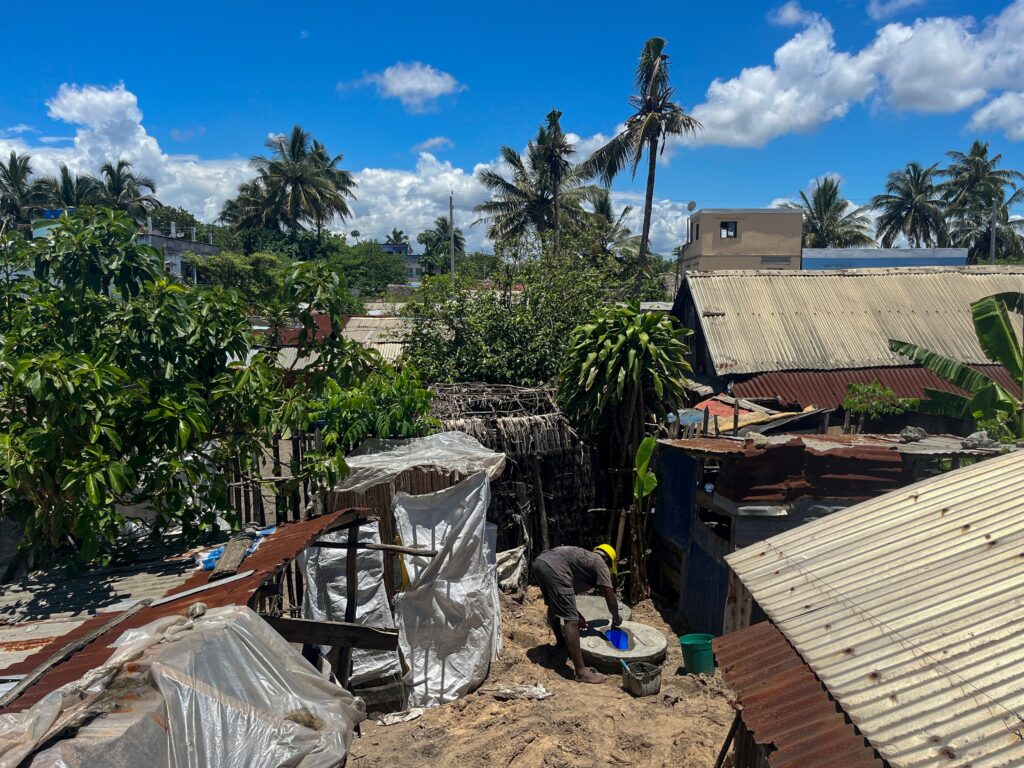
TOAMASINA, Madagascar — The centerpiece of the aid project was a toilet known as the Minimal Value Product: the MVP1.
It did the things any adequate toilet should do, like contain waste, limit odors and prevent flies. When it became available last year in this crowded port city, those capabilities made the American-sponsored toilet nothing less than an instant phenomenon.
Hundreds of MVP1s sold in the first few months. Jean Christian Tahasy, one of 14 people hired to sell the toilet door-to-door, so believed in the model that he carried invoices with him even after his shift ended and would pitch strangers while having beers at the bar.
Encouraged by the early results, the international aid organizations leading the project planned to expand to other cities and rollout other toilet models. It seemed a real chance to spur a sanitation revolution in the world’s fifth-poorest country.
“A true innovation,” said Tahasy, 31, who earned the nickname Mr. Toilet.
In many parts of the world, people flush without a thought. But nearly half of humanity doesn’t yet have that luxury, leaving them exposed to life-threatening diseases and compounding social and economic problems.
For more than a decade, 193 nations agreed that should change. They set targets — the United Nation’s Sustainable Development Goals — that provided a blueprint of progress for humankind and included a call for universal access to adequate sanitation by 2030. Nations pursued those goals unevenly, but with unanimous support, up until the precise point that 489 MVP1s were sold in Toamasina, Madagascar.
That’s when the Trump administration halted the work of the U.S. Agency for International Development, taking a series of steps in January and February to terminate funding for projects across the world.
In March, the United States also became the first nation to break ranks and reject the Sustainable Development Goals, calling them contrary to the “interests of Americans.”
The era of collective resolve to tackle some of the planet’s biggest problems was effectively over. And one tiny remnant of that old framework — a $60 toilet — suddenly became part of a messy aftermath where some of the most basic human needs would remain unmet.
“It’s a vacuum,” said Lyla Mehta, a water and sanitation specialist at the Britain-based Institute of Development Studies.
The State Department, in a statement, noted that most of the U.N.-led development goals are off track, and that such a model “promotes soft global governance” and reinforces the “donor-recipient model.”
In Madagascar, what had started as a four-and-a-half-year, $10-million USAID project involving six NGOs — with expertise in sanitation, waste treatment, marketing and finance — was inherited by a 29-year-old local who tried to hold a few of the pieces together.
“The reason to keep going?” said Valisca Ravololonihanta. “This is something that people need.”
She had entered the toilet business in desperation after her father’s death: Needing to support younger siblings, she’d applied for his vacated job and rose to become a regional manager within a toilet-producing network called Diotontolo.
She could see and smell the needs across her city, a sprawl of unplanned neighborhoods built on sand near the Indian Ocean. Toilets were rudimentary outhouses, typically shared by several households. Most areas in Toamasina had no sewer pipes, so using the toilet meant squatting over a pit, often lined with scrap tires, or an oil drum, and covered with wooden planks.
Even the better version offered by Ravololonihanta’s company before the sanitation project, with a concrete tank and ceramic lid, still could leave foul odors and waste exposed to disease-carrying flies. During storms, floodwaters would force the contents of the city’s toilet pits upward, gushing across yards and into homes.
The MVP1 could avoid those problems. Designed after months of surveys and testing, it consisted of a concrete pit topped with a blue plastic toilet bowl, known as the Sato pan. The bowl had a weighted flap that would close after each use, sealing off the pit, and enabling some of the hygiene benefits of a modern flushable toilet.
“A clear upgrade,” Ravololonihanta said.
But she had no way to replicate what had once made the MVP1 feel emblematic of a big mission. Gone was the idea of furnishing microloans to the many people whose monthly salaries failed to cover the cost of a toilet. Gone, too, were the resources to remove the waste after it accumulated in pits. Ravololonihanta lobbied for Diotontolo to absorb some of the salespeople, including Tahasy. But they all had to take steep pay cuts.
“We just have to do our work by ourselves,” she remembered telling her workers.
The age of international aid
Ten years earlier, countries gathered at the United Nations headquarters in New York to endorse a vast agenda. With President Barack Obama invoking the possibility of “ending extreme poverty in our world,” they agreed on 17 overarching goals with 169 specific targets on topics including road deaths, malnutrition, clean energy and, yes, sanitation.
Experts emphasized the giant health leaps known to flow almost automatically from installing sewer pipes in the ground and good toilets in homes. Cholera and typhoid are brought in check. Child mortality plummets. Rivers and streams stop functioning as vectors of disease.
Cities such as London and New York made these gains in the 1800s — an advancement in urban life akin to the automobile or the lightbulb. Now it was a matter of delivering that same progress to another roughly 4 billion people.
“It is such a fundamental thing we need for healthy, functional societies,” said Barbara Evans, a professor of public health engineering at the University of Leeds, who consulted on the goal.
Countries that had already made massive sanitation leaps had tended to use a combination of loans, heavy investment and good central planning. That’s how they pulled off the engineering — the networks of pipes, waste treatment plants and water supply — essential after a toilet is flushed.
But some of the countries left behind, especially in sub-Saharan Africa, couldn’t copy that formula. Some were at war or wobbling with corruption. Many prioritized other basics like roads and energy. And they tended to face high borrowing costs.
So they leaned on donor nations and aid groups.
The aid that flowed to Madagascar and elsewhere led to some locally meaningful projects — but also others that fell short of their goals.
Harisoa Rasamoelina, who helped manage an earlier USAID-funded sanitation project, described helping villagers build toilets with local materials — only for those toilets to fall into disrepair after the aid workers left and logged progress.
“So much wasted money,” she said. “When the project stops, it’s just big numbers, but no lasting changes.”
Trump officials cited concern about waste as a primary reason for shuttering USAID and slashing the budget for foreign aid work. Republican Rep. Marjorie Taylor Greene listed “toilets in Africa” as among the wasteful projects.
Other traditional donor nations — among them Germany, Britain, Sweden and France — have pared back their programs, too. A development network affiliated with the U.N. described global aid as collapsing in a “veritable free fall.” In June, when countries met in Spain to discuss the cavernous gap for the development goals, the U.S. didn’t attend.
“The Trump administration completely abandoned the pillars that have defined the West’s approach since World War II,” said Steven Radelet, a former USAID chief economist and a professor at Georgetown University.
A fraction of U.S. aid work has continued under the State Department, and the administration has focused on spending less money on a smaller list of issues, such as global disease threats like as HIV/AIDS and tuberculosis. It emphasizes deepening trade ties, satisfying many African nations’ goal of becoming less dependent on aid.
Such a model, experts say, has virtues but also leaves major blind spots. The most fragile countries — Somalia, Central African Republic, South Sudan, Madagascar — don’t attract much investment. A lack of sanitation, whose ills play out over a lifetime rather than triggering immediate crises, is a hard sell even in the best of times.
In the U.S. government’s 40-page paper laying out a new “America First Global Health Strategy” this fall, sanitation wasn’t mentioned.
The World Health Organization says the world, at the current rate, won’t achieve its goal for adequate universal sanitation access until the 22nd century.
Madagascar’s government, recently toppled in a military coup, has a punishingly long list of problems to deal with and spends just a tiny fraction of its budget on sanitation. Studies have shown widespread contamination of Madagascar’s drinking water, the result of feces buried in pits seeping into the ground. Diarrheal diseases rank among the top causes of death, according to the WHO.
So where does a country like Madagascar turn?
“We’re asking the same question as you,” said Willy Jackson Voavy, the sanitation director for the region that includes Toamasina.
A vision goes ‘poof’
It didn’t take long for Ravololonihanta to feel alone.
During the sanitation project she’d felt, for the first time, like business was taking off. Diotontolo, which had previously been selling about seven toilets per month in Toamasina, ran at a completely new pace, selling 85 per month, with salespeople like Tahasy working the streets. Both she and Tahasy were spotlighted as local “success stories” in a report by iDE, the Denver-based NGO leading the work. Ravololonihanta had even imagined she might visit America one day.
But when she tried to carry on the work this spring, sales numbers promptly slid back down, to about 35 per month. The company had to buy components like the plastic blue pans that had previously been provided by the NGOs, raising costs.
She was working 16-hour days and felt her spirit wane. This wasn’t the kind of work that could transform a city; it was work that couldn’t keep up with the needs. Without loans, she saw evidence of lost opportunities everywhere — including when talking with people who said they couldn’t afford food, let alone an improved toilet.
“There was this big shared vision, and then — poof,” she said.
She could tell that the salespeople, too, were nervous — they sometimes asked her if they’d be fired. But the first real sign of strain came in May, when she realized that some payments had gone missing. She immediately thought of Tahasy, who’d received extra responsibility as a payment collector. She flagged the missing $700 to Diotontolo’s headquarters, in the capital of Antananarivo. Both she and a sales manager confronted him.
She viewed Tahasy as a “big talent.” As a salesman, he channeled the same charisma that made him a singer in a local cover band. During the project, he hit a sales rate two-and-a-half times higher than any other agent.
But this was how a big goal cracked apart without resources.
Tahasy had come off the NGO payroll and seen his monthly earnings dip from $170 to $80. He said he could no longer pay his daughter’s tuition nor rent at his modest home, where he shared a single toilet with 30 other people.
So yes, Tahasy told Ravololonihanta, he took the money.
“It was wrong, I admit,” he said separately in an interview, confirming the account, while declining to say how much he’d taken. “But it was the pressure of life.”
Tahasy said he’d repay the money, and Ravololonihanta didn’t fire him. But soon after, he said, he stopped doing his job, he said.
A yard of filth
Then came a day in November when Ravololonihanta came face-to-face with the biggest consequence of losing aid: the community’s inability to safely manage the waste.
At a property about a quarter-mile from the ocean, the concrete pit of an MVP1 toilet had filled up after 11 months. Ravololonihanta arrived along with a four-man work crew, which carried shovels and wore no protective gear. They walked toward the outhouse and began the job of emptying the pit — by digging a new hole in the same yard.
“It defeats the whole purpose,” Ravololonihanta said.
The most challenging aspect of sanitation, experts say, comes not from installing the right toilet, but from handling the waste. Such a notion might barely register in North America and Europe, where 84 percent of toilets are connected to a sewer system, where pipes transport the waste directly to treatment plants. Even for the smaller share that rely on septic tanks, trucks eventually arrive and carry off the remnants of human waste, known as fecal sludge.
But in a place like Toamasina, tens of thousands of toilet pits need to be emptied every year — manually. Only two companies, charging much more than most people can afford, offer health-compliant services that transport waste to a treatment center five miles outside the city.
“Environmentally, it’s a disaster,” said Dan Nover, a former USAID sanitation adviser who’d been involved in the project.
The MVP project had been attractive because it promised a solution. The NGOs had aimed to equip some of Toamasina’s several dozen informal pit workers with small loans for protective gear, suction equipment, canisters and transport wagons. They could haul the waste out of neighborhoods, and link up with trucks that would take it to the treatment site.
But when the project was terminated, those plans existed merely on PowerPoint slides.
Scrambling for a stopgap, and fearful of liability, iDE requested some USAID money to close out the project and, among other things, cover the costs of a round of emptying. This amounted to a short-lived premium service, the kind usually used by hotels and properties in Toamasina’s palm-tree lined city center. It was a needed, but short-lived, unsustainable fix.
Few would want to pay for future cleanups on their own, said Lala Ralaivy, a field coordinator who’d worked for iDE in Toamasina. The cost of a single formal cleanup, he said, equates to rice that could feed a family for six weeks.
“People end up having a choice, and they will naturally opt for the cheaper option,” he said.
Even before the U.S.-paid servicing neared its Dec. 31 end date, there were already ways to glimpse that ominous future, because some MVP customers lived in neighborhoods too tight for the cleaning service trucks to access.
So they relied on crews in flip-flops.
Ravololonihanta watched, taking cover under a sliver of shade, as the crew picked a spot about two feet in front of the MVP1. They chipped through the dry surface, and the soil darkened. They unearthed some torn clothing, some cigarette butts, a time capsule of plastic scraps. And then, from two feet deep, a powerful stench rose.
Ravololonihanta backed away.
They’d selected a spot that already contained old, buried feces.
“I thought this job would be easy,” said Herve Ratahirinomenjanahary, one of the crew members. “But it isn’t.”
They finished over the next 90 minutes, returning the unearthed soil to the first hole, and then breaking ground on a second, this time behind the outhouse. Pigs from a nearby stall snorted. A faraway boom box played music. And finally, lighting a cigarette, a crew member straddled the open container of the MVP1, and reached a shovel into a year’s worth of human refuse.
When the new hole in the ground was full, he covered it with dirt.
Ravololonihanta said she was “ashamed.”
The workers were just doing their jobs, she said.
But nobody who’d invested in an improved toilet deserved to live in a yard of filth.
‘Only the rich can afford a toilet’
As the cleanup problems came into view, so did the MVP1’s main limitation — its storage capacity. If used by dozens of people, the toilet’s concrete pit would fill up in just a few months. So Diotontolo responded with a design tweak, offering customers larger storage capacity. They called the model the MVP2.
During the final months of the year, Ravololonihanta’s team raced to the install the final batch of toilets that had been ordered during the project. iDE had secured $100,000 from USAID to wind things down, so Diotontolo — at iDE’s urging — used part of that money to offer the MVP2 upgrade for free to the people who’d ordered a toilet during the project.
The termination had been abrupt, and iDE, which saw 13 projects globally get canceled after the USAID cut, wanted to leave in good standing, even if it meant abandoning the project’s business concept. A part of Ravololonihanta’s job, then, involved crisscrossing Toamasina, overseeing toilet upgrades paid for with some of the last money USAID would ever spend.
“Thank you,” Ravololonihanta heard from customers again and again, as she knocked on doors, took photos of the installations, and logged GPS coordinates.
But there was the other side of her job, which involved the hundreds of thousands of people in Toamasina who hadn’t ordered toilets during the project. This was Diontolo’s potential customer base, and their reality left Ravololonihanta feeling crestfallen.
“Only the rich can afford a toilet,” she said.
There were entire neighborhoods where no salesmen had yet knocked on doors. Angela Marie, a mother of three living near a canal, described how after decades at her property, nearly every patch of yard had sludge buried underneath. She warned kids not to play in the yard.
“I’m not satisfied with this, but I can’t afford more,” Marie said. “If you know anybody who can help, let me know.”
Diotontolo’s profit margin during the project had been thin, an attempt to keep the toilet price as low as possible. Since then, raw materials costs had risen, Ravololonihanta said.
Diotontolo could have raised the price of the MVP1.
Instead, it had reverted to promoting a more profitable model — the one with the ceramic lid. Salespeople earned the highest commissions not by selling the MVP1, but by selling the toilet the MVP1 had been designed to replace.
Some people still wanted the MVP with upgraded storage, Ravololonihanta said.
But as the future came into focus, the best-selling model was a toilet that existed before aid ever arrived.
Lova Andrianaivomanana contributed to this report.
The post The wondrous, short-lived dream of the MVP1 toilet appeared first on Washington Post.