Who could have foreseen that the bipartisan trashing of hundreds of years of legal norms to satisfy political demand would not bring the catharsis supporters hoped for?
Rep. Clay Higgins (R-Louisiana) was the single member of Congress out of 535 to vote against the ongoing exercise known popularly as “releasing the Epstein files.” As Higgins — a former sheriff’s deputy — noted last month, the indiscriminate release of investigative material to the public “abandons 250 years of criminal justice procedure in America.”
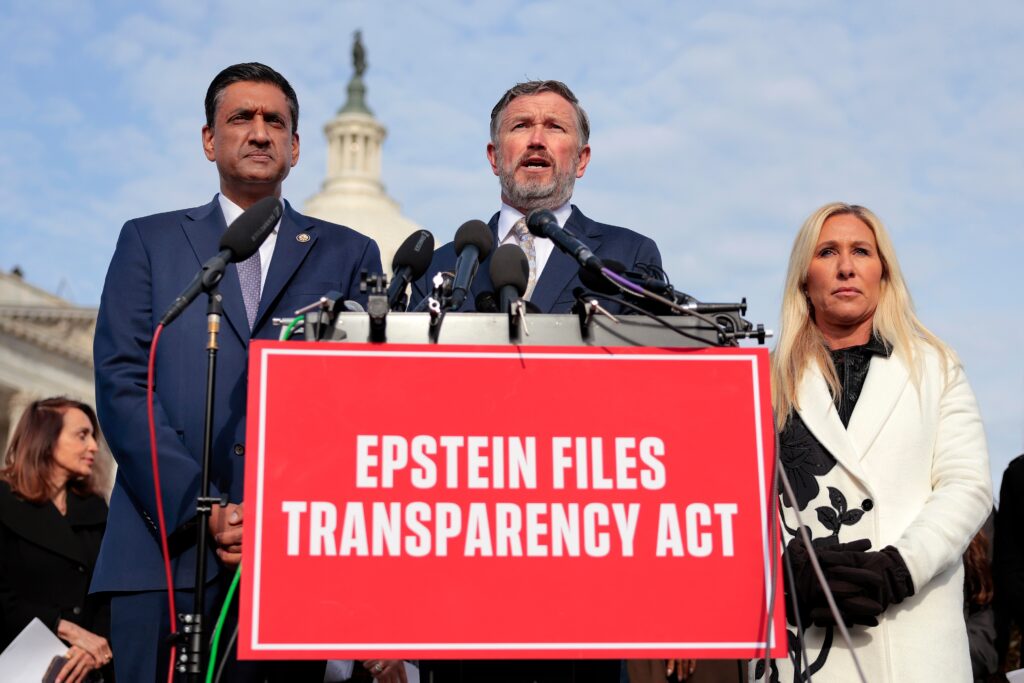
That didn’t concern Higgins’s colleagues with fancy law degrees. They stampeded to pass the Epstein Files Transparency Act, which requires the Justice Department to release any information in its possession — real or fake, confirmed or unconfirmed — related to the notorious sex offender Jeffrey Epstein, who died in jail in 2019. The Justice Department also has to publish any material, again regardless of its veracity, about anyone “referenced” in legal proceedings involving Epstein, and any “entities” with “ties” to Epstein’s “networks.” The bill authorizes redactions for information that could identify victims or interfere with current investigations.
Needless to say, the Justice Department is not set up for document dumps. It’s set up to investigate crimes, build cases and punish those responsible. But now Congress’s herd of independent minds has ordered the department to toss its records into the political maelstrom, overriding grand jury secrecy and witness expectations of privacy. The result so far is an inconclusive muddle that has predictably satisfied no one. Consider what this pursuit of “transparency” has accomplished so far.
First, it has waylaid massive Justice Department resources. As The Post reported, “The laborious process to review and redact what may be as many as a million pages of documents has required about 200 attorneys from the Justice Department’s National Security Division to work around-the-clock since Thanksgiving.”
Second, it has amplified new myths. One unlikely account sent in after Epstein’s 2019 arrest says, “I was taken to an underground location … I was kept in a stall, it looked like a horse stall.” The fact that the email appears to be completely unverified doesn’t stop it from being circulated online with the imprimatur of the “Epstein files.” The New Yorker published an article describing a letter in the files purportedly sent by Epstein to imprisoned sexual abuser Larry Nassar. The forged letter made reference to President Donald Trump. The New Yorker acknowledged that it was probably fake, but averred: “The case for this President’s indecency hardly requires putting a dubious letter into evidence.” How’s that for a drive-by smear?
Third, the Epstein document dumps are probably making it harder for authorities to prosecute similar crimes in the future. As former federal prosecutor Elizabeth Geddes wrote in the New York Times last month: “Informants often demand confidentiality before speaking with investigators, fearing reputational harm and retribution from the accused. Wholesale disclosure of the Epstein files will discourage potential informants in other high-profile cases, prompting them to question any assurances that their information will be treated as confidential. Investigators and prosecutors, too, will second-guess every step they take if they believe that their files might be broadly disclosed, leading to long investigative delays and the termination of some investigations before they even begin.”
At least one woman who reported Epstein to the authorities was inadvertently identified in the Justice Department’s releases, according to CNN. Meanwhile, the department is being attacked for not releasing the files fast enough, but reduced vetting to accelerate the process would make such slips more likely.
As for previously unknown participants in Epstein’s crimes, none have been identified. If the Justice Department had enough evidence to prosecute others, it presumably would have done so (either in Attorney General William P. Barr’s Justice Department, or Merrick Garland’s, or Pam Bondi’s). If other people are now under criminal investigation, their identities can be withheld for that reason, per the legislation. So if anyone’s reputation is tarnished in this process, it will most likely be for noncrimes. It’s hardly a great achievement for Congress to repurpose the mighty FBI and Justice Department as vehicles for tarnishing reputations rather than charging crimes (as tempting as that might be if the people tarnished are political opponents or generally unsavory).
That brings us to the fourth achievement of the Epstein files’ release. As journalist Michael Tracey has noted, the spectacle has given the legislation’s authors — the ambitious Rep. Ro Khanna (D-California) and his Republican sidekick Rep. Thomas Massie (Kentucky) — more opportunities for political exultation. Khanna thundered on television that the American people want to know whether the system is “so corrupt that Thomas Massie and you defy the odds, pass a bill through a discharge petition, get the Senate, get the president to sign it, and still these rich and powerful people are being protected.” He added, doing his best impression of professional conspiracist Alex Jones: “Who has this kind of hold on our government? What are they hiding? Why are they not releasing this?”
Again, it’s entirely predictable that the release of more Epstein information would do nothing to temper the fixation and would in fact intensify it. Most conspiratorial thinking is kept in check not by disclosure but by the fact that only one party pushes any given conspiratorial idea to its extreme. In Trump’s first term, Republicans pushed back on liberal conspiracy theories about Russia somehow sexually blackmailing Trump, while Democrats pushed back on Trump’s election-fraud claims. But the notion of a vast cover-up of Epstein-related criminality has been nurtured by the right and left alike for political gain, so there’s no longer any penalty for joining the mania. The only thing worse for getting at the truth than partisanship is conformity.
The post The Epstein files fiasco was completely foreseeable appeared first on Washington Post.