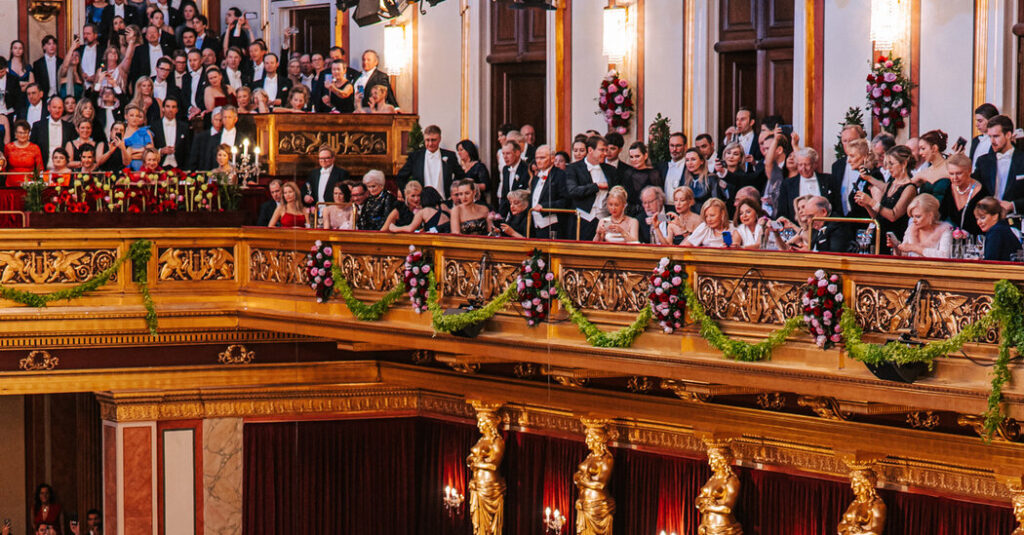
It’s all a waltz. A few weeks after the Vienna Philharmonic performs its New Year’s Concert at the gilded Musikverein concert hall, people of all generations gather in the same venue for the orchestra’s annual ball.
Vienna hosts an estimated 450 balls across the city, such as the lavish Opera Ball and the more recent HipHop Ball, in a season that stretches from November to February each year. The Philharmonic Ball, with brass fanfares for guests of honor and debutantes twirling in custom-made tiaras, ranks among the most esteemed.
At the next dance on Jan. 22, Daniel Harding will conduct a program including works by Tchaikovsky and, naturally, Johann Strauss II, who went down in history as the “waltz king.” While the orchestra’s last ball celebrated Strauss’s bicentenary, the theme of the upcoming edition will be fairy tales.
Balls are not just places of diversion but an important economic driver of the city, supporting local businesses such as hairdressers on site to fix a collapsed chignon and the family-owned dance schools that train the debutante couples. The 2023-24 season broke previous records with 560,000 attendees, 30,000 of whom were tourists. The average guest spent 330 euros ($388) on the evening, generating some €185 million in profits. In 2020, it was estimated that some 20,000 bottles of wine, prosecco and champagne are consumed over the course of the season.
The festivities are key to understanding a city defined by imperial architecture, rich pastries and pre-modern elegance. When the dance master declares “Alles Walzer” (“It’s all a waltz” or “Everyone waltz!”) after the debutantes open the evening in a choreographed procession, the guests of the Philharmonic storm the floor of the Musikverein in white tie and floor-length gowns.
Vienna’s balls have become increasingly international destinations as more tourists attend and debutante couples arrive from as far as the United States and Japan. At the Philharmonic Ball, 180 young couples auditioned to open the next ball, and only 80 could be accepted.
Paul Halwax, a tubist with the orchestra who has served as the ball’s organizer since 2015, said that he strives to bring the event “into the current age — with old values, but still new.” In addition to the main dance floor, there are rooms downstairs with an Austrian folk music band and a D.J. who plays a range of contemporary fare.
The next event will additionally bring performances by La Philharmonica, a six-person group of female players from the Philharmonic, and the seven-person ensemble Philharmonix, which brings together select members of the Vienna and Berlin Philharmonic orchestras in experimental programming.
“I hope that the gold flakes off the caryatids and the ceiling” of the Musikverein, Halwax said. “That’s how things need to be heated up.”
He pointed to the ball as an important opportunity to have open conversations with audience members about former programs, conductors’ debuts and more.
Ball season reaches its height in January and early February, echoing the original timeline of carnival festivities. Since the Middle Ages — and even today in the Austrian countryside and other Catholic parts of Europe — masked processions have served as entertainment during the dark weeks of winter.
In Vienna, however, such loud public gatherings were outlawed in the 18th century, by the Empress Maria Theresa. “Celebrations moved from the streets into people’s homes, where people danced,” said Michaela Lindinger, an author and curator at Wien Museum. Instead of carnival revelry, which “originated to drive winter away,” she said, “we enjoy ourselves in bright ballrooms.”
Ball culture became synonymous with the city in 1814, when numerous balls took place during the Congress of Vienna, organized to restore order to Europe following the defeat of Napoleon. The dances provided respite between protracted political negotiations, but also became venues for important private conversations.
Though the waltz was first danced by commoners in taverns outside the city, Lindinger explained, it had been adopted by the nobility in a tamer form by the mid-19th century.
In the second half of the 19th century, coinciding with the rise of Johann Strauss II to international fame, new balls emerged that reflected the growing social influence of wealthy families that were beginning to rival the old aristocratic establishment.
Lindinger pointed out that while members of the moneyed middle class mingled with aristocrats at these “grand balls,” only a fraction of the city’s population would attend. “Only two or three thousand people were invited,” she said, noting that the city’s population would soon more than double to over two million inhabitants by the turn of the century.
A stock market crash that threw fortunes into disarray in 1873 provides the backdrop to Strauss’s most famous operetta, “Die Fledermaus,” which unfolds on the night of a New Year’s Eve ball. The work, with its romantic escapades, champagne-induced inebriation and nostalgia for a more stable time, remains the ultimate embodiment of what the scholar Camille Crittenden has in a 2000 book called a mood of “nihilistic gaiety” — one that still rings true of ball culture today.
The Philharmonic Ball was founded in the aftermath of a different economic downturn, first taking place in 1924, when a currency reform was introduced to counteract inflation and broader instability after World War I. “Now that some people at least had money again,” explained Lindinger, “one organized a beautiful, expensive ball.”
Among the first group of debutantes was Alma Rosé, the daughter of the Philharmonic’s longtime concert master, Arnold Rosé. In 1944, she would die in Auschwitz.
While today’s balls are organized by everyone from hunters to coffeehouse owners, those in the Musikverein and the State Opera remain “something for the cultural elite,” Lindinger said. “Many Viennese weren’t born in Vienna. It’s completely foreign to them, and they’re not interested.”
For those with an affinity for the history, however, the Philharmonic Ball provides an occasion to celebrate the elegance and tradition that define the orchestra. Every year includes the performance of a fanfare Richard Strauss composed for the inaugural edition in 1924, and descendants of the composer continue to attend. Other notable past guests include Jamie Bernstein, daughter of the composer and conductor Leonard Bernstein, and the daughters of the Austrian conductor Herbert von Karajan.
This year, Joey Schoenberg, the 21-year-old great-grandson of the Vienna-born composer Arnold Schönberg, will be among the young couples to open the ball. He is the first member of his family to be present.
Schoenberg, a Los Angeles native, said that debuting in the Musikverein, where the 150th anniversary of his ancestor’s birth was recently celebrated, held personal importance given that his family was forced into exile by antisemitic Nazi policies. “It’s in a way reclaiming history, but it’s also just fun,” he said.
Schoenberg, who holds Austrian citizenship, said that while participating in the ball was not necessary for his family “to feel whole again,” he also believed that his great-grandfather would not disapprove.
Halwax admitted that at a time when things “are not exactly rosy” amid unresolved wars and an energy crisis, people needed an occasion to melt their cares away. “I don’t want to quote Johann Strauss from ‘Die Fledermaus,’” he said with dry irony, “but ‘happy is he who can forget what cannot be changed.’”
The post Inside Vienna’s Ball Season of Waltzes and White Ties appeared first on New York Times.