SEOUL — On a bustling Saturday in the South Korean capital, shoppers filed in and out of a clothing store that would cause any jet-setter over a certain age to do a double take. Pan Am — at one point the dominant international airline in the United States, before its bankruptcy in the 1990s — was recognizable by its bright blue globe-shaped logo. Or was it?
Outside the store, Sang-ji Lee, 26, said the clothes “look comfortable, so I wanted to try them,” but she wasn’t sure what theme the store was going for. It made her think of outer space, she said. Ryusei Tanaka, 30, who had just purchased a Pan Am T-shirt, described the brand as “unique” and “stylish” and said the logo reminded him of a basketball. The company’s past life as a pioneer of global aviation was all but lost in the trendy, Instagram-ready interior.
Inside, there were few travel-related products: Instead, in an exposed concrete interior, Pan Am-branded purses lined shelves and $130 windbreakers hung in neat rows. “Departures,” read one sign over the register, but the closest shoppers got to aviation were faux airplane seats.
It’s not just Pan Am. In South Korea, an array of American companies that have little to do with fashion have been resurrected or reinvented as sleek clothing companies — all with a K-beauty glow-up. In this surreal afterlife for brands, one country’s defunct airline can become another’s fashion statement.
South Korea’s National Geographic stores, for instance, do not appear to have print magazines for sale — but they do stock some of the country’s most popular winter coats. The Discovery logo is more likely to be seen on shoes strutting the streets of Seoul than on a TV screen. Even Lockheed Martin, the aerospace and defense company, has a South Korean line, though the only arms on display on its website are those revealed by a stylishly rolled-up T-shirt.
South Korean consumers’ long-held preference for international brands has allowed “Korean companies to accumulate extensive experience in the localization process,” Jin Joo Ma, a fashion professor at Hongik University in Seoul, said in an interview.
Yet what stands out about these reborn fashion brands in South Korea is the degree to which the original product has been divorced from the new one. To Ma, this can be an asset rather than a drawback, as “this uniqueness adds an intriguing appeal for consumers,” she said. “Young consumers in Korea do not perceive fashion merely as clothing. Instead, they view it as a form of self-expression that reflects their lifestyle.”
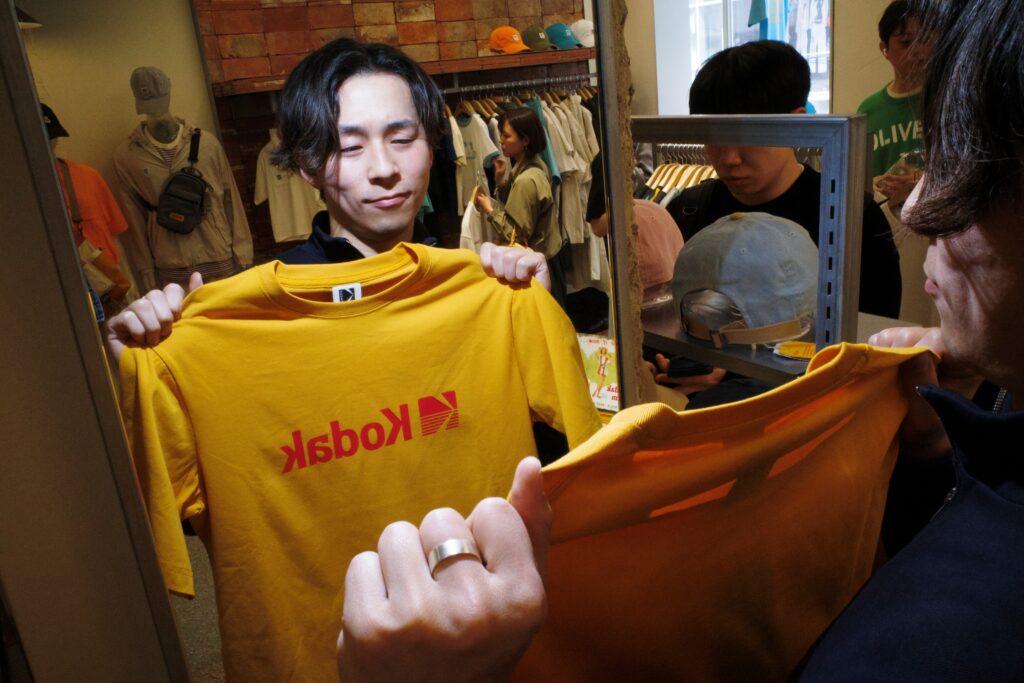
There could be an aspirational component in a country where attending an elite university is viewed as the key to a successful career: The Yale brand once ranked higher than Adidas and Nike on Musinsa, a prominent fashion platform, according to local media reports, while UCLA and Columbia University have brick-and-mortar fashion outposts in Seoul. Ma even recalled one friend commenting that it seemed like a lot of Koreans went to Harvard — another name popularly seen on apparel. Or people who like photography may look to clothing featuring a storied brand in the industry, such as Polaroid or Kodak.
Kodak operates an extensive global brand licensing program, Clara Fort, vice president for global brand licensing at Eastman Kodak Company, said in an email. South Korea represents a “particularly significant market,” she said, with about 120 stores across the country and a comprehensive apparel line that aims to appeal to a broader audience while maintaining Kodak’s “strong association with its heritage in imaging and technology.”
The companies behind the Pan Am, National Geographic and MLB brands did not respond to a request for comment in time for publication.
Ma said she finds clothing from a licensed version of Billboard especially interesting, given the way K-pop has taken off globally. “Nowadays Korean pop idols have been successful in the Billboard charts. So I think that’s one of the reasons why Billboard aimed to expand their marketing and launch the fashion line in Korea too,” she said.
Borrowing a brand from abroad can also have financial benefits, she notes. “Paying royalties to access an established brand name, logo, identity, concept and archival asset rather than investing heavily in developing a brand from scratch can significantly reduce the time and financial investment,” Ma said.
Kyunghee Pyun, a professor of art history at the Fashion Institute of Technology in New York, echoed the sentiment. “If you start a new brand, it’s very difficult to get into the department store,” she said. “But if you have the license, the name, you can have a better marketing strategy.”
Pyun traces the prevalence of companies seeking these licenses to South Korea’s history of garment manufacturing and well-developed supply chains. Their success, she says, should be credited to entrepreneurs such as Young-jun Park, who brought the National Geographic brand to South Korea. “These people are world-class salespersons,” she said, adding that their curation of overseas brands has added cultural cache to what are already high-quality products.
This approach goes back at least as far as 1997 with the launch of MLB Korea, which sells clothing emblazoned with logos from U.S. baseball teams in fashion-forward designs. Its management company describes it as “one of the ‘pioneers’ in bringing sports closer to the masses through fashion,” and it has since opened stores around Asia. In the 2024 fiscal year, F&F Co., the company that owns MLB as well as Discovery, brought in about $1.3 billion in revenue.
NBA and NFL brands also popped up in South Korea, though there have been some local media reports suggesting the trend is cooling down in the face of an overcrowded market and consumer preferences shifting away from prominent displays of brand names.
Pyun noted that there is a significant contrast in the performance of brands such as South Korea’s Kolon, which sells generic-brand outerwear, and licensed brands such as the Korean licensor of National Geographic, which has expanded to China and Taiwan.
National Geographic makes “cute logos and all kinds of gear, right? But those kinds of gear easily could have been made by Kolon,” she said. Kolon hasn’t seen the same kind of popularity, though, suggesting “marketing the generic brand to the Korean audience is not working.”
Pyun said it’s not necessarily a bad thing that the brands have been separated from their original purpose. Such revivals have benefits, giving historic designs — such as the Bauhaus-inspired Pan Am logo — a chance to see the light again, she said.
And brands shift meaning all the time. She pointed as an example to a certain ubiquitous brand of tote bags: “I mean, in the world, how many people read the London Review of Books?” Still, “as a historian, it bothers me,” she admitted.
Many of these heritage brands lean into their history, even if it’s a cosmetic nod. On their products, Billboard and the Brooklyn Museum prominently display the years they opened. The walls of the Kodak store in Seoul’s trendy Seongsu neighborhood are lined with old advertisements. And some shoppers in that area suggested that South Korea’s interest in old brands follows on from the widespread popularity of vintage clothing.
Much like fashion sense, the effectiveness of this approach comes down to the individual. When Hyeonji “Lizzie” Lee, 31, recognized the Kodak logo on the store in Seongsu, she was brought back to her college days studying photography and was excited to stop inside and pick up a camera for an upcoming trip to Japan. The Kodak name is everywhere in the store, on shirts and hats — but she didn’t immediately see any actual cameras for sale. Lee was disappointed, “because my expectation is film, not clothes,” she said.
But Linyu Chu, 38, and Ke Yu-ching, 40, who were visiting from Taiwan, had a different perspective. After hearing about the store on social media, they came by and bought a T-shirt.
The long legacy of Kodak sparked their curiosity, Chu said. “We know this is an old brand, and we wanted to see, do they have anything new?”
The post How Pan Am and Kodak turned into fashion brands, with a K-beauty glow-up appeared first on Washington Post.