SPOKANE VALLEY — Verónica García woke up, as she always did, on the floor. Her head hurt. Her stomach cramped with hunger. It was the morning of her first race of the season, and she had longed the night before to carbo-load with Olive Garden breadsticks, but her family didn’t have money for that. Instead, the 17-year-old had cooked the only substitute she could find — a quarter-pack of spaghetti with no sauce.
She nudged her school-issued laptop awake and searched: “Washington State transgender athlete.” A TV station was reporting that a school district two hours south had filed an “urgent complaint,” asking President Donald Trump to keep Verónica off the track.
“This male unfairly competed last year,” the complaint said. “Not only does his current inclusion in the 2025 season directly violate Title IX and President Trump’s Executive Orders, but it is also ‘demeaning, unfair, and dangerous’ to the young women with whom he competes.”
Verónica shifted on the thin pad where she slept and considered her frame. Dangerous? She was 5-foot-7 and skinny in a way that concerned her coaches.
“I’m a twig,” Verónica told her mother, Traci Brown. “Who could I hurt?”
Brown nodded, then closed her eyes. She and her other daughter were half asleep in the one bed the family owned. The three of them lived in a studio apartment, so they did everything — sleep, shower, dream of a different life — within a few feet of each other. But they didn’t talk much.
Verónica looked at the awards she had hung on the wall. She won most of them at small-town events. Last year, she earned her first big medal — the 2A Washington state championship in the girls’ 400 meters. The win had changed her life, but not in the ways she had hoped. Colleges had not sent her scholarship offers or letters of interest. Her high school had not listed her on its wall of champions. All she had to show for that win was a gold medal and a growing list of people around the country who wanted to take it away.
She reached into a cardboard box she used as a headboard and pulled out two expired power bars. They would have to last her until dinner. She slipped on her black and green track uniform, and clipped a bow around her wavy, brown ponytail. She added three beaded friendship bracelets her teammates had made to commemorate her senior season. Then she found a bare patch of floor and performed what she considered “a very important ritual.”
She swayed and threw her arms into the air as Lady Gaga’s “Abracadabra” played from a disconnected phone. When the song ended, Verónica exhaled and did her best to pretend she wasn’t nervous.
“Okay,” she said. “I’m ready.”
For the last 10 months, some of the country’s most powerful people had talked about girls such as Verónica as if they were a threat to all women. Former college swimmer Riley Gaines posted videos of her online, and some of Gaines’s 1.6 million followers said Verónica was a cheat who should be arrested. Two dozen states had banned girls like Verónica from competing. Even prominent Democrats echoed public surveys that showed two-thirds of Americans believe transgender women have an unfair advantage competing against female athletes.
But sports were never fair, Verónica thought as she rode a school bus to a track across town. The swimmer Michael Phelps had an unusually long wingspan, and Brittney Griner towered over the WNBA. Once upon a time, Verónica had had higher testosterone levels than other girls, but she wasn’t sure that was the case anymore. Even if it were, she knew plenty of girls who had advantages she did not. Some hired personal trainers. Others had the kind of expensive shoes that can help propel runners ahead of their competition. Her own shoes were donated and two sizes too small.
Today would be the first time in nine months that she would race against her toughest competitor, a junior named Lauren Matthew. Lauren was one of the best athletes in Eastern Washington. She played soccer for a nearly undefeated team. She raced club track in the summers. And she had finished just behind Verónica at the 2024 state championships.
Now, it was a Saturday in late March, and few people had come to watch their first rematch. Lauren and Verónica crouched into position one lane apart, but they didn’t look at each other. A gun fired. They bolted out of their blocks, and suddenly, Verónica wasn’t hungry or afraid. She ran with the kind of joy she only felt in competition, and when she and Lauren crossed the finish line, the scoreboard showed they had both clocked personal records — 56.65 seconds for Lauren, 55.23 for Verónica.
Verónica rolled to the ground. She knew those 55 seconds would be the happiest she would feel all month. Other girls had cellphones and bedrooms. They had mothers who never missed a meet, shoes that fit, bodies that felt like theirs. Verónica had none of that. All she had was running.
“That’s a whole ass man and a half,” a student spectator yelled from a fence 10 feet away, where half a dozen girls had gathered to heckle Verónica. “That’s an it.”
“What was it doing on the track?” a tall girl in a hijab said. “Riley Gaines said he switched to the girls team just so he can win.”
Verónica knew she could tell those girls how wrong they were about her life. She only wanted to belong somewhere, and she wanted to do that as herself. But she would discover over the coming season that to do so, she would have to endure increasing notoriety and the abuse that came with it. She and Lauren, who did not respond to requests for an interview, would meet again and again on the track. Legal challenges against trans athletes around the country would move ever closer to the Supreme Court, which will hear oral arguments in cases from Idaho and West Virginia in January. None of those things — the fierce competition, the public opposition, the looming court decision — would be the toughest thing Verónica would face. That would come months after her final meet.
Looking for a team
Before Verónica ran, she drifted.
She was born in California to a White mom and a Mexican dad, but her father returned to Mexico soon after she was born. Verónica and her mother shuffled between apartments, eventually living in rural Idaho with a stepdad. After he died in the fall of 2020, they moved to Spokane Valley, a small suburb near the Idaho border, where they reunited with Verónica’s half-sister, Briana.
Those lockdown years were tough for most young people, but for Verónica, they felt especially isolating. She was 13, new to a town where she had no way to make friends, and her body felt all wrong. It seemed blurry, disconnected.
When Washington state schools reopened in 2021, a teacher in freshman P.E. told Verónica she possessed a natural athletic ability. He suggested she join a team.
Verónica worried she wouldn’t be good at sports, but she was lonely. Her sister was eight years older, and her mom worked long hours at blue-collar jobs. A team sounded nice, Verónica thought. Maybe she would make friends.
The first time she ran the 5,000 meters on the boys cross-country team, she came in 417th place. She had fun, though. She felt as fast as a fire engine when she jogged through the woods, and later, after she joined the track team, her male teammates didn’t say anything when she ran in a skirt. She almost felt like she belonged, but she knew she wasn’t one of them.
After the track season ended, Verónica asked her doctor if she had some kind of chromosomal disorder. She had gone through puberty, but her hips widened like a girl’s, and her face was almost perfectly smooth. Her mind felt like a girl’s, too, she confessed. The doctor asked Verónica if she thought she might be transgender, and something inside her sharpened. That was it.
Verónica let her hair grow, and she tried out a few girl names, but she did not make any immediate medical decisions. A few weeks later, she decided she wanted to run with the girls her junior year.
Washington has allowed trans girls to compete in all-girls sports since 2007, when it became the first state in the nation to pass a trans-inclusive policy. Verónica was born that same year.
Still, she was nervous as she approached her coaches at the end of June 2023. While Washington is a liberal state, Spokane is conservative. At least half the cars parked outside her apartment complex had Trump stickers, and she knew several girls on the team were Christians. What if they didn’t want to run with her? No one had ever made a big fuss about the policy, but then again, Verónica knew, they had never had a reason to. In nearly 20 years, a trans girl had never won a Washington championship.
Verónica wore a dress and a small, paper trans flag to talk to the girls’ coach. Her legs shook. Her voice broke, and her heart jumped around. She knew the coach couldn’t legally turn her away, but she was 15 and worried less about the law than what people thought of her.
“I’m trans,” she told the coach.
The coach, a former Division 1 runner who had won several championships, was not surprised. She handed over the summer workout plan and told Verónica she would see her at practice.
For most of her life, Verónica had struggled with depression. But joining the girls team eased that feeling. She wanted to go to school. She stayed late to run with her teammates, and her world felt much bigger than it had before.
She shaved more than five minutes off her 5,000-meter time. In November, she finished in 13th place at the cross-country championships. She was so proud, she tacked the medal to her wall.
In the early months of 2024, between the cross-country and track seasons, with her mom’s blessing, Verónica asked her doctor if she could start medications to suppress her testosterone and boost her estrogen.
The doctor warned that the pills would probably slow her down. Her muscles might atrophy. She might never place any higher than 13th. Verónica told him she didn’t care. She wanted to be herself more than she wanted to win.
When the track season started a month later, Verónica signed up for the 400 meters. In the beginning, she was a good sprinter, but not excellent. The fastest high school girls in the nation regularly run 400 meters in 52 seconds or less, and a Washington student once ran it in 53.83 seconds. It took Veronica closer to a minute.
All winter, she ran along the Spokane River until her legs ached. Her time didn’t budge. By May, when the state championships began in Tacoma, she still hadn’t cracked 58 seconds. She figured she had no shot at winning, even in one of the state’s smaller divisions.
But as she sprinted off her block at the championships, she could tell she was moving quicker than she usually did. She felt completely spent as she finished, but she didn’t know until the announcer read her time just how fast she had gone: 55.75 seconds — the fastest girl time of the day. Verónica felt “absolute joy.” She was a state champion.
When the announcer called Verónica to the podium, the crowd went silent. It’s like I’m a phantom, Verónica thought. Invisible.
“She’s not a girl,” someone shouted.
A few hours later, Riley Gaines posted video footage of Verónica’s race. “Would you look at that,” Gaines wrote. “In Washington & Oregon this past week, the fastest ‘girl’ in the each state has been a boy.” (sic)
Gaines has been an outspoken critic of trans athletes since 2022, when she tied for fifth place with trans swimmer Lia Thomas at the NCAA Division I championships. She has made exposing trans athletes her career.
Verónica did not find out about the post until she returned to school. By then, more than a million people had viewed it, and Fox News had aired a story. Hundreds of adults had commented. They called her “disgusting” and “reprehensible,” a “loser” who should be sent to an asylum.
As Verónica scrolled, she knew she would never feel invisible again.
A looming ban
Footage of Verónica and other trans athletes appeared online over and over in the fall of 2024. As the presidential election neared, Republican candidates spent more than $215 million on network TV ads that targeted transgender rights, at least $111 million of which mentioned sports. By then, nearly two dozen states had partnered with right-wing groups to bar trans girls from sports. Critics argued that female athletes had fought to have their own, equal playing fields and that lawmakers have a duty to protect them. They called trans girls “biological males” who have inherent and irreversible physical advantages.
For many Americans, that argument was persuasive. By the time Trump won a second term, two-thirds of Americans believed trans girls and women should not compete against cisgender ones. Most arguments made in statehouses around the country suggested transgender women have an inherent edge: People who go through testosterone-fueled puberty are, on average, taller, stronger and faster than people who undergo estrogen-dominant puberty.
But the science might be more complicated than what feels, to many voters, like common sense. While some trans women remain tall and deep-voiced, their athletic abilities change as they undergo gender treatments. A 2020 study of 46 trans women who began taking testosterone-blockers and estrogen while in the Air Force found that after two years on hormones, the trans women could no longer do as many push-ups or sit-ups as men. They could only do as many cis women. They also ran slower than they had before they transitioned, but they still ran 12 percent faster than cis women.
And last year, the International Olympic Committee released a groundbreaking study that showed trans female athletes who suppress their testosterone and take estrogen retain a few advantages over cisgender women, but their bodies also change in ways that leave them unable to perform as well as their competitors. The study, which tested 75 cis and trans athletes, found that trans women did have better grip strength than cis women. But they also couldn’t jump as high or breathe as easily as cis men or women — key skills for track-and-field athletes.
Verónica hoped the research might calm her detractors, but she knew the science wasn’t conclusive. The Olympic and Air Force studies are two of just a dozen that have tested trans women’s athletic performance, and most of the others tested fewer than 20 athletes. None looked at adolescents.
Trump seemed to have no interest in resolving the scientific debate. Instead, he cut funding for research into LGBTQ issues, and he made good on a campaign promise. The first week of February, on National Girls & Women in Sports Day, he signed an executive order he called Keeping Men Out of Women’s Sports.
When Veronica made it home that day, she pulled up footage of Trump’s announcement. Her mom was at work cleaning hotel rooms, and her sister was away, too.
“You’ve been waiting for a long time for this, haven’t you?” Trump asked the crowd gathered in the White House. “So have I.”
Verónica groaned. The president had been in office less than a month, but already he had signed executive orders to ban her health care and to bar trans people from joining the Army National Guard, which had been her goal. Now this.
Gaines stood behind the president, and a crowd of young girls in sports uniforms ringed the podium.
“I wanna make this a really good signature,” Trump said, “because this is a big one.”
The next morning the NCAA said it would no longer allow trans athletes to compete. Verónica had yet to receive a single call from a college recruiter, and now, she realized, she probably never would. Two weeks later, Trump threatened to cut off Maine’s federal funding because a trans teenage girl had won a pole-vaulting event there. In March, a few weeks before the track season began, the U.S. Department of Education opened an investigation into a Washington state school district five hours west of Verónica’s because it had allowed a trans girl to join a junior varsity basketball team.
The trans basketball player at the center of that investigation told a conservative pundit she had never taken hormones and wasn’t sure she ever would. Verónica watched the interview and felt the girl wasn’t being fair to her competitors. If she wasn’t suppressing her testosterone, as far as Verónica understood it, that meant she did have an advantage.
Her situation was different, Veronica thought. She had taken medication, and so she hadn’t retained whatever hormonal advantages she might have had. But the president didn’t seem inclined to consider athletes on a case-by-base basis, and Verónica wasn’t sure her state could afford to defy the president. The state superintendent told reporters that fewer than 10 of Washington’s roughly 250,000 student athletes are trans. Would state leaders really risk more than a billion dollarsjust to let a few kids play?
By the time the track season started, Washington officials still hadn’t commented. Verónica felt scared and a little burnt out, but she decided she would compete if the state let her.
Veronica had beaten Lauren that first race of the season, but she lost her second event of the day — an 800-meter sprint — by 19 seconds. A few weeks later, she ran one of the slowest 400 meters she had ever raced. Meanwhile, the campaign against trans athletes was picking up speed.
In April, two school board members from another Washington district went on Fox News to denounce Verónica and remind Trump of the pending “urgent complaint.” Soon after, one of the nation’s largest conservative legal groups began representing two girls who wanted to file their own complaint. That same day, Trump created a new team to investigate trans athletes.
Verónica waited for her governor or attorney general to say they would sue to protect trans athletes, in the way they had fought other executive orders. She wrote letters to state representatives and read the news every morning, but all of April and most of May went by, with no one challenging Trump.
Maybe, Verónica thought, her elected officials were lying low. Maybe their silence had kept Trump at bay. But as the state championships began in Tacoma the last weekend in May, she found herself hoping someone would stand up for her.
A championship rematch
More than 10,000 people bought tickets for the season’s final meet. Everywhere Verónica could see, people were eating hot dogs and Hot Cheetos, popsicles and bowls of macaroni piled high with what looked like barbecue pork. She had only eaten a few packets of Spanish rice that week.
Verónica longed to do what every other teenager was doing. She wanted to frolic. But the country’s attitude toward trans people had become increasingly hostile, and Verónica’s school leaders didn’t want to risk anything happening to her. She could not wander the stadium or eat tacos on the sidewalk. All she could do was hide and wait to run.
On the day of the final, while four middle-aged women protested outside, Veronica’s coach ushered her into the stadium through a side entrance.
“We’re not here to pick on him specifically,” a woman said as she passed out pink “Girls deserve fair sports” bracelets. “It’s not my fault he’s been lied to. We’re here to stand up for girls.”
Inside, boys whooped and jumped into each other’s arms when they crossed the relay finish line first. Girls cried, found their parents and cried some more. Verónica sat in the stadium and imagined her race as a raging wildfire she had to confront.
At the starting line, Lauren stood ramrod straight and powerful. Two lanes away, Verónica’s legs trembled. She took half a dozen deep breaths, then positioned her feet. Someone in the crowd screamed, “That’s a boy.” Verónica put her hands on the track.
The gun fired. Verónica’s French braid swung in the wind, and her toes curled inside her too-tight shoes as she overtook one runner, then another. No one was ahead of her as she reached the final 100 meters, but she could feel Lauren closing in. Verónica pushed herself until she thought her limbs might fly off, then she spilled over the finish line.
She gasped for air and looked at the clock: 55.70 seconds. Not the meet record or her own PR, but good enough for first place. Lauren, again, had run a second slower.
Verónica hobbled into a scrum of reporters. She told the Spokesman Review that Lauren ran a great race. “I honestly couldn’t do this without competition,” Verónica said. “Miss Matthew, I think she really pushed me.”
Lauren viewed their race differently.
“I shouldn’t have to push myself to the point of where I’m about to, like, die in order to win,” Lauren told the reporter. “I don’t want a man pushing me to have to go.”
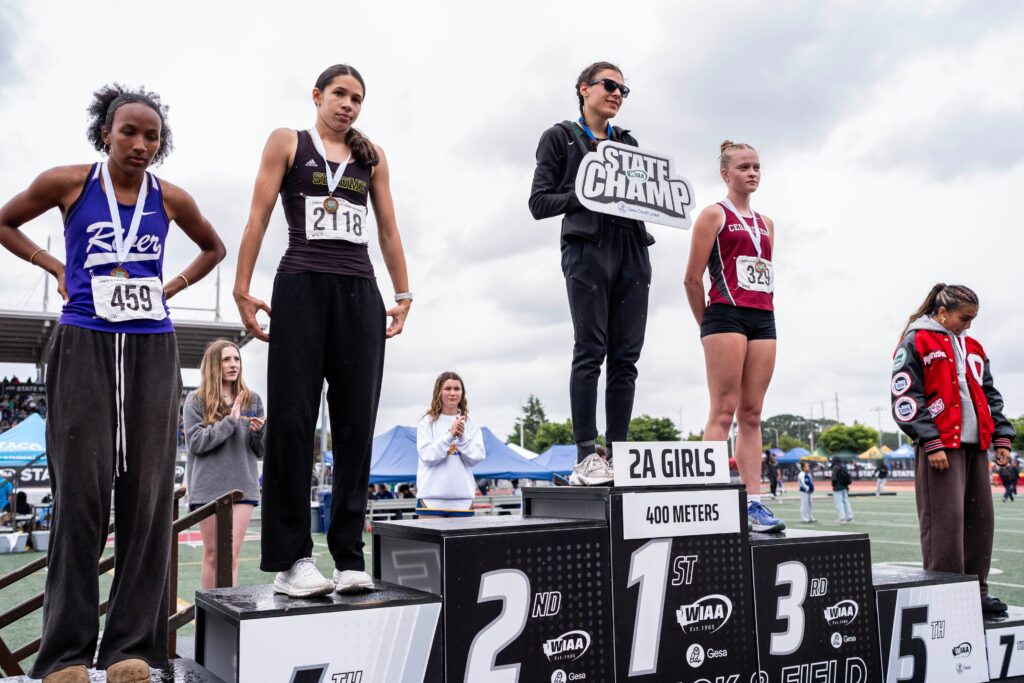
Verónica clapped as the announcer read each medal winner. Girls from Bainbridge and Sehome and Cedar Crest took their spots on the podium. When the announcer called Lauren, the crowd roared, and Verónica clapped, but Lauren’s second-place spot remained empty.
“And in first place,” the announcer said, “your 2025 winner, in a time of 55.70 from East Valley in Spokane, Verónica García.”
The crowd booed loud and long. Teenage boys yelled that Verónica should “get out,” and none of her fellow competitors clapped. Verónica pulled her shoulders back, climbed the podium and smiled.
The crowd booed again when Verónica’s relay team finished third, and later, thousands of people did their own kind of booing online. They called her cuss words and said she should be taken to jail. Verónica read every comment. The one that hurt the most was a picture Gaines posted of Lauren. While Verónica collected her medal, Lauren had carried a sign to the top of the stadium.
“Washington State track and field REAL GIRLS 2A 400m CHAMPION,” it said.
Verónica longed to ask Lauren what she thought a real girl was. Biology suggests it’s far more complicated than chromosomes, Verónica knew, but she suspected she would never change anyone’s mind about that. At the final awards ceremony, an entire team took the stand wearing “Keep women’s sports female” T-shirts.
Verónica rode the bus home. She hung her medals and her bib number, then she lowered herself onto the floor and fell asleep.
The harder road
A few days after the state championship, Verónica washed her uniform and returned it to the school. This was the hardest moment, she thought. Harder than listening to people boo her. Harder than watching the president call girls like her cheaters. She handed in the uniform, and she knew her time as a competitive athlete was over.
All season, she had mostly kept her thoughts to herself, but the day after she turned in her uniform, she decided to write an official statement about her final season.
“I didn’t dominate the race,” she wrote on Instagram. “I only started taking the lead the last 170 meters.”
She hoped the statement might reach some of the people who had bullied her. It was okay if they didn’t want her to race, she wrote. They were free to write op-eds or contact their senators, but it hurt and scared her when they called her slurs. She hadn’t broken any rules. She was suppressing her testosterone.
“Like 605 girls could easily whoop my ass,” she wrote. “(I’m ranked 606th nationally.) My time, while fast, isn’t some magical number that cisgender girls couldn’t reach.”
She didn’t experience peace, exactly, as she wrote it, but she did feel calm. She had defended herself, let out a little venom, and she hoped that was that.
A week later, a member of U.S. Congress appeared on the House floor to accuse Verónica of stealing Lauren Matthew’s medal. Republican Rep. Michael Baumgartner, whose district includes Spokane, brought a portrait of Lauren to the floor of the House and declared that she was the “rightful” winner of the race. Verónica’s victory, he said, was a “betrayal of the young women who dedicate themselves to excellence through hard work and training.”
Verónica told herself she had also dedicated herself to excellence. She had trained hard, and she had done so without a bed or good shoes or even enough food.
No one mentioned her win at graduation. The school leaders didn’t add it to the list of athletic achievements they keep posted on a wall outside of the gym. Even people at the community college where she enrolled to study fire science told her there wasn’t a spot for her on their teams. She felt as if she were a bad memory everyone wanted to forget. But then, in mid-June, Washington Gov. Bob Ferguson (D) sent her a letter.
“You exemplified leadership, determination and dedication,” Ferguson wrote. “This was no small feat, especially as you faced unprecedented challenges to earn this title.”
The letter came in a special, navy blue leather holder, and it bore the official Washington state seal. It was the kind of memento she wanted to hold onto forever, but soon after she received it, another letter came in the mail. This one said that her mother hadn’t paid rent in three months, and that they had two weeks to leave or a sheriff’s deputy would evict them.
Verónica was still 17, but she knew she would have to find her own way. That night, she cleared out the box she had used as a headboard and set the governor’s letter on the bottom. She peeled her Lady Gaga poster off the wall, added it to the box, then began taking down each of her medals. She tucked in pictures of her teammates and coaches, and soon the wall was bare.
She knew she would have to move into a homeless shelter, and she knew she couldn’t take the box with her. Her mom promised to put it in storage. They said goodbye without hugging or kissing, then Verónica took a city bus downtown.
She slept on a cot for a while at a youth shelter. She begged for money outside grocery stores, and one night, two men offered to buy her some ice cream, then sexually assaulted her instead. She was too incapacitated to move, so she texted a former teammate, who called an ambulance to pick her up. At the hospital, the nurses administered a rape test, which eventually became part of a police investigation. When they discharged Verónica the next morning, she couldn’t find her running shoes. A nurse gave her a pair of heavy boots.
Verónica went all summer without stepping on a track, but people talked about her online as if she were still a threat. They wrote more articles, posted more pictures. She had ruined an entire season of girls’ sports, people said. She was nasty, a power-grabber, a jerk who deserved no consideration.
Lauren never talked about Verónica online, but at the end of the summer, she started posting her own pictures. In one, she wore a University of Montana track uniform. In another, she had on University of Wyoming yellow. She hadn’t committed, she wrote in the captions. She still had another year of high school running to do. But Verónica saw the photos and knew Lauren had options she did not.
In September, on Verónica’s 18th birthday, the shelter told her she was an adult and could no longer stay. She had not talked to her mother in two months, and Verónica had no idea where she was living. She felt hopeless in the way she used to before she found running, only now, she had no shoes to run in.
A teammate’s family took her in. The parents bought Verónica a birthday cake, and they let her sleep in a guest room. When community college started in mid-September, her old coach said she could stay with her for a while. They ate meals and watched TV together, and Verónica felt loved in a way she never had before. The coach paid for the fire science uniform Verónica needed for class, and she took her to Goodwill to search for a new pair of running shoes.
The only ones they could find were a size too big, but Verónica slipped them on one fall evening and ran the way she used to, for fun, with no political consequence to consider. Her legs felt strong as she made her way out of the neighborhood. The sun sank, the world felt big, and Verónica allowed herself to be emotional for once. Maybe she didn’t have a spot on a team. Maybe the president would find a way to take away her championships. But she had a makeshift family and a future, and for now, she was doing the thing she loved most in the world.
The post For young transgender runner, racing wasn’t the hardest thing appeared first on Washington Post.