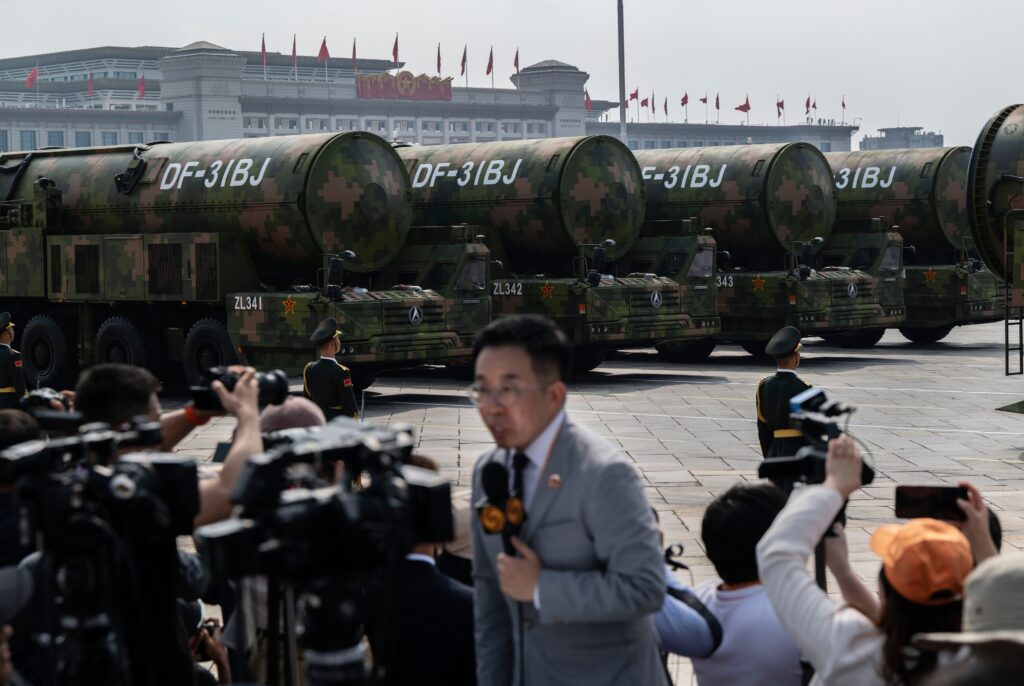
China is rapidly overhauling a network of secret facilities used to manufacture warhead components as it expands its nuclear stockpile faster than any other country, according to an analysis of satellite imagery.
These changes are taking place as Beijing intensifies efforts to be able to retaliate more quickly against an attack, according to expert assessments of official publications — dramatically raising the stakes of any nuclear standoff.
“The levels of changes that we’re seeing since around 2019 to today are probably more extensive than anything we’ve ever seen,” said Renny Babiarz, who led analysis of half a dozen key sites for a project by the Vienna-based Open Nuclear Network (ONN) and the London-based Verification Research, Training and Information Centre (VERTIC).
China’s rapid expansion of weapons-production facilities continues, even as a Pentagon report last week shows nuclear warhead production has slowed since 2024, with totals in the low 600s, though it’s on track to surpass 1,000 by decade’s end.
President Donald Trump recently said, when discussing plans to restart U.S. nuclear weapons testing, that China could catch up with U.S. nuclear capabilities within five years.
Analysts say it’s unlikely that China could match the estimated 3,700 warheads in the U.S. arsenal in the foreseeable future. But the dramatic changes Beijing has made to almost every part of its nuclear weapons program suggest the People’s Liberation Army is preparing for an all-out arms race, they said, even as it claims it does not want one.
The ONN/VERTIC satellite imagery and expert analysis, shared exclusively with The Washington Post, show that Beijing has sharply accelerated activity at key sites involved in producing nuclear warheads — a burst of expansion since 2021 that could supercharge China’s nuclear ambitions.
The construction includes major upgrades at facilities thought to design and manufacture plutonium pits — the cores of nuclear warheads — as well as plants that produce the high explosives used to trigger nuclear reactions.
Chinese military textbooks, internal publications and articles by military-affiliated scholars further suggest that nuclear brigades are being placed at higher alert levels and might be shifting toward a launch-on-warning posture, meaning that China would be prepared to retaliate as soon as a missile attack were detected. This is a significant departure from Beijing’s strategy of prioritizing its ability to retaliate after an attack, analysts said.
Together, these changes show how Beijing is developing more versatile munitions and tactics that give it options to threaten the U.S. and its allies, even if it cannot match the size of the U.S. nuclear warhead stockpile.
Infrastructure surge
China’s fast-growing arsenal remains one of the world’s most opaque: Detailed glimpses into how Beijing is positioning itself as a leading nuclear power are rare.
Attention has largely focused on hundreds of missile-silo fields carved into its remote northern deserts since 2021. But satellite imagery of less-scrutinized facilities linked to warhead production indicates that China made significant upgrades across its nuclear weapons supply chain as it built the silos.
Analysts track these sites by matching reports, including declassified government documents and academic papers, with places that have specific structures — such as blast chambers and specialized chemical storage sites — and comparing them to similar facilities elsewhere in the world. They also review military vehicle movement patterns at the Chinese sites.
Nuclear warheads thought to be under construction in China contain a core of fissile material — typically weapons-grade plutonium — manufactured into a spherical shape known as a pit and surrounded by conventional high explosives. When detonated, these explosives compress the fissile core and trigger a chain reaction that releases enormous energy in a nuclear explosion.
Production of pits and high‑explosive components is likely separated across multiple facilities, which have expanded in parallel with testing sites and missile silo fields since around 2020.
In a mountainous area of China’s Sichuan province near the city of Pingtong, a facility to be used for the production of fissile material pits has undergone vast changes in the past five years, according to Babiarz’s analysis. New security fencing has more than doubled the site’s secured footprint, alongside building upgrades and construction across at least 10 locations, including near the core facility where the pits are thought to be produced, the images show.
Pingtong is the only publicly identified plant linked to China’s plutonium pit production.
In researchpublished in the U.S. Air Force-affiliated Journal of Indo-Pacific Affairs, one analyst describes the site as similar to the Pantex plant in Texas, which assembles and maintains U.S. nuclear warheads — but China’s site has additional plutonium pit production capabilities.
A separate facility in the supply chain — which analysts and previous U.S. government assessments say is probably the primary site for producing the high‑explosive components used to trigger nuclear pits — has also undergone rapid changes. Located in a remote area of Zitong County in Sichuan province, the site has expanded significantly since 2019, according to Babiarz’s analysis of satellite imagery.
There are sweeping changes across the multisite complex. In one area alone, Babiarz identified an extensive security wall under construction since about 2021, a possible new storage area and large, newly cleared tracts for additional facilities, probably beginning in 2023. The construction is concentrated near sites that appear to be built for testing explosions, including dome-shaped high-explosive test chambers and a shock-tube test site — a roughly 2,000-foot-long tube used to simulate blasts and assess vulnerabilities in new nuclear warhead designs.
At Zitong, Babiarz’s team identified a 430,000-square-foot facility, completed last year, that they assess could be used to assemble, handle and prepare warhead components, possibly for transport to other locations in China for storage and assembly.
“Based on all the changes that we’re seeing that show a huge investment in these locations, that altogether indicates an improved capability to produce nuclear warheads for the nuclear program,” Babiarz said. While the increased production capacity at the facilities could equate to more warheads, he said it could also mean Beijing is upgrading and modernizing existing warheads.
China’s main nuclear test site, Lop Nur in far western Xinjiang, has also expanded in recent years, with new underground tunnels and large shafts that might be preparations for renewed nuclear testing.
Beijing conducted only 46 tests from 1964 to 1996 — the year it signed, but never ratified, the Comprehensive Nuclear-Test-Ban Treaty — far fewer than the 1,000 carried out by the U.S. and Russia.
China’s initial tests likely resulted in a far greater ability to build a variety of warheads — including smaller and lighter bombs — than was previously recognized, according to a new book by Hui Zhang, a senior research associate at the Project on Managing the Atom at Harvard University, based on little-known accounts from Chinese nuclear scientists.
Faster retaliation
At the same time as these production facilities were upgraded, Beijing has gradually signaled its ambitions to field a far more diverse nuclear force at higher alertness levels, giving it more tools to pressure the U.S. in an escalating standoff.
The Pentagon report last week said Beijing has made significant strides in developing rapid counterstrike capabilities similar to the U.S. Launch on Warning (LOW) system, which can detect ballistic missiles thousands of miles away and launch a counterstrike before they detonate. It also said China has probably loaded more than 100 solid-propellant ICBMs into silos to support the system and refined the ability to launch multiple missiles simultaneously after late-2024 tests.
Chinese military publications covering the period of the buildup through last year, recently unearthed by Western analysts, suggest that China is readying its nuclear brigades to retaliate as soon as an incoming attack is detected.
China has already built out infrastructure and command structures to support a launch-on-warning posture, although some of its capabilities remain rudimentary, according to analysis of China’s evolving early warning architecture published by the Pentagon’s Defense Threat Reduction Agency last month.
“This is one of the most significant and overlooked aspects of ongoing shifts in China’s nuclear forces,” said David Logan, an assistant professor at Tufts University and one of the authors of the analysis. “What states do with their weapons and how they posture them often matters much more than … how many they field.”
The PLA Rocket Force has “adjusted its nuclear warhead storage and handling practices and training to support regular high alert status” and has now standardized “combat readiness duty” for brigades, according to articles in Rocket Force News, an internal publication, seen by Logan and Phillip Saunders, an expert on the Chinese military at National Defense University.
It is unclear what this duty involves but it might mean that China has more warheads attached to missiles in peacetime, instead of its traditional practice of keeping most warheads in storage. This change would be “a big deal because it’s a big change from how China operated similar forces in the past,” Logan said. “It’s also much riskier.”
Beijing now has a sufficient number of early warning satellites and radars to detect incoming missiles, analysts said. It has a command structure designed to quickly disseminate orders — by fiber-optic cables, microwaves, radios and satellites — to ensure that nuclear-armed intercontinental ballistic missiles can be launched within minutes.
These changes come as Chinese leader Xi Jinping has overseen a massive purge of top generals, including from the Rocket Force, in an attempt to ensure political loyalty and accelerate military modernization, including of the nuclear forces.
Recent Chinese military textbooks have described launch-on-warning systems as essential for national security in peacetime and war and for nuclear and conventional conflicts.
These publications often praise the U.S.’s advanced early warning systems as having strengthened American deterrence and argue that China needs similar capabilities to ensure Washington takes its nuclear forces seriously.
“Strategic early warning is among decisive factors reflecting a nation’s military strength,” said a textbook published by China’s National University of Defense Technology last year. The text also warned that the systems must be exceptionally accurate to avoid an accidental launch.
Another textbook, published in 2023, described advanced early warning systems as allowing a country to use “strategic offensive weapons to gain the initiative in combat” and added that a “powerful, responsive, and globally covered strategic early warning system can create a strong deterrent effect on the opposing side.”
But that ability to deter adversaries comes with additional risks. Throughout the Cold War, technical glitches and human errors in American and Soviet early warning systems created multiple false alarms that nearly ended in disaster.
“For China to abandon its traditional policy of delayed retaliation and move toward rapid response could significantly increase the risk of misunderstanding, overreaction and even incidental nuclear war,” said Tong Zhao, an expert on China’s nuclear weapons program at the Carnegie Endowment of International Peace, a Washington think tank.
The post China expands nuclear warhead manufacturing capacity, research finds appeared first on Washington Post.