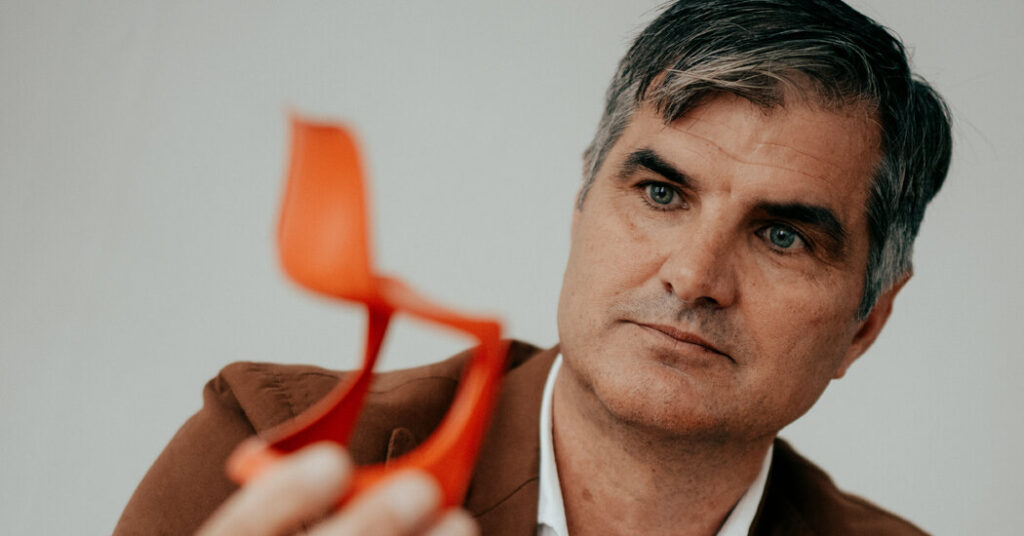
On a sunny evening in mid-June, a group gathered on a terrace overlooking the Tivoli Gardens amusement park in Copenhagen, sipping Ruinart and snacking on tomato-salmon puffs. Their host, a former private equity investor named Mark Masiello, moved through the crowd.
Mr. Masiello was on a mission to make a 90-year-old lighting designer named Carlo Nason a household name. Then he’d sell as many of Mr. Nason’s lamps as possible.
The guests, a group that included designers, journalists and executives, moved to a mirrored private dining room with a view of an old roller coaster. A vellum-wrapped packet of small cards at each place setting advertised an exhibition of Mr. Nason’s lamps mounted by Mr. Masiello’s company, Form Portfolios.
In a toast, Mr. Masiello said the way that Mr. Nason’s work transformed light was “remarkable to see.” Alberto Nason, Carlo’s son, listened from across the table. Most of his father’s designs have not been produced for decades. But Form was nearing a deal that could result in Carlo Nason’s lamps being offered again to customers.
“I think we have many, many, many people, like my father, to be discovered,” Alberto Nason said.
Consumers have been rediscovering décor from the middle of the 20th century for decades. Eames loungers dot their living rooms. Isamu Noguchi paper lampshades glow above their dining tables. The appetite for midcentury modern style has fueled knockoffs designed by West Elm or Article to approximate the look at a fraction of the price.
But for some customers, in the age of the ubiquitous dupe, the provenance is the point. Purchasing something from an undiscovered designer adds another dimension: They don’t just have good taste, they’re ahead of the curve.
Form Portfolios has bet its business on those people.
Designers leave behind scores of objects that are no longer available for consumers to buy. Their archives also often include ideas that were never produced or were made for a single project.
Their heirs license those products to a manufacturer or retailer in exchange for a royalty, which often hovers around 5 percent.
But it’s a pain to set up those deals. That’s where Form comes in.
Sometimes, Form buys the intellectual property outright. In other cases, it acts as a manager for the heirs and takes a generous cut of the royalties when it successfully gets their ancestor’s work back into production.
It’s not unheard-of for high-end furniture manufacturers to revive old designs. But Form’s hope is to build those comebacks at a different scale. It has licensed around 800 products from the archives of its designers since its founding in 2016, and the products it sells are often sold to consumers at relatively accessible prices.
Products developed or pitched by the company are the backbone of a line at CB2 that has resurrected furniture and lamps by Paul McCobb, Bill Curry and Gianfranco Frattini. The three, all active after World War II, were well regarded by collectors but had fallen off the radar of the public by the time Form got involved.
When the family of the revered architect Louis Kahn wanted to bring his furniture to market for the first time, it asked Form for help. The descendants of Charles and Ray Eames hired Form to pitch lighting based on the couple’s designs to manufacturers.
Form isn’t alone in trying to capitalize on the consumer fetish for vintage cred. MillerKnoll this year opened a 12,000-square-foot archive at its Michigan headquarters. IKEA has in recent years reintroduced classic pieces from its archives, at the same time that a healthy secondary market developed for vintage pieces from the brand.
“If you’re going to create a furniture business and you need to break through the noise of a very crowded global consumer market, a very easy way to do that is to somehow bring to market things that are already legitimized,” said the culture writer W. David Marx. “If you start from scratch and you just find a really talented new designer, you have to build that value from zero.”
Form is part of a broader 21st-century economy that relies on rebooting the 20th. Disney brought Luke Skywalker back to the big screen; an Italian tycoon reopened the couture house of Elsa Schiaparelli.
“Trend cycles have gotten so fast,” said Mr. Marx, whose new book, “Blank Space,” argues that the last 25 years have been marked by a lack of cultural innovation. “And then we look back at the 20th century, where trends were slower moving — where they were anchored to more ideological ideas or avant-garde art or these iconic figures — and we see all this gravitas.”
There’s no shortage of opportunities to push dead designers’ brands beyond their original intentions, whether by producing products only loosely inspired by their works, or lending their aesthetics to key chains. Even if a brand faithfully reproduces the look of an old design, there is no guarantee the result will rival the original. Consumers now expect to furnish their homes at the speed of fast fashion.
“If Form starts selling all of the Eames designs to Crate & Barrel,” said David Rosenwasser, the co-founder of Rarify, a furniture marketplace, who has worked alongside Form on a project to revive furniture by the architectural firm SOM, “there will be an uproar of nerds who will be furious at making these heritage pieces into disposable, low-quality, not well-produced, inexpensive pieces.”
So the furniture world, via Form, confronts the same question as other industries before it: How do you profit off old intellectual property without cheapening it?
It Started With Risom
Midcentury design had long captivated Mr. Masiello, who retired from a Providence, R.I., private equity firm in 2012.
A year later, Mr. Masiello traveled to Germany to take possession of a new silver Porsche 911 and embarked on a road trip across Europe with his father, who had run a manufacturing firm. In Denmark, Mr. Masiello talked his way into the studio of the designer Hans J. Wegner, who died in 2007.
Anders Brun, a cabinetmaker who was managing Mr. Wegner’s estate, gave him a tour. Mr. Masiello was struck that just Mr. Brun, working part time, was responsible for promoting Mr. Wegner’s legacy, which includes icons of Danish design like the Wishbone Chair.
Mr. Masiello returned to America with an idea: What if there was a company that owned and managed the rights to old designs, just as music publishers manage an artist’s back catalog?
American law does not allow someone to copyright the design of a functional object the same way a songwriter can copyright his work. But designers can trademark their names to promote their work as the genuine article. You can buy a chair that looks like an Eames lounger from Wayfair; but only Herman Miller has the ability to produce an authentic Eames chair in the United States.
One of Mr. Masiello’s first targets was Jens Risom, a Dane who was the first designer for the furniture company Knoll and died in 2016. Mr. Risom had a house on Block Island in Rhode Island, where Mr. Masiello owned a home.
Using the local connection, Mr. Masiello met Jens’s son, Sven, who licensed his father’s work to companies like Design Within Reach. But Sven found it was hard to balance that work with his own job.
After many conversations, Mr. Masiello persuaded Mr. Risom’s four adult children to sell him their father’s work.
Having ‘a Moment’
In Copenhagen, in the 1830s building where Form has its offices, Mr. Brun pulled up a page on his MacBook that he uses to track the products in Form’s pipeline. Under the heading “prototype/report received” was a barrel-backed dining chair with three bent wooden legs.
It was designed in 1960 by Steen Ostergaard, a Dane whose space age plastic furniture appeared in two “Star Trek” movies. Mr. Ostergaard, 90, has reached an agreement for Form to manage his work.
Under the agreements, Form and its clients split proceeds from any products sold, by 50-50 in some cases, according to multiple people familiar with the contracts. (Mr. Masiello declined to comment on the specific terms.)
The company tries to ensure it is dealing with a designer’s rightful heirs. Then Form begins going through the designer’s archives, which can include finished drawings, quick sketches and images of long-forgotten projects.
Form found photographs of Mr. Ostergaard’s barrel-backed chair in old advertisements for a complex of apartments built for bachelors. Peter Christensen, Form’s creative director, measured a surviving copy of the chair at the home of Mr. Ostergaard’s brother.
Last year, Mr. Masiello met with Ryan Turf, CB2’s president, and pulled out an oversize book that Form had produced of work by Mr. Ostergaard. As Mr. Turf flipped through, the chair caught his eye. Curved furniture does well for the retailer, and Mr. Turf thought it looked on trend.
The chair is expected to join CB2’s “Design Legends” line next year for a retail price of about $500, according to Form. (A vintage example of the chair is on sale at a Dutch design gallery for $6,450.)
The retailer’s pitch is heavy on history and prestige. On a page devoted to Mr. Ostergaard’s work, the company notes that his designs have “garnered international critical acclaim and been exhibited everywhere from New York City to Milan.”
“Marketing companies pay millions of dollars to create artificial stories to get people excited. These are real,” said John Edelman, the chief executive of Heller, which makes plastic furniture and dishware in bright colors that was designed by Massimo and Lella Vignelli in 1964 and is now available at retailers like the MoMA Design Store. “And that’s a much stronger sales pitch.”
Since 2021, CB2 has released more than 150 products based on old designs that Form either owns or manages.
The collaboration’s biggest success is its 2021 resurrection of Paul McCobb, which got attention from Architectural Digest’s professional vertical and other corners of the design trade press. By 2023, The Los Angeles Times had declared that Mr. McCobb was “having a moment,” with no mention of Form’s role as architect of the revival.
CB2 makes it clear that customers are purchasing an authorized reproduction of an old design. For some buyers, the fact that they can buy this at mall prices is part of the appeal.
Other people buy the products just because they like the way they look. Raul Chiu, who works in real estate in the Dallas-Fort Worth area, recently went to a CB2 store to buy a chess set for a friend.
A saleswoman showed him a set with cylindrical steel pieces designed by Mr. Frattini in 1972.
“It’s pretty simple and minimalistic, but it has a very elegant feeling to it,” Mr. Chiu said, adding that the saleswoman had not mentioned the origins of the set.
CB2’s partnership with Form has raised concerns among some in the design world who say it is impossible to match the quality of furniture from the midcentury today.
In response, Mr. Masiello said that the company was careful about choosing its partners for these comebacks. He said Form sometimes left money on the table when it felt that a retailer or manufacturer could not produce at a certain standard of quality.
While Form was involved in a recent small collection of tableware featuring patterns by Ray and Charles Eames at Crate & Barrel, the couple’s famous furniture is still produced exclusively by the high-end manufacturers Herman Miller and Vitra under deals established directly with the designers.
Mr. Masiello said the company, which is privately held and does not disclose financial results, has “proven that the business can be profitable.”
But it has faced setbacks. It filed a lawsuit last year that accused Food52, a recipes site that also sells home goods and owns the famous midcentury Scandinavian brand Dansk, of violating the terms of a deal to license more than 600 designs from Form. Food52, which said in a statement that it disputes the claims in the lawsuit, has stopped paying royalties for products it sells based on designs that Form controls, Mr. Masiello said. Earlier this month, a judge dismissed some but not all of Form’s claims.
The Next Big Lamp?
A few years ago, a friend in Venice lured Mr. Brun to the city with an invitation to the Regata Storica, the famous boat race. But the friend mostly wanted to introduce Mr. Brun to Carlo Nason, the scion of the Murano glassmaking family that was the subject of the company’s exhibition in Copenhagen.
Mr. Brun was captivated by Mr. Nason’s archives. His work spans decades, styles and manufacturers. But his signature pieces feature layers upon layers of hazy glass that look like glowing jellyfish.
Collectors scour vintage marketplaces for Mr. Nason’s lamps. But most are no longer produced. Mr. Nason’s son called him a “ghost designer.”
The Form team has been going through Mr. Nason’s archives, and has an agreement with Gubi, a Danish brand that sells directly to consumers around the world, to reintroduce several of Mr. Nason’s lamps starting next year.
The lamps represent something like portfolio diversification for Form.
Mr. Nason’s signature lamps look nothing like the commercialized vision of “midcentury modern” décor that Form chased for years. Instead of employing clean, contained lines, they appear to ooze.
Consumers have started to look for something fresh, and embraced the blobby aesthetics of the 1970s and the sleek glamour of the 1980s. So Form needs to keep scanning the globe for the next old thing it can make new.
“We have designs that were created in each decade of the last 100 years,” Mr. Masiello said. “As long as modernism continues to grow as an interest, we have it covered.”
David McCabe is a Times reporter who covers the complex legal and policy issues created by the digital economy and new technologies.
The post Can You Reboot a Lamp Like a Superhero Franchise? appeared first on New York Times.