As voters started going to the polls on Sunday for the first round of a heavily stage-managed election in Myanmar, the outcome was all but assured. The military junta that has ruled the country since seizing power in 2021 was almost certain to maintain its iron grip on power.
But some still hoped there was room for change.
“We have to do something,” said Nant Khin Aye Oo, chairwoman of the Kayin People’s Party, one of the few parties that was not barred from fielding candidates. “We can’t live under this anymore.”
The military has governed Myanmar for most of the country’s history since it gained independence from Britain in 1948. For about a decade starting in 2010, the country was seen as an exemplar for democracy after the military handed some power to a civilian government led by Daw Aung San Suu Kyi, who had long been the country’s beloved opposition leader.
That ended in 2021 when the army announced that it would not recognize the 2020 election victory by Ms. Aung San Suu Kyi’s party. There is a widespread feeling in Myanmar that the generals have severely mismanaged the country since then.
For the junta, the elections are in part to placate neighboring China, which has pressured it to hold the polls as a way out of a four-year civil war. The military also hopes that the elections, which will determine the next Parliament, will give it an air of legitimacy that may give other countries an opening to embrace what is now largely a pariah state.
With voting unfolding over three days, it will be difficult to draw quick conclusions. Results are not expected until late January.
Despite its firm hold on power, the junta has left nothing to chance. It disbanded 40 political parties, including the country’s main opposition party, the National League for Democracy. The military’s proxy party, the Union Solidarity and Development Party, is effectively running uncontested in many areas. More than 100 people have been arrested since July for violating a new law that makes it a crime to criticize the election.
Still, some members of the country’s dwindling opposition said they were determined to make their voices heard. U Ko Ko Gyi, a veteran pro-democracy activist, who is running for a seat in Yangon under the People’s Party, acknowledged that there were issues with the elections, but said they were the most pragmatic way forward. “What’s the better alternative?” he asked.
“Whether we like it or not, we cannot move the military out of politics,” he said.
Like several others, Mr. Ko Ko Gyi said the vote could result in a Parliament with enough authority, while still limited, to divert some power away from Senior General Min Aung Hlaing, the army’s commander in chief.
Amara Thiha, a nonresident fellow with the Stimson Center, said the election could bring incremental change to Myanmar.
“Everyone is already fatigued, even the S.A.C.,” he said, referring to the State Administration Council, the official name of the junta. “Nothing can be worse than this.”
But others in the opposition have condemned any participation in Sunday’s voting, saying that it contributes to a democratic veneer on many have called a sham election. The National Unity Government, Myanmar’s shadow government in exile, has said that officials, poll workers or candidates participating in this election are collaborating with “the enemy of the state.” The National League for Democracy, the party of the jailed Ms. Aung San Suu Kyi, has consistently said that it will boycott the elections.
In the hours before the polls opened, social media footage showed an explosion at a U.S.D.P. office in Myawaddy. One person was killed and at least a dozen others injured, according to a local official in Myawaddy. In the city of Mandalay, there was a similar incident at a polling station, according to the city’s chief minister.
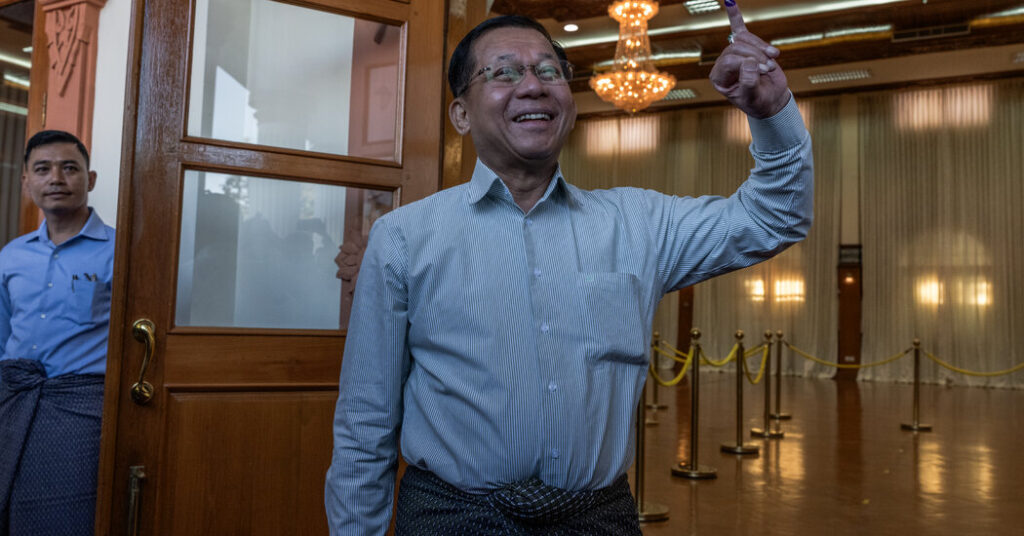
In Naypyidaw, the country’s capital, Gen. Min Aung Hlaing emerged grinning after casting his ballot, showing off his left pinky finger dyed purple as a sign of having voted.
“We can confidently guarantee that the election is free and fair because it is being carried out by the military,” he said. “Our military will not allow its reputation to be tarnished.”
Few people believe that. Many people in Myanmar interviewed before the vote said they had decided not to participate.
“I don’t think this is an election that I should vote in,” said Kyaw Saw Han, an independent analyst based in Yangon, the country’s commercial capital. “It will be old wines in new bottles.”
The polls have been widely condemned by many governments in the West, though notably not the Trump administration, which said plans for “free and fair elections” represented progress for the country. Ballots will be cast only in areas under military control, estimated to be less than half of the country’s territory.
Regardless of how the election pans out, people hope that living conditions in the country of more than 50 million may soon start to improve. Since 2020, Myanmar’s economy has contracted by9 percent. To fund its war efforts, the military has printed an estimated 30 trillion kyat, or $6.5 billion, causing inflation to soar to a stunning 34 percent. Basic food items like eggs and cooking oil are now unaffordable for the average family.
The army also has launched brutal airstrikes against its citizens. Over 3.5 million people are internally displaced. Major cities like Yangon have had to manage with only eight hours of power per day. Health experts now warn that diseases like malaria could spread across Myanmar’s borders.
U Kyaw Min Htet, 30, is running for Parliament in the Yangon region with the People’s Pioneer Party, whose plan for the country is “reconstruction, rehabilitation and recovery.” He said that after the coup, many of his friends took up arms against the junta, but that all that brought was civilians being targeted and villages and infrastructure destroyed.
“I don’t believe that armed revolution is the right thing,” he said.
His colleague, Daw Htet Htet Soe Oo, 34, joined the party three months ago and is running as a candidate for the lower house. She said she had decided to run because there was more power in working as a party than as an individual.
“We should stop arguing,” Ms. Htet Htet Soe Oo said. “What we need is dialogue and negotiation.”
Hannah Beech contributed reporting from Naypyidaw in Myanmar.
Sui-Lee Wee is the Southeast Asia bureau chief for The Times, overseeing coverage of 11 countries in the region.
The post As Some Boycott Myanmar’s Flawed Election, Others Hope for Change appeared first on New York Times.