Every year on Jan. 1, some 50 million people around the world watch the Vienna Philharmonic’s New Year’s Concert: a program of waltzes, polkas, marches and mazurkas. At the baton is a star conductor in formal attire.
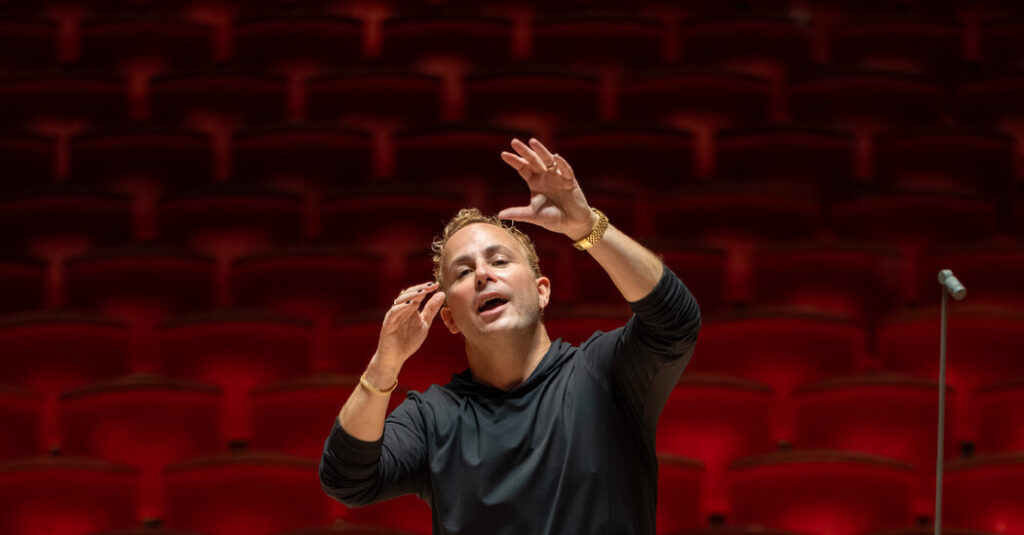
This year, it will be Yannick Nézet-Séguin — music director of the Metropolitan Opera and the Philadelphia Orchestra, and artistic director of the Orchestre Métropolitain in Montreal. Beyond his rich musical career, the Canadian conductor, 50, is known for his unconventional look: bleached-blond hair; custom-made jackets in bright, sparkly patterns; and occasional nail polish.
Nézet-Séguin is making a noteworthy addition to the Vienna concert program: “Rainbow Waltz,” by the African American composer Florence Price.
And what will he wear? A custom outfit by Louis Vuitton, styled by his husband — the violist Pierre Tourville — which will be “traditional with a twist,” the conductor said in a recent phone interview, which has been edited and condensed.
What inspired your interest in conducting at age 10?
It was very instinctive. I felt completely compelled.
The real epiphany that I had was that I loved music, but I found it very lonely to be a pianist. When I started to sing in the choir, I understood the power of music as a collective and the energy of being all together. Then I saw the conductor getting sounds out of people. It felt like the right place for me, because I don’t like to be alone.
I guess I also showed, at an early age, some kind of leadership quality. At school, I liked to lead groups that I was in. I probably felt that this was the right place for me: to be at the center of all this without being the only person onstage. Because what I love the most about my profession now is that it gives me this human contact.
Does musical ability come from nature or nurture?
It’s a very open question, and I don’t think we’ll ever be able to know exactly. I do sense that there is something in talent, and I believe that every human being does have a talent of some kind. It’s the right seed in the right soil. You need to be in a certain environment. It doesn’t mean being necessarily a musician in a musical environment. My parents, who were teachers, loved music and had a record player, but that’s about it.
In a world where, sometimes, instant celebrity can come for no reason whatsoever, it’s the responsibility of the human being to develop their talent to its maximum potential. In my case, my passion was so irrepressible that I don’t think I gave my parents any choice.
You bring a certain youthfulness and charisma to the table, and your fashion choices bridge generations. What qualities does classical music need to survive and thrive?
The first quality of a musician, and especially of a conductor, is authenticity: being more authentic and true to ourselves and to others. I was lucky to grow up in cities where being who I am was always accepted. When I became music director at age 25 in Montreal, I had my hair dyed several different colors. I never did it on purpose to be cool and to make classical music more trendy. I did it more as a way of saying: this is who I am, and I won’t shy away and change by virtue of having a responsibility in a world that seems still very traditional and conservative.
How is the Met Opera doing, and what is your vision for it?
In recent years, I have used my platform to feature composers of different and more diverse backgrounds: women composers, African Americans, composers of Middle Eastern or Latin American or Indigenous descent. What has been really transformative for the Met in recent years has been putting our energies into works of our time, reaching communities that traditionally didn’t feel like we were connecting with them in opera.
It’s working in terms of tickets, and in terms of the general attention that the New York scene is giving to the Met. With what’s happening also in the United States politically, the Met is standing strong.
You mean focusing on artists who might be described as diverse?
Exactly. I will talk only about classical music — I’m not a politician — but I feel like the debate about diversity, equity and inclusion is so wrong, because that’s not what we’re doing. We’re actually opening up our repertoire to feature an unjustly neglected part of our audience. Opera is supposed to be for everyone. Yes, I know, not everyone can afford the ticket, but nor do you have 300 or 400 performers, in other shows, giving you the highest quality. That said, it’s not justified to keep programming only works representing 18th-century Italy, the Spanish Inquisition and 19th-century Paris.
So the Met Opera is doing well?
I have been going to the Met in terms of guest conducting, at first, since 2009, and the Met has never been better.
The actors Cate Blanchett and Bradley Cooper have recently played conductors on film; you actually coached Cooper in “Maestro.” Someone unfamiliar with classical music might say that conductors just gesture wildly while others make music. What’s your answer?
I don’t blame anyone for thinking, what is that person doing? It’s still very mysterious to me why, if I wave my arm this way, there’s actually a result. This is one of the true beauties of conducting. It is something that has a component of being magical, intangible. At the end of the day, it’s almost telepathic.
Every orchestra can kind of get along without a conductor — start and finish together and keep the tempo — but then it remains very basic. The conductor creates the right circumstances for the musicians to stay together, relax and express something. It’s about agreeing on the emotion of a piece. Then the musicians can throw themselves into the music and the audience can feel something, which is my goal. It’s a little bit like coaching for a sports team.
What do you do in your leisure time?
I love to walk and work out and take care of the physical aspect of my body, because it’s essential to being a conductor: not to get injured and to feel free. I lift weights and do yoga and run and swim. I also like to read and watch very basic TV, like Home & Garden Television renovation shows. Three times a year, I go to the beach and am very good at not doing anything while there. There’s no classical music played. It’s only R&B or Bad Bunny — who I’m obsessed with. I was looking at my Spotify Wrapped today, and the first four songs are by Bad Bunny.
The post A Star Conductor Brings Sparkle to Vienna’s New Year’s Concert appeared first on New York Times.