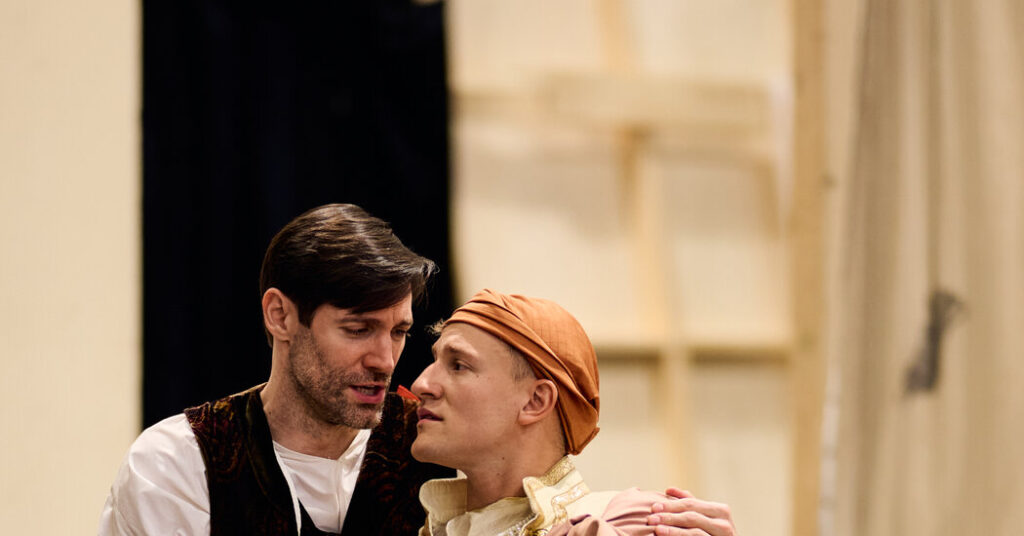
There may be a lot of waltzing in Vienna this holiday season, but one local theater that premiered some of the world’s most famous waltzes is about to shimmy and fox trot.
The MusikTheater an der Wien will mount “Benamor,” a rarely seen 1923 operatic work by the Spanish composer Pablo Luna, for nine performances from Jan. 11 to Feb. 7. The piece is a Jazz Age example of zarzuela, a genre little known outside of its native Spain. The form dates from the 17th century and is comparable to operetta, with songs, spoken dialogue and dances, typically influenced by Spanish folklore and politics.
“Benamor,” like several other zarzuelas from the period, tested the boundaries of artistic expression at a chaotic moment in the Catholic country’s history. “Benamor” featured cross-dressing characters and risqué humor that was largely tolerated during the Roaring Twenties in Madrid and premiered just months before a military coup that brought an end to the constitutional monarchy.
“I think many people don’t know that Madrid in the 1920s was a city much like Berlin in that it was definitely a space for intellectuals and queer love,” Christof Loy, the director of this production of “Benamor,” said in a recent video interview. “But in the 1930s, Francisco Franco’s administration took away all of the social criticism in zarzuela and reduced it to something folkloristic.”
This staging — the first ever in Vienna — comes after the 50th anniversary in late November of the death of Franco, whose fascist regime banned many zarzuelas rich with political satire during his 35 years in power, as well as many other books, plays and films.
“Benamor” stood out among them as a target for its cross-dressing plot set in 16th-century Persia, in which a mother swaps the identities of her two children, Sultan Darío (a woman disguised as a man) and her brother, Benamor (actually a man, raised as a girl), resulting in a Shakespearean-like comedy of identity and gender swapping. Compounding the gender play, the role of Benamor was written as a trouser role and therefore is almost always played by a woman. Loy decided to push his production even further by casting a male soprano as Darío.
Things get interesting — both for the plot and the work’s history — when the character of Juan de León, a Spanish adventurer and overall macho man, wins the admiration of Darío and becomes confused when he develops feelings in return for a person he believes to be man (who is actually a woman, played in Loy’s staging by a man).
“After its world premiere in 1923, the trio in the first act between Benamor, Darío and Juan de León was removed,” Enrique Mejías García, a music historian based in Madrid, said by email. “I suggest the possibility that this was an excessively queer moment.”
This sort of moment, he said, was among the many reasons zarzuela — and “Benamor” in particular — was targeted by the government.
“Apparently, Pablo Luna’s widow tried to mediate with the censors, arguing that by the 1940s, it was already a ‘classic’ work in the zarzuela repertoire,” Mejías García added. “But she failed to convince them.”
Loy, 63, a veteran German opera director, saw his first zarzuela years ago, but did not truly fall in love with the genre until 2021, when he chanced upon a production of “Benamor” at the Teatro de la Zarzuela in Madrid.
“When I was in my 20s, I saw a zarzuela in German, and it was not very impressive, I have to say, because it was sung in German and the whole atmosphere just felt like a boring operetta and not done with much conviction,” Loy recalled. “But with this ‘Benamor,’ I saw how in zarzuela, the audience is as important as the people onstage. When you read about the first performances of ‘The Marriage of Figaro’ in the 18th century in Vienna, the audience asked for nearly every number to be repeated. This happens with zarzuela.”
That interactive approach fascinated him, so he began staging more zarzuelas. Last year, he staged a production of the 1874 “El barberillo de Lavapiés (The Little Barber of Lavapiés)” by the composer Francisco Asenjo Barbieri in Basel, Switzerland, and was surprised by how enthusiastically it was received.
“One of the singers explained to the audience before it started that it was the first time they were performing the opera outside of Spain,” Loy said. “The audience was invited to participate, and they were nearly more enthusiastic than in Spain.”
Also last year, Loy created the zarzuela company Los Paladines in Vienna that plans to stage productions throughout Europe. He feels that the zarzuela is an art form not so much misunderstood as simply not known, yet which has an important place in the history of opera and operetta — and politics and shifting cultural norms — on the continent, he said.
“These zarzuela operas are like Offenbach operettas in that they often question authority and have very strong women at the center of their stories,” he said. “During Franco, ‘Benamor’ was just not done because it was too queer.”
Once Loy approached MusikTheater an der Wien, where he had directed before, with “Benamor,” it was a revelation, even at an institution associated with premieres and reinterpretations.
“I understood at once why Christof is so in love with this piece, because it’s so sophisticated,” Kai Wessler, the theater’s dramaturg, said in a recent video interview.
The MusikTheater, one of the birthplaces of Viennese operetta, premiered works by Johann Strauss II such as “Die Fledermaus” and later became a key venue for Franz Lehár’s operettas. Staging a zarzuela there reflected the exchange between the two genres, and “seemed like the perfect fit,” Wessler said. Lehár’s “The Merry Widow,” which premiered at the theater in 1905, “set a new standard in musical comedy, including the use of international dances, not just the Viennese waltz,” he said. “This new form of operetta had a big influence worldwide, but also on zarzuela, and many Viennese operettas were translated into Spanish and became part of the repertoire of zarzuela theaters.”
This production, which will be performed in Spanish with German and English subtitles, features two young rising opera stars: Marina Monzó as Benamor and Federico Fiorio as Darío. For the Spanish baritone David Oller, who will play Juan de León, it will be a chance to share a groundbreaking work that fell into relative obscurity for a century.
“Zarzuela comes from the traditional dance music of Spain, and the international audience might just think it’s all music, dancing and comedy, but there is deeper content,” Oller said in a recent phone interview. “‘Benamor’ is a comedy, but in the end, it’s a serious statement that says that the sexuality of the person you love is not important — only the feelings you have for someone.”
The post A Gender-Bending, Jazz Age Comedy Once Banned by Franco Arrives in Vienna appeared first on New York Times.