A frustrated father in Spain, whose teenage daughter regularly sidesteps parental controls that block social media, wants the government to ban apps like TikTok and Instagram for children.
In France, a mother of three worries about social media’s effect on young people and will not give her children smartphones until they are 15. But she is skeptical that a government prohibition is the answer.
A mother in Chile says it is a parent’s job, not the government’s, to teach children how to use social media responsibly.
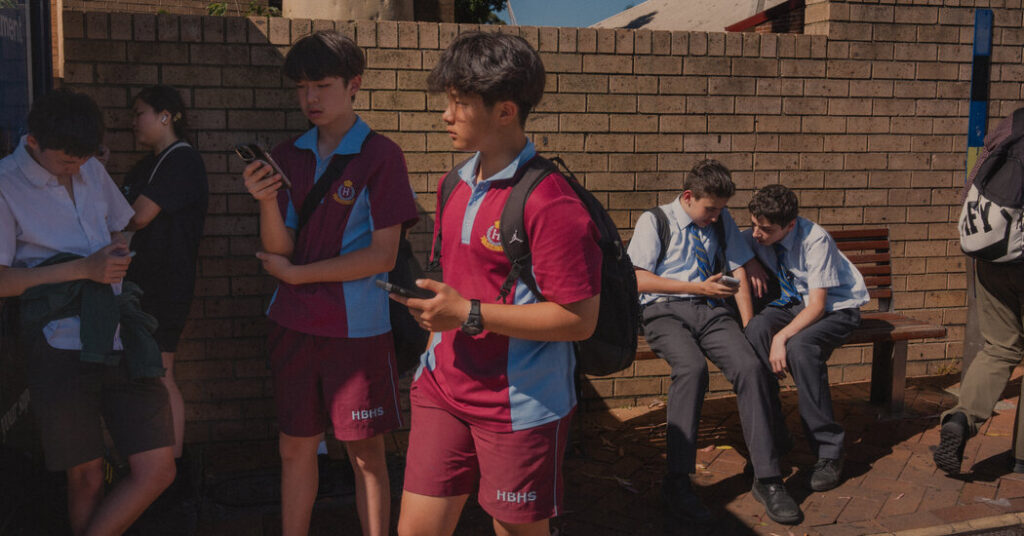
Since Australia this month barred children under 16 from using social media, parents around the world have been debating at school drop-offs and playgrounds, and on group chats and online forums, whether similarly tough action is needed in their own countries.
In Australia, surveys show that most parents support the new rules, while young teenagers have talked about using VPNs and other workarounds.
Several countries are weighing whether to adopt similar laws. The Malaysian government has announced plans to bar children under 16 from using social media starting in 2026.
Denmark could impose the toughest restrictions in Europe, though the measures would not go as far as Australia’s. The government has said it would block anyone under 15 from using the platforms as soon as next year, although parents would be allowed to give children from the age of 13 permission to use social media.
In the United States, several states have passed laws to restrict children’s social media use, including some requiring parental consent.
Many parents in interviews said they were aware of the impact of smartphones on their own lives, and wanted to protect their children from the most harmful effects.
But many also said they felt as if they were fighting a losing battle and were worn down by the time, arguments and technological know-how needed to keep their digitally savvy kids off social media. Parents who feel that way welcomed government action.
Israel Pèrez, a designer in Barcelona, said his 14-year-old daughter was constantly pestering him to lift the restrictions he has imposed on her social media use. He said an Australia-like law would help create new social norms and give parents more support in pushing back against such an online culture.
“I really see it as necessary, not as a drastic or excessive measure,” he said. “Even with parental controls, they bypass them. Even with attentive parents, if a phone is given, like in our case, it’s hard to control.”
In Denmark, Anne Kroijer, a mother of four who lives outside Copenhagen, took action herself. She persuaded about three-quarters of the parents in her eldest daughter’s class not to buy smartphones for their children. They got older flip phones instead that do not have many apps or a large touch-screen.
“It’s so incredibly uninteresting that she forgets it half the time,” said Ms. Kroijer, who is a founder of a group to help parents wean their children off social media.
Justine Roberts, the founder of Mumsnet, an online community for parents in Britain, said that screen time was one of the most common topics on the site’s message boards, and that support for government intervention has grown. In a poll of its users conducted this year, Mumsnet found that 83 percent said they would back an Australia-like ban in Britain, while 58 percent said they would be more likely to vote for a political party that committed to such a policy.
“That level of support speaks to real frustration, and to a belief that this is now a public health issue, not just a parenting problem,” said Ms. Roberts. Her company also helped develop, with the handset maker Nothing, a “safety first” smartphone for children that filters certain content and has tools for parents to limit apps and track notifications.
Not all parents believe new laws are needed, and some worry about government overreach. Others see new technologies and social media as an inevitable part of their children’s daily lives.
Charlotte Valette, a mother of three in Paris, said she was grateful that her children’s school bans smartphones. Strong parental controls also help parents restrict the content children see while giving the kids “an opening to the world.”
“I am not so enthusiastic about the idea of a state taking such a drastic measure,” Ms. Valette said.
In Santiago, Chile, Paulina Abramovich, a mother of three children ages 11, 15 and 20, said she was fairly relaxed about her children using social media. Her youngest does not use Instagram, but watches a lot of YouTube videos, which she said has helped him in school. Her middle son mainly plays video games.
“I am a mother who has given her children complete freedom in the use of social media, but I have thought more about the trust I have in them and in their education for self-control,” she said.
In Kenya, a country betting on technology to bolster its economy, it will be hard to persuade parents to take away their children’s smartphones, said Calvin Odera, a social worker in Nairobi, the capital.
Mr. Odera said that as soon as he gets home, his 5-year-old son starts clawing at his pockets to have his phone. But while he has restricted screen time, he said it would be difficult for the government to restrict platforms that have become instrumental in the daily lives of Kenyans.
“People are very sensitive about it,” he said.
In Germany, the government held a yearlong review of a petition brought by parents to Parliament calling for an age limit on social media use. The public debate showed that opinion was split.
One respondent in the public debate forum on the petition wrote: “So, you’re supposed to register on social media with a digital ID card now, or some other method to verify your actual age? That seems rather absurd.” The person added, “The clock can’t be turned back.”
Verena Holler, who lives in Hamburg, Germany, was one of the parents supporting the petition. She kept her children off social media until they were 16, holding firm even as they complained that hardly anyone played during recess, and that all they could do was watch others play games on their phones. “It’s a global crisis,” she said.
In Malaysia, Shoaib Sabri, the father of an 11-year-old daughter, supports his country’s proposed ban, citing concerns over early exposure to adult content on platforms like YouTube. He monitors his daughter’s viewing history and uses Apple settings to keep tabs on the apps she downloads.
“I know exactly what she is watching,” he said.
William Kvist, a former professional soccer player and father of two in Denmark, has spent years pushing for stricter limits on smartphones and social media for young people. He now works part time for a boarding school that limits students’ screen time and believes much of the world is catching up with his view.
“Three years ago, people were looking at me weird when I talked about this, but people see now that there are real consequences,” Mr. Kvist said. “The tailwind has really grown.”
Roser Toll Pifarré contributed reporting from Barcelona; Zunaira Saieed from Kuala Lumpur, Malaysia; and Ségolène Le Stradic from Paris.
Adam Satariano is a technology correspondent for The Times, based in London.
The post Worn Down by Worry, Parents Look Longingly at Australia’s Social Media Ban appeared first on New York Times.