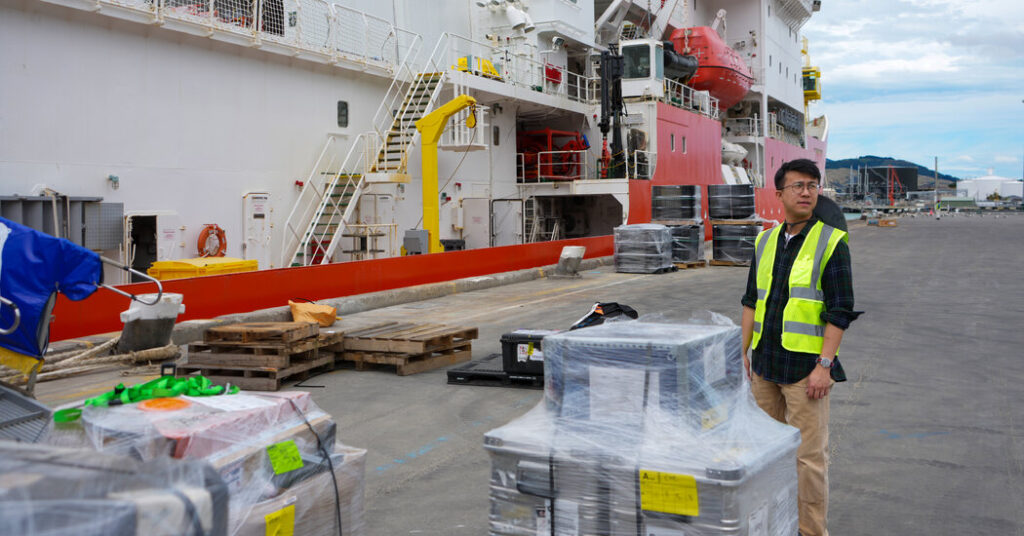
It was Christmas Day, but these weren’t the kinds of boxes you might find under a tree.
A group of nearly 40 scientists spent their holiday this week boarding an icebreaker in Christchurch, New Zealand, and unpacking some seriously heavy-duty containers: wooden crates, steel chests, rugged protective cases. Inside was an arsenal of equipment bound for one of the most hostile environments on the planet: Antarctica.
I’m a climate reporter for The New York Times, and for the next eight weeks, I’ll be traveling with these researchers and the Times photographer Chang W. Lee to some of the fastest-melting ice on the frozen continent. Warm ocean currents are eating away at the ice from below, and scientists fear that a particularly large glacier, the Thwaites, could collapse catastrophically. That’s where we’re heading first.
I’ll be publishing updates throughout our journey on what the scientists are learning and how they conduct research in such an inhospitable place. I’ll also be bringing you slices of life from our floating home base, the research vessel Araon. Please tell us what you’d like to know, too. Just email us at [email protected].
If you’re wondering, for instance, what the first day of an Antarctic expedition is like, I can tell you that it’s a bit like the first day of summer camp and a bit like the first day of a Mars mission.
Everyone looked for their cabin assignments, met their roommates, set out their shower caddies. But there was also a tingling sense of anticipation, especially among the Antarctic first-timers on the ship (myself included). And appreciation, at the chance to further our understanding of this slightly unreal and otherworldly part of our planet.
Mostly, though, there was work to be done: gear to be assembled, software to be checked, spare parts to be picked up on last-minute runs to the hardware store.
As the sun was setting on Dec. 25, two days before we were to set sail, Jamin Greenbaum and his colleagues were on the helicopter deck assembling a custom-built rig that looked a bit like a homemade lunar lander.
Their plan is to lower this rig from a helicopter into slender rifts in the floating ice in front of Thwaites. There, it will sit at the sea surface while a winch sends data-collecting instruments into the watery depths. Such rifts are too narrow for a ship to sail to, so the only way to study these waters is from the sky.
The team was hoping to do as much prep as it could while the ship was still in warm weather and not moving, said Dr. Greenbaum, a polar geophysicist at the Scripps Institution of Oceanography.
In the middle of the Southern Hemisphere summer, Christchurch this week was gorgeously sunny and just the right amount of hot. Farther south, it will be neither of those things.
At 10 a.m. on Saturday, the crew pulled up the gangplank and took in the mooring lines, and soon the Araon was steaming out of the harbor, with dolphins cavorting alongside. An ocean away, Antarctica awaited.
“After eight weeks, all of this is going to feel like a long, long time ago,” said David Holland, a climate scientist at New York University, gesturing toward the pretty, sun-drenched harbor as it shrank behind us, our last glimpse of civilization for a while. “There’s a lot of ice in the way between now and then.”
For updates on the voyage, including reporter videos, follow us here.
More climate news from around the web:
-
Global warming means agricultural pests are breeding and spreading faster, according to an analysis covered by The Guardian.
-
The children of women exposed to both high heat and high humidity during pregnancy are at higher risk of stunted growth, research reported by EuroNews has found.
Read past editions of the newsletter here.
If you’re enjoying what you’re reading, please consider recommending it to others. They can sign up here.
Follow The New York Times on Instagram, Threads, Facebook and TikTok at @nytimes.
Reach us at [email protected]. We read every message, and reply to many!
Raymond Zhong reports on climate and environmental issues for The Times.
The post Setting Off for Antarctica appeared first on New York Times.