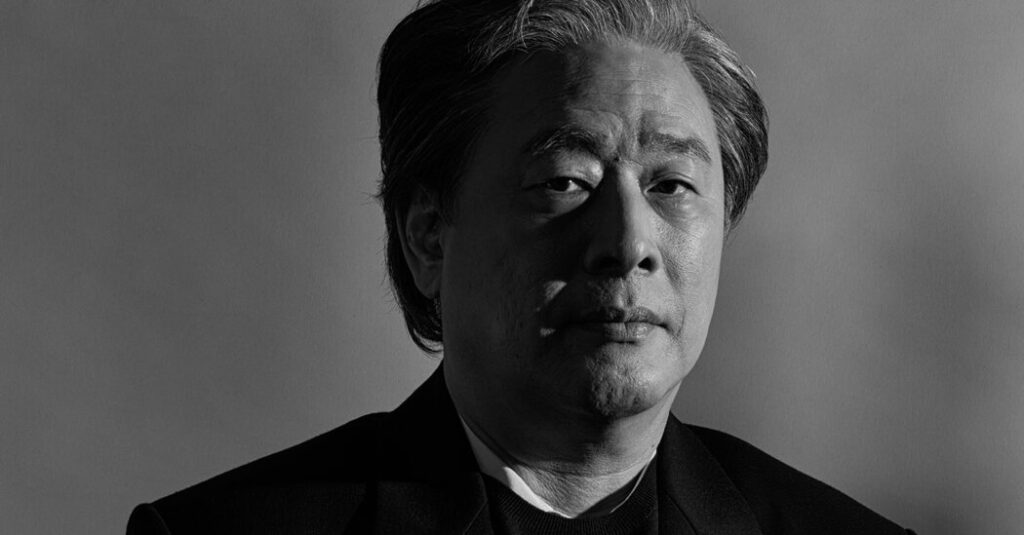
Park Chan-wook is one of Asia’s most famous directors, an auteur beloved as much for his complex, often critical visions of his home country of South Korea as for scenes of stomach-churning horror. But when Park started work on “No Other Choice,” he really wanted to direct it as an American film, so much so that he spent 12 frustrating years trying to get financing from Hollywood studios. The source material, Donald E. Westlake’s 1997 horror thriller novel, “The Ax,” was based in the United States, “so it just felt very natural to me,” he said. “I didn’t put too much other thought in it.”
Beyond the novel’s suburban East Coast setting, the plot and lead character also felt particularly American to the Korean director: a manager of a paper company has his life upended by corporate downsizing, and to secure a new job, he sets about murdering his rivals in increasingly gruesome ways. “This is a story about the capitalist system,” Park said. “I thought it would be best told in America, since America is the heart of capitalism.”
Tightfisted studios in the United States had other ideas, however, and Park ultimately made the film in South Korea. But the move had its upsides, like the chance to reunite with Lee Byung Hun (“Squid Game,” “KPop Demon Hunters”), the Korean superstar who first worked with Park on the 2000 film “Joint Security Area,” and who plays Mansu, the beleaguered former manager, in this one.
Back then, neither of them were doing nearly as well as they are now. “Director Park had failed in his first two films, and I had failed in my first four films, so there wasn’t really a great sense of hope about it,” Lee recalled. But “Joint Security Area” proved a breakout film for both director and star, winning multiple awards and becoming the highest grossing feature in Korean history at the time.
Like that film, “No Other Choice” was a box office hit in South Korea, winning film festival awards and garnering rave reviews. In the U.S., where it arrived Thursday in theaters, it has earned three Golden Globe nominations and has been shortlisted for best international feature at the Oscars.
For awards season, Park has gotten advice from his longtime close friend, Bong Joon Ho, whose dark comedy “Parasite” won best picture in 2020. “Since he’s already been through an Oscar campaign with ‘Parasite,’ he scared me a lot about them,” Park said. “He would tell me things like, you have to make sure to take care of your health.”
It’s not just the jet lag from all those trips from Korea to the U.S. and back again, Park said. “I think people here are very used to standing with a cocktail and talking with strangers every day, but that’s a very foreign act for all of us in Korea. On top of that, Bong and I are both very introverted, which makes it even harder.”
Park has made a string of critically acclaimed films since he first began thinking about what would become “No Other Choice.” There was “The Handmaiden” (2016), which was the first Korean film to win a BAFTA Award, and “Decision to Leave,” for which Park won best director at Cannes in 2022.
In person, the director, 62, is soft-spoken and warm, dressed in a maroon sweater over a white collared shirt, not quite what one might expect from the creator of some of the most intense and visually stunning films of his generation. Speaking through an interpreter on a recent morning at a restaurant at the Four Seasons in Los Angeles, he described the long slog to adapt “No Other Choice” since falling in love with the novel in 2005.
“There’s so much I now regret,” he said.
Fittingly for a film that hinges on money, the struggles began over financing. “It’s not that they offered me nothing,” he said of the Hollywood executives he spoke with. But it wasn’t nearly what he felt he needed to make the film.
Still, Park was enticed by the prospect of shooting at the gigantic U.S. paper mills he had seen on numerous location scouts, and unnerved by the daunting prospect of transporting his American hero and already-written English screenplay to Busan. There would be so much to change, he thought.
“Years ago, one of our producers, Michèle Ray-Gavras, actually suggested to me, since we can’t make this an American film, why don’t we just make it into a Korean film,” he said. “But I just kept waiting and ignored her suggestion. But now that we’ve made it into a Korean film, I’m thinking, why didn’t I just do this a lot earlier?”
Indeed, elements of the film that feel particularly Korean aren’t. A fancy eel dinner given as a pre-layoff omen? “I just made that up,” Park admitted. The post-layoff inspirational seminars, where the recently sacked self-soothe with words of affirmation? “My co-writer Don McKellar found out that people do that in job training programs in America.”
There were plenty of Korean elements, however, like the family’s nearly unbearable grief over losing their Netflix account. “In America, you have other streaming platforms like Paramount or Disney or Max, but in Korea, people mostly just watch Netflix,” the director said. The distressing loss of face when the husband is laid off also had a particularly Korean feel. “The Korean audience can empathize with that more because Korean society still has traces of Confucian values, where being a proficient husband and father is really closely connected to your job, and making money from it.”
The film is one of Park’s funniest, with much of the humor rooted in misery and misfortune. In one scene, our hero, Mansu, buries a rival neck deep in the ground and jams sausages and vodka down the man’s gullet, all part of a plan to make it look as if the man drank himself to death. We feel bad for Mansu, Park said, for being “forced” into this situation, while simultaneously horrified by the violence.
“You’re watching him stuff these disgusting sausages in, but then he’s also disgusted by what he’s doing, so he almost barfs,” Park said. “So that part is funny, but it’s mixed with all these different emotions that you usually don’t feel at the same time.”
Many of Park’s films are full of such comically dark moments, like “Oldboy,” with its “when will it end?” single-take fight scene in which the hero dispatches goon after goon with a hammer in his hand and a knife in his back, or “Decision to Leave,” in which a married detective develops an awkward crush on a woman he suspects threw her husband off a cliff.
“The humor I like comes from absurd situations,” he said. “But I think what I find funny isn’t too different from anybody else.”
Lee disagreed. “I think when he tries to do humor, it sometimes skips a couple of steps, so it can go over people’s heads,” he said. “I tell him, humor can’t be that deep! It should just be one step, and relatively intuitive.”
The author Viet Thanh Nguyen worked with Park on the HBO adaptation of his novel about a Communist spy in post-Vietnam War California, “The Sympathizer.” He said, “Park didn’t make any jokes in my presence.”
The author recalled an evening when Park was at his home in Los Angeles with two other producers. “He said, ‘You know what? What if we had all the white characters played by one white guy?’ Now, that’s a funny thing. But he didn’t smile when he said it. He was just thinking of it as an artistic and intellectual choice.” (Robert Downey Jr. ended up playing the many white characters.)
With “No Other Choice,” one of Park’s biggest challenges was making Mansu’s motivations believable. “I had a lot of conversations with Byung Hun where he asked me, ‘Just because someone lost their job, would they become a serial killer?’” he said. “He even argued that he himself wouldn’t become a serial killer in that situation.”
“So I told him, the character I want you to portray in this film is not you,” Park continued. “It’s someone who would become a serial killer because they lost their job.”
Park and Lee have had a few such philosophical conversations over the years. After the release of “Oldboy” and the Vengeance trilogy that film is part of, Lee asked the director, “Where do all these violent and angry emotions come from? And Director Park said that perhaps because I have such a quiet and normal life, I’m able to express these extreme emotions through my imagination.”
And it’s not as if theatergoers have to empathize with Park’s motley crew of cheats, murderers and scoundrels, or necessarily should, the director said: “I don’t think the sole purpose of film or art is for the audience or the reader to think, oh, I would also do that. I can completely understand why they do that.”
He continued, “It’s actually to convincingly propose that there are people who would act differently from how I would in this world,” he continued. “I think that allows the audience and the reader to expand their imaginations and their understanding of mankind.”
The post Park Chan-wook and the Funny Thing About Stomach-Churning Horror appeared first on New York Times.