When Josh Safdie was researching “Marty Supreme,” his new film about an ambitious young table tennis player in the 1950s, he learned just how much the game dismissively called Ping-Pong has been disrespected.
“Realizing that this sport has a history, and a rich one, just dignified the sport in a way that I found to be fascinating,” Safdie said in a video interview.
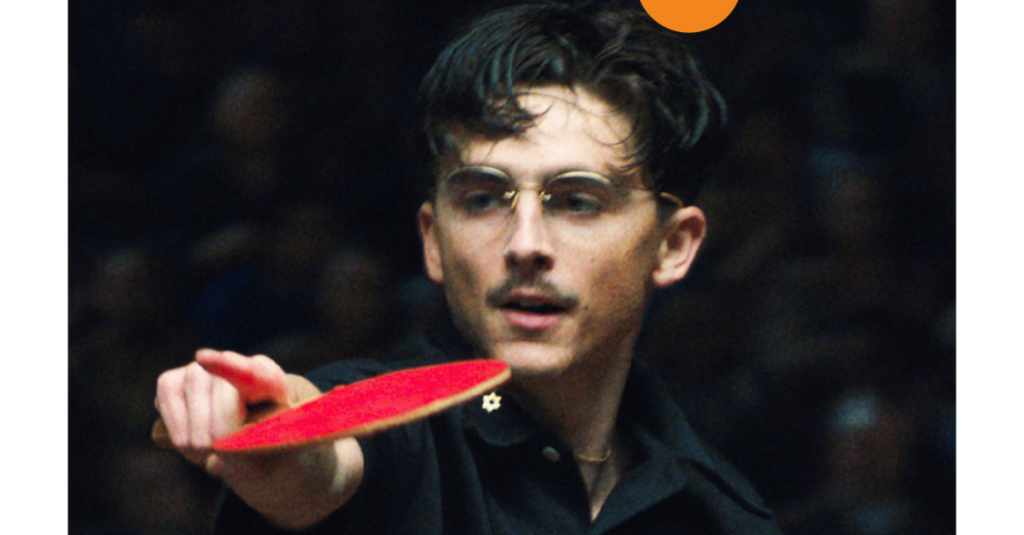
“Marty Supreme” follows Marty Mauser (Timothée Chalamet), a 23-year-old Jewish New Yorker whose prowess with a paddle is what propels his unfettered ambition. Safdie recreated the world of midcentury table tennis on both a hyperlocal and a global scale. But he also had to figure out how to capture the onscreen matches in a way that got at why the game excites him, making the play both legible and thrilling. That undertaking was “frightening,” he said, in part because there were few other examples to reference, with the exception maybe of a brief section in “Forrest Gump” (1994).
When it came to table tennis onscreen, “there was nothing to look at,” he said.
“Marty Supreme” is incredibly loosely inspired by the table tennis great Marty Reisman — an eccentric figure who published “The Money Player: The Confessions of America’s Greatest Table Tennis Champion and Hustler” in 1974 — but Safdie cautioned that his film is not a biopic. In fact, he met a viewer who knew Reisman and who questioned why the film doesn’t use any of the real Marty’s wild stories.
Instead, Safdie was inspired by an entire generation of American players from the 1940s and ’50s, many of whom were Jewish. They had a “scrawny, wiry” energy that Safdie encountered in his visual research.
“They couldn’t stand still,” he said. “They all looked like characters.”
Safdie and his co-writer, Ronald Bronstein, dug into volumes about the history of table tennis and read books by the players Dick Miles and Sol Schiff. They also reached out to members of the community who had played in the era in which the movie is set, one of whom was very close to Safdie: His great-uncle John Sprung, who frequented Lawrence’s in Manhattan, a legendary table tennis club near 54th Street and Broadway that is Marty’s home away from home in the film.
“Dickie Miles would come over for Shabbat dinner and they would clear the table and play table tennis on the table at my great-grandparents’ apartment,” Safdie said.
From his research, Safdie also learned that table tennis was partly responsible for Japan’s re-emergence on an international stage at the end of the postwar American occupation. In 1952, the year “Marty Supreme” takes place, Hiroji Satoh was the first to win the world championship using a sponge racket, a Japanese innovation. At the British Open finals, the fictional Marty meets Koto Endo (Koto Kawaguchi), who is using the same kind of paddle, and finds himself unable to respond to his opponent’s serve.
Safdie said the sport had the possibility of a “growth spurt” in the mid-20th century. “And it certainly was very entertaining to watch,” he said. “You could see a point that would last an hour. And then the sponge racket came about, designed by the Japanese, and as much as it advanced the sport technologically it pulled it back in its entertainment value because the points became so shortened.”
To design the onscreen play, Safdie recruited Diego Schaaf, who along with his wife, Wei Wang, an Olympic player, has studied the sport and consulted on “Forrest Gump.” Schaaf was reassured that Safdie was intimidated by the task.
“My response to him was, ‘Great, because I know how to do it, and that fact that you’re terrified means that you know how difficult it is,’” Schaaf said in a video interview.
In summer 2024, Schaaf began working with Chalamet, who had already been practicing on his own, to teach him specific techniques and footwork that resembled the 1950s style. Schaaf also wrote out choreography for every point onscreen, drawing from modern and retro games alike.
“It was mindbogglingly confusing when you looked at this Frankensteined document,” Safdie said. “There was a video document that had a blueprint for every point visually that we’re pulling from 75 years of the sport.”
Chalamet then had to memorize these moves. It was “unbelievably physically demanding, but also mentally demanding,” Schaaf said. “Because nobody memorizes points. He did. He took notes. He named the points so he would remember what it was. He just memorized how the ball would have to go.”
Often takes were performed without the ball, which was later added in using VFX, but Chalamet was “adamant about it, for his own pride that he was going to play every point” with the actual ball, Safdie said. Even so, the director added, Chalamet and Kawaguchi, a player in real life, became so proficient at the choreography that when they weren’t using an actual ball, they visualized it so precisely they could improvise picking one up off the floor.
“It was so realistic that I thought there was a ball there,” Safdie said, noting that he couldn’t quantify how many shots involve a real ball and how many are effects.
To capture it all, the cinematographer Darius Khondji said he and Safdie wanted to film the sport in a “classic” way. “Not like gimmicky like a sports commercial,” he said. He was inspired by George Bellows’s painting of boxers.
As for the sets, Safdie said he and the production designer Jack Fisk aimed to recreate both Lawrence’s and the British matches at Wembley Stadium as accurately as possible, even tracking down city records to determine the layout of Lawrence’s. “Those two pieces were the visual North Stars,” he said.
While there’s a stately quality to Wembley, Safdie wanted to populate the pool hall-like Lawrence’s with “unique faces that don’t fit the mold of a mainstream person.” His great-uncle had described the place to him as an orphanage for outcasts.
Safdie also asked his great-uncle why so many Jewish players were drawn to table tennis during that period. Sprung explained that while he didn’t really think about it at the time, it was a cheap sport when there wasn’t a lot of money on the Lower East Side.
“I can’t speak to the phenomenon,” Safdie said. “I know that it’s a great sport for anxious people.”
The post How ‘Marty Supreme’ Got Table Tennis Right appeared first on New York Times.