A dozen rice farmers ate chili and munched on sandwiches on a recent afternoon at the Richvale Cafe, a lunch spot that was bustling by local standards and brought more people face to face in one sitting than each might see in an entire week.
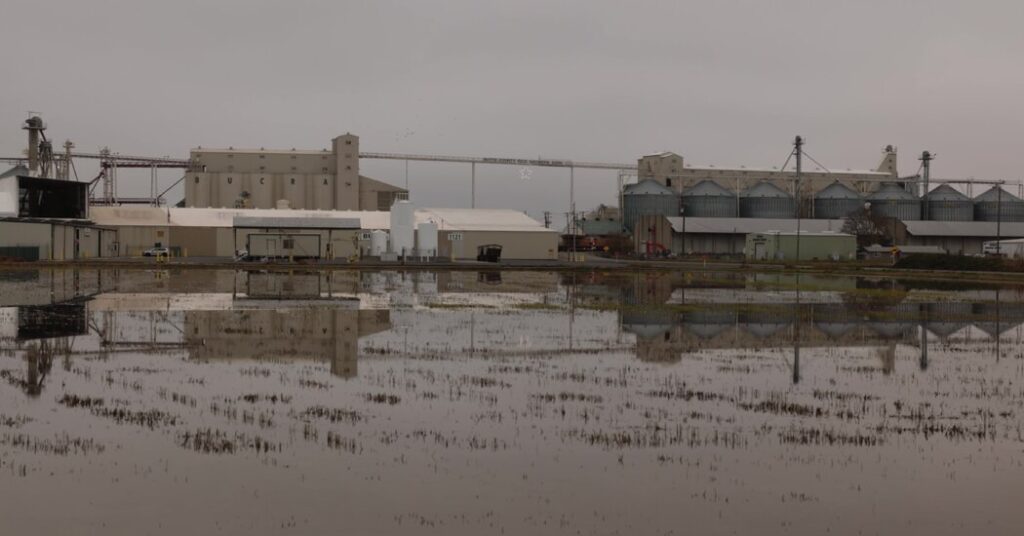
Richvale, population 234, has a cluster of ranch-style homes surrounded by a flat expanse of furrowed plots and flooded rice fields. It sits hundreds of miles north from the tech hubs and balmy beaches that many Americans envision when they think of California.
The almond growers and cattle ranchers here take turns volunteering as firefighters and make sure to remember their neighbors’ birthdays. (If they forget, a whiteboard next to the cafe’s kitchen offers a handy reminder.)
For decades, residents in the rural north have longed for a political earthquake that would cleave their region out of California and allow them to create their own fabled “State of Jefferson” with conservatives in Southern Oregon. They have increasingly felt underappreciated and misunderstood by the liberal Democrats who run California and dominate the congressional delegation — who, in their telling, siphon away their water and prioritize environmental regulations that undercut farmers’ livelihoods.
Now, they not only lack a conservative State of Jefferson, but their entire region is also likely to lose its Republican congressman and have him replaced by a Democrat after next year’s midterm elections. On a recent December day, they were still coming to terms with the fact that California voters, at the urging of Gov. Gavin Newsom, had just approved an aggressive gerrymander designed to turn five Republican seats Democratic.
“People in the cities don’t have a clue what it takes to survive out here,” said Terry Williams, a 75-year-old rice and walnut farmer who moved to Richvale in 1974. “I don’t think people that were born and raised in the cities can represent us to the same extent.”
The 26,000-square-mile First Congressional District currently stretches from the forested Oregon border to the Sacramento Valley breadbasket where farmers grow tomatoes, walnuts, peaches and billions of pounds of rice. The new map splits those voters into different districts. In what remains of the First Congressional District, part of the Sacramento Valley is now combined with a strip of Wine Country liberals north of San Francisco, who prognosticators estimate will turn this seat blue next year.
Soon after voters passed the redistricting measure in November, Mike McGuire, a Democrat and former State Senate president pro tem from the wine region, said he would run in that redrawn district.
Sacramento Valley residents seem anguished but also resigned to their fate.
“There was definitely a feeling of throwing up your hands,” said Gene Lifur, 52, in nearby Orland, known as the “Queen Bee Capital” of North America because it raises so many of the pollinating insect. “You’re going to lose a lot of the interest for voting in the North State.”
In Richvale, Lloyd Horn, 101, finished his food at the cafe and started walking to the door, with a Chico Enterprise-Record newspaper in hand. “I may not be in tomorrow,” Mr. Horn told Mr. Williams, so his lunch companion wouldn’t send out a search party.
The cafe is a nonprofit kept afloat by locals, who wanted to ensure that the area’s solitary farmers had a place to meet. An attached museum boasts of one farmer who grew the world’s largest watermelon in 1979, with a photo of the bulging fruit as evidence.
It shuttered during the Covid-19 pandemic for six weeks until DaNell Millerberg, its manager, saw how much the lack of socializing was hurting Mr. Horn, who lives alone. She reopened the restaurant, but told patrons they had to sit far from each other.
Ms. Millerberg, 62, said the idea of her small town being represented by someone from the Bay Area was “scary.”
“They want to save the opossums and the beavers and the snakes,” she said. “But it’s not good for the farmers, because those animals dig holes in their ditches.”
Perhaps no one is angrier than Representative Doug LaMalfa, the Republican who lives near Richvale and has represented the sprawling region since 2013. Like many of his neighbors, Mr. LaMalfa is a rice farmer.
His tractors and harvesters stood silent on a recent December morning outside of Oroville, about an hour drive north of Sacramento. This time of year, honking geese were floating in the flooded rice fields and feasting on stray seeds.
The congressman drove through part of his 1,900 acres in a green 1974 Ford F-250 pickup truck, describing the laborious process of harvesting, processing and storing rice. He clambered up the steep stairs that led to steel dryers holding this year’s product. That night, he would fly to Washington to present a bill that would restore funding for rural schools.
He was building, unsubtly, toward a point: I understand people here far better than a Bay Area interloper.
Rural residents, Mr. LaMalfa said, grew crops enjoyed by California’s cities but were scorned by those living in cities. He said that Democrats were passing expensive pollution regulations, tearing down crucial dams in the name of protecting salmon populations and introducing wolf packs that attacked their herds. Proposition 50 was the latest affront.
“Their voice is being silenced on how they feel about the issues here, because Newsom and the three-to-one ratio of Democrats wanted to see if they could steal five seats,” Mr. LaMalfa said of the governor and state lawmakers.
“I’m furious,” he added, “because I’ve had my people kidnapped from me.”
The Democrats running against Mr. LaMalfa agreed that rural Californians have been neglected by many in their party. But they also argued that Republicans like Mr. LaMalfa have hurt farmers and agrarian communities with their policies.
The cuts to Medicaid in President Trump’s domestic policy bill, which Mr. LaMalfa voted for this summer, will harm rural hospitals. The president’s tariffs have raised the costs of farming equipment, and retaliatory tariffs by countries like China have hurt farmers’ exports, forcing Mr. Trump to announce a $12 billion bailout. Farm operations also have been upended by federal immigration raids against immigrant workers.
“Trump and LaMalfa talk a big game about farmers, but the policies that they’re actually enacting have driven up costs,” said Audrey Denney, a Democrat in the race for the First Congressional District who lost to Mr. LaMalfa twice before when the district favored Republicans. She grew up on a coastal cattle ranch and has lived in the Northern California college town of Chico for two decades, where she has worked for agricultural nonprofits and teaches about agriculture at the local university.
Mr. McGuire, who lives in Geyserville, a winery-rich town about 75 miles north of San Francisco, said he spent part of his childhood growing up on his grandparents’ ranch, where they harvested grapes and prunes. He said he had heard frustrations from rural residents about losing local representation, but said the best way to assuage them was to “keep showing up. You build trust, and you deliver.”
He said he had been informing residents about his efforts to invest in wildfire prevention, refurbish schools and build affordable housing in his State Senate district, which includes coastal territory from San Francisco’s Golden Gate Bridge all the way to Oregon.
If Democrats oust Mr. LaMalfa, the region would still have Republican control of local government, as Trump supporters have won seats on county boards and city councils. Republicans also represent the region in the State Legislature.
Democrats suggest that Republicans have themselves to blame for the gerrymander outcome in California. Mr. Newsom said that he pursued a Democratic redraw of political maps only after Mr. Trump urged Texas to eliminate Democratic-held seats through a partisan gerrymander. And other states have followed suit after California and Texas.
A host of Democratic voters in Republican-controlled states now face the same lament as voters in rural Northern California. Those living in a district held by Representative Emanuel Cleaver, a Democrat in Missouri, could have a Republican representative for the first time in 12 terms. The same could happen to residents in eastern North Carolina, a region with a large number of Black voters represented by Don Davis, a Democrat, who is likely to lose his seat to a Republican because of redistricting.
In Willows, Calif., a town of about 6,000 west of Richvale, where the local high school mascot is the Honkers because of the preponderance of geese, locals said they felt like unintended casualties in a bigger war, now likely to be saddled with a politician they didn’t want.
“Somebody from Santa Rosa, Oakland, they’re not going to understand, and honestly I don’t think they’re going to take the time to get educated about what’s going on up here,” said Chris Culp, 62, a retired Navy officer who was drinking a Coors Light at the Last Stand Bar and Grill, which prides itself as the last remaining bar in California where patrons stand instead of sit on stools. “We’ve got different needs than the people in the dense cities and the coast.”
To relate to their northern neighbors who farm crops, Mr. Culp imagined that Wine Country Democrats like Mr. McGuire might point out that they grow grapes in their region.
“Well,” Mr. Culp said, “it’s not the same thing.”
Kellen Browning is a Times political reporter based in San Francisco.
The post They Wanted a Conservative State. They Might Get a Democratic Representative Instead. appeared first on New York Times.