The weary griever is used to the expression “I can’t imagine.” It is an expression of distance, and of pity. It is a declaration of separation, an implication of difference and a means of personal reassurance. “I can’t imagine your pain” is a personal promise: I won’t do it, I can’t face it, I’ll never have to. Thank God it’s you, not me. Phew.
And yet some of the best art is art that does precisely this sort of imagining, refusing to look away from the very human condition of grief.
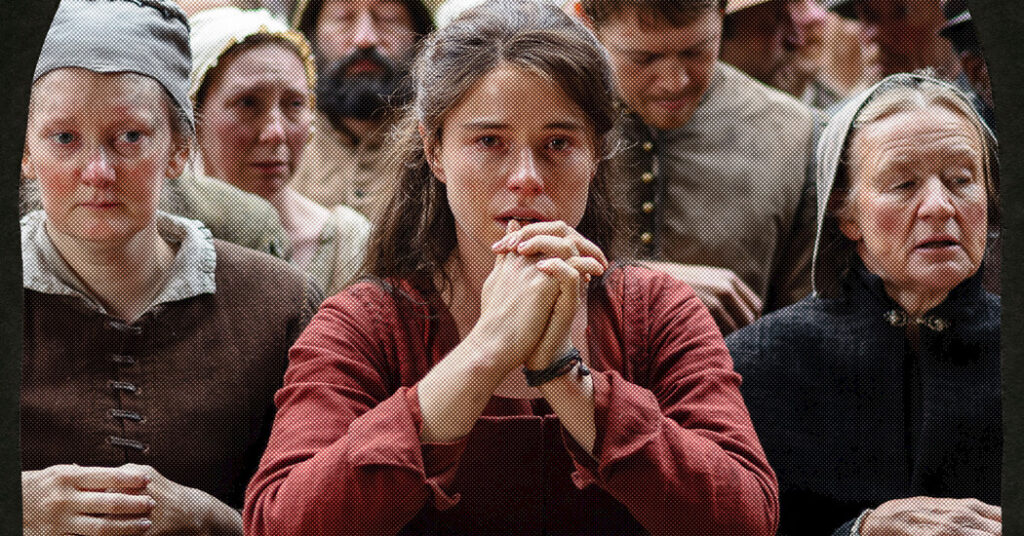
This season, the standouts of such work are “Hamnet,” the film directed by Chloé Zhao and adapted from the magnificent book by Maggie O’Farrell, and the surprise best-selling novel “The Correspondent,” by Virginia Evans.
“Hamnet” is an imagined narrative surrounding the death of Shakespeare’s 11-year-old son, in this telling, to the bubonic plague. In Ms. O’Farrell’s mind, it is this death that inspired “Hamlet,” the tragic play. But the brilliance of both book and film is to focus on the pain not of one of the world’s most famous men, but that of Agnes, Shakespeare’s wife.
In the 16th century, though a child’s life was so easily lost, it was no less shattering an experience. Consider the passage where Hamnet’s twin, Judith, is the first of the two to fall ill, and Agnes attends to her, assisted by her distraught mother-in-law, Mary, herself a bereaved mother: “Agnes is gripping the child’s limp fingers, Mary sees, as if she is trying to tether her to life. She would keep her here, haul her back, by will alone if she could. Mary knows this urge — she feels it; she has lived it, she is it, now and forever.”
And then in a section pulled nearly word for word into the film, spoken wrenchingly by Emily Watson, in the role of Mary. “What is given may be taken away, at any time,” she says. “The trick is never to let down your guard. Never think you are safe. Never take for granted that your children’s hearts beat, that they sup milk, that they draw breath, that they walk and speak and smile and argue and play. Never for a moment forget they may be gone, snatched from you in the blink of an eye, borne away from you like thistledown.”
As heart rending as the scenes of illness and death are — and they are remarkable, in their rendering, the full-bodied scream of a mother who has released her own child from this mortal coil — part of the reason “Hamnet” had me still sobbing in my seat as the credits rolled is how well it captures the lingering drudgery of grief, the dull way in which it silvers the hair and deadens the eyes, the way in which time means so little. It captures completely how the very fact that a person could be here one day, and simply gone the next, scrambles sanity.
“I may run mad with it. Even now, a year on,” Shakespeare says to Agnes, both in the text and the film. “A year is nothing,” Agnes replies, dry-eyed, dry-toned. “It’s an hour or a day. We may never stop looking for him. I don’t think I would want to.” And then it all makes so much sense to see the ghost of Hamlet onstage, to hear the famous soliloquies rendered as not a call for applause but instead, perhaps, a means of resurrection.
In approaching “Hamnet,” novel or film, you know you are preparing for a story both about creation and about loss, about child death and about creativity.
Not so much so for the book “The Correspondent,” which follows the epistolary internal life of a quiet retired lawyer, Sybil Van Antwerp, through her letters to her brother, her friends and her admired favorite writers. This debut novel was published in April and then crept onto best-seller lists, lauded for its remarkable depiction of a septuagenarian woman seeking to find her way in the world, through her own adoption story, her estrangement from her children and her former husband, and finding (however belatedly) new love.
While it’s easy to fall for this curmudgeonly character, what struck me most was how sharply observed the experience is of both Sybil and her ex-husband, Daan, following the accidental death of their son Gilbert, at age 8, in the middle of their lives together.
Losing Gilbert reshaped Sybil’s adult life, her internal world. It caused her to close off her relationships, marital, parental and platonic. “I spent my life afraid, but now I am trying — trying not to be. After all, what is there to fear in the end, really? Loss? I’ve lost the most,” she writes in one of her final letters to her oldest friend. “My grief has been an unbearable noise in my head for decades, and yet now, finally, I have written this letter to you and I’m surprised to find it is finally quiet.”
Sybil denied herself, in the wake of her son’s death. It is in the final reconciliation, and her insistence on not only continuing to hold the memory of Gilbert, but also allowing herself to finally once again come close to others, that makes this book so gorgeous in its depiction of the ineffable. (The loss of a close friend’s child, a boy named Wade, during the edits of this book, Ms. Evans told me, had her re-examine every moment to assess if she had been true to the community-shattering experience of child loss.)
Perhaps what makes these two cultural moments so moving is how, in the depths of their drawing of devastation, they offer a glimpse of hope in their versions of the eternal. It asks us to reconsider how Hamlet plays onstage, or in Shakespeare classes, the world over: “If thou didst ever hold me in thy heart / Absent thee from felicity awhile / And in this harsh world draw thy breath in pain / To tell my story” — and wonder if those words were, perhaps, the chance to see the magic in creating a son, losing him, and creating him, over and over. Hamlet, in this imagining, is then a means of forever capturing a son’s energy, his presence.
When we read how Sybil allows herself to finally fully narrate a story that has haunted her, we see her pain, and her reluctant release, not of love for her child, but in her self-flagellation. In doing so, she, however late, no longer denies herself the humanity of attachment to others.
These women are depicted in the fullness of their loss. We are not offered the luxury, or the ease, of turning away from their pain, nor their belief that they failed in their essential role of mother. We are asked to see how that changed the way they move in the world. And then we are offered the faintest of uplift, to see how both lost children allow themselves to be felt, beyond the grave, thus pushing all of us to imagine not only the destructive nature of grief, but also the tethering of love and loss through time, to all those gone before us.
Both books and the film ask us to consider a person’s passage from a world once whole into a world now broken. It is, unfortunately, not a stretch for me to consider this splintering, having experienced the death of my own older daughter, Orli, at age 14, ravaged not by plague but by cancer, in 2023.
Catastrophic personal loss is not required. We have all, of course, always been able to imagine this: how fragile life is, how close we all are to the membrane between well and unwell. Cocooning ourselves with a lack of imagination is a false form of protection from which we can be rudely removed at any time.
For the griever such art offers a sense of not only being seen, as we are apt to say these days, but being centralized in the story or, at the very least, surprisingly well described. Among the world of grievers, it is my personal suspicion that we bereaved parents are the most unused to seeing ourselves drawn in dimensions — we are all too often characters rendered simply flat. When our stories are told well, it can be almost startling. We’ve been noticed, here in our strange corner, our place on the periphery.
Sarah Wildman is a staff editor and writer in Opinion. She is the author of “Paper Love: Searching for the Girl My Grandfather Left Behind.”
The Times is committed to publishing a diversity of letters to the editor. We’d like to hear what you think about this or any of our articles. Here are some tips. And here’s our email: [email protected].
Follow the New York Times Opinion section on Facebook, Instagram, TikTok, Bluesky, WhatsApp and Threads.
The post The Beauty in Imagining Loss appeared first on New York Times.