In early October, Hoda Abu al-Naja, age 12, landed in a hospital in Gaza because severe malnutrition was ravaging her body.
In six months, she had lost a third of her weight, her doctors said. Her limbs were spindly, her ribs visible, and her shoulder blades jutted from her back like fins. Her brown hair had become wispy and turned the color of hay.
Lying on a gurney, she struggled to speak.
“Before this, I was pretty and such, but in the war I got malnutrition,” she told a local photographer. “Every day, I feel death.”
For months, a wave of hunger had been crashing over Gaza. In August an international panel of experts declared an “entirely man-made” famine in part of the territory and looming famine elsewhere. Aid organizations warned that stringent Israeli restrictions on food entering the territory were fueling widespread deprivation.
Images of severely malnourished children raised global alarm about how Israel was fighting the Palestinian militant group Hamas. By the second anniversary of the conflict in October, the Gaza health authorities had attributed 461 deaths to malnutrition, including 157 children. The rate of such deaths spiked this year.
Israeli officials accused Hamas of stealing supplies and aid groups of failing to get food to people in need. They cast doubt on reports of starving children, saying that many suffered from pre-existing medical conditions.
For Hoda, as for other Gazan children who fell ill, that was true, but not the complete picture.
Hoda was diagnosed in March with celiac disease, which causes the immune system to react to gluten, a protein in wheat and other grains, by attacking the body. An exam in April found that her intestine had been damaged over time, a common result of the disease. It hampered her ability to absorb nutrients, effectively starving her.
Normally, celiac disease is treated with a gluten-free diet, which can allow damaged intestines to heal. But an Israeli siege of Gaza from March to mid-May and later border restrictions deprived Hoda of the foods she needed: gluten-free flour, fruits, vegetables, meats, eggs and fish.
That plunged Hoda and her family into a monthslong struggle to navigate Gaza’s vast shortages and battered medical system to get what she needed to survive.
The New York Times reconstructed Hoda’s case from dozens of medical reports, images showing her symptoms and interviews with her parents and doctors. Three outside physicians who specialize in celiac disease assessed her case. All agreed that it was likely that she could have returned to health had proper food and medical care been available.
They weren’t, and her condition turned critical.
“The progressive decline of this poor girl was 100 percent caused by scarcity of protein-rich food and gluten-free food together with multiple deficiencies in the hospital treatment,” Carlo Catassi, a professor of pediatrics at the Polytechnic University of Marche in Italy and a celiac expert, wrote in an email.
Hoda was so sick by June that her doctors recommended her for treatment overseas. She was still waiting to leave Gaza in October, when she told the Palestinian photographer that she had become “a skeleton.”
“I used to be like any normal child — I would play and all that,” she said. “I long to get treated and travel abroad so that I can live like children in other countries.”
Siege Begins
Hoda’s parents and doctors described her as intelligent and expressive. Her mother, Sumaya, said that Hoda — who was born Hodallah, the second of four siblings — would bake bread in a clay oven, make dinner and put her younger siblings to bed.
Her father, Hussein, who works in the Internal Security Forces for Gaza’s Hamas-run government, said she not had serious health problems.
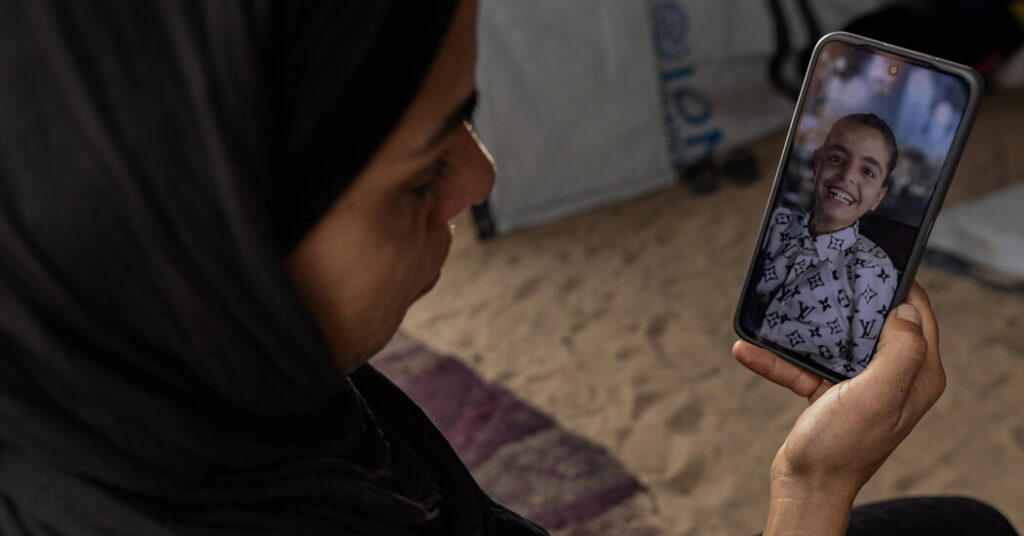
Photos from before she fell ill show dark hair, healthy skin and a broad smile.
On March 2, Prime Minister Benjamin Netanyahu announced that Israel was imposing a siege on Gaza to punish Hamas for refusing to accept a cease-fire proposal.
“As of this morning, all entry of goods and supplies into the Gaza Strip will cease,” his office declared.
Nearly 17 months had passed since Hamas led an attack in which 1,200 people were killed and 250 more taken hostage. During the war that assault started, Israeli bombardments killed tens of thousands of Gazans, according to health officials there, who don’t distinguish between combatants and civilians. Much of the territory was in ruins, and its health system was in shambles.
Throughout the war, Israel, which controls Gaza’s borders, had restricted what could enter, saying it did not want outside supplies to strengthen Hamas. The March blockade was more severe, almost completely sealing off the territory.
A spokesman for the Israeli military office that deals with humanitarian agencies in Gaza said that Israel facilitates the entry of a variety of foods, including fruits, vegetables, meat and other products, based on requests from aid organizations and other countries.
During the conflict, Hamas has shown reckless disregard for Gaza’s civilians by fighting from residential areas and rejecting proposals that could have ended the war because they would have removed the group from power.
Two days after the blockade began in March, Hoda turned 12.
Like most Gazan families, hers had moved repeatedly to escape the war and lived in a crowded tent camp near Gaza’s Mediterranean coast.
In March, her complexion turned yellow and she developed exhaustion and diarrhea, her parents said. Ahmed al-Farra, the first doctor she saw, said in an interview that she had tested positive for celiac.
Some celiac patients show few symptoms until after their intestines have been damaged, doctors say, which appears to be what happened to Hoda.
In April, a pathologist inspected a sample from her small intestine and wrote in a report reviewed by The Times that Hoda was suffering from a stomach infection and a damaged intestine.
Dr. Catassi, the celiac expert, said that proper treatment would have excluded gluten from her diet and included intravenous feeding, steroids, antibiotics and the gradual reintroduction of appropriate food.
“This treatment would be 100 percent effective in saving the girl,” he said.
But treatment in Gaza was limited.
Hoda’s family received gluten-free flour and enriched peanut bars from aid groups, they said. But shortages made such food scarce, and Hoda’s hands, feet and face swelled.
In Nasser Hospital in the southern city of Khan Younis, she was diagnosed with “severe acute malnutrition,” said Dr. al-Farra, who heads the pediatric ward.
Dealing with their own shortages, the doctors gave her milk, dietary supplements, rice and grapes, her mother said. Blood transfusions buoyed her temporarily, and she was discharged.
Her decline resumed. Her hair thinned further, and pains developed in her joints and her chest, her parents said.
In June, she entered a malnutrition treatment center supported by Doctors Without Borders, where she received antibiotics, anti-worm medication and a diet to help her rebound. A medical report said she had level three edema, meaning she was so malnourished that her swollen skin did not rebound quickly after pressure was applied. Her condition improved somewhat after 12 days, the report said, so she returned to her family’s tent.
Her health soon faltered again, and her parents grew frustrated that the doctors could not reverse her downward spiral.
“My daughter became a puzzle the doctors could not solve,” her father said.
A Way Out?
As summer progressed, signs of extensive hunger in Gaza became stark.
The number of children admitted to malnutrition centers supported by UNICEF increased, doubling from June to July to more than 16,000. The total peaked in August at 17,300, even though Israel had let in more food since late May, a lag that aid groups blamed on insufficient quantities and distribution problems.
Aid groups sounded the alarm.
In July, the U.N. World Food Program said that one in five Gazans faced starvation and that almost 100,000 women and children were suffering from severe acute malnutrition.
“I don’t know what you would call it other than mass starvation, and it’s man-made,” Tedros Adhanom Ghebreyesus, the head of the World Health Organization, said. “This is because of blockade.”
Days later, President Trump reacted to images of emaciated Gazan children, calling it “real starvation.”
Israeli officials denied the gravity of the crisis.
A government spokesman, David Mercer, told Sky News, “There is no famine in Gaza — there is a famine of the truth.”
In August, Mr. Netanyahu told journalists that Israel had been working “to prevent a humanitarian crisis while Hamas’s policy has been to create it.”
Hoda’s health followed a troubling pattern. During hospital stays, she rebounded and spent time coloring boats, rocket ships and sailboats. She got worse after being discharged.
The charity that had provided gluten-free flour ran out, her parents and an official at the organization said. Her family struggled to find enough food for themselves, much less the rarer items that Hoda needed.
“Breakfast, forget it — and lunch,” her mother said. “Forget dinner. The essential meal was whatever you could provide.”
Hoda needed vegetables, she added. “Either there were none, or the prices were very high.”
A hospital report from late June said that Hoda had “malabsorption syndrome,” which can result when celiac patients eat too much gluten. Damage to Hoda’s small intestine severely limited the nutrients it could take into her body from the food she ate. That had caused swelling and low height and weight for her age, known as failure to thrive.
The report said the gluten-free diet she needed was “not available in Gaza.”
Her parents and her doctors decided that she should go abroad for treatment.
“She was in the heart of famine — no fruit, no meat, no eggs,” her father said.
To leave Gaza, she needed a referral from a Palestinian medical committee, security clearance from Israel, and another country willing to accept her. The World Health Organization would coordinate.
The number of sick and injured during the war had overwhelmed Gaza’s evacuation system, and only a fraction made it out. So there was no guarantee that Hoda’s case, which is now being investigated by the Palestinian committee, would be approved.
In August, after a long hospital stay, Hoda returned to her family’s tent to wait.
‘Play Like Other Kids’
Tent life was hard, and Hoda’s health made it worse.
Shortages continued, and food prices were high.
Hoda’s father recalled buying her an apple for $10. He once treated her to a candy bar — for $15.
“I needed to be a millionaire to keep her alive,” he said.
He called it “psychological torture” to eat bread that he could not share with her because it would harm her.
“She felt terrible, and we were starving,” he said.
By autumn, she had shortness of breath, body pains, ceaseless diarrhea and extreme fatigue, her parents and doctors said. Her skin was dry and scaly, and eating or drinking made her vomit.
On Oct. 4, she entered the emergency room.
In Hoda’s interview with the Palestinian photographer soon after, she slumps on a hospital bed, her thin arms, her light hair and the bags under her eyes giving her the look of an elderly woman rather than a child.
“I wish I could play like other kids,” she said. “Every day, my siblings go to the sea, but I can’t go. Every time I want to play, I fall down.”
On Oct. 9, her health failed. A doctor wrote on a medical report that at 10:30 a.m., “The girl moved to the mercy of God Almighty.”
The report attributed her death to septic shock, an infection that overwhelmed her immune system, and severe acute malnutrition.
Her family buried her that afternoon.
Later that month, Hoda’s parents received a surprise call from the W.H.O. It had not been informed of her death.
Her request for medical evacuation was moving forward.
Italy had agreed to welcome her for treatment.
In early November, Israel, which was also unaware that she had died, approved her departure.
Aaron Boxerman contributed reporting from Jerusalem.
Ben Hubbard is the Istanbul bureau chief, covering Turkey and the surrounding region.
The post One Gazan Girl’s Fight to Survive Extreme Hunger appeared first on New York Times.