Gree Say recognized the suspicious spots down the toddler’s throat only from her textbooks. She has been working as a nurse for more than a decade, but had never been confronted with a case of diphtheria, a potentially fatal disease.
“This isn’t something we have seen here before,” she said.
The Mae Tao Clinic, where Ms. Gree Say works, opened in the Thai border town of Mae Sot in 1989, after a military crackdown in Myanmar, also known as Burma, drove many people to seek shelter in the borderlands.
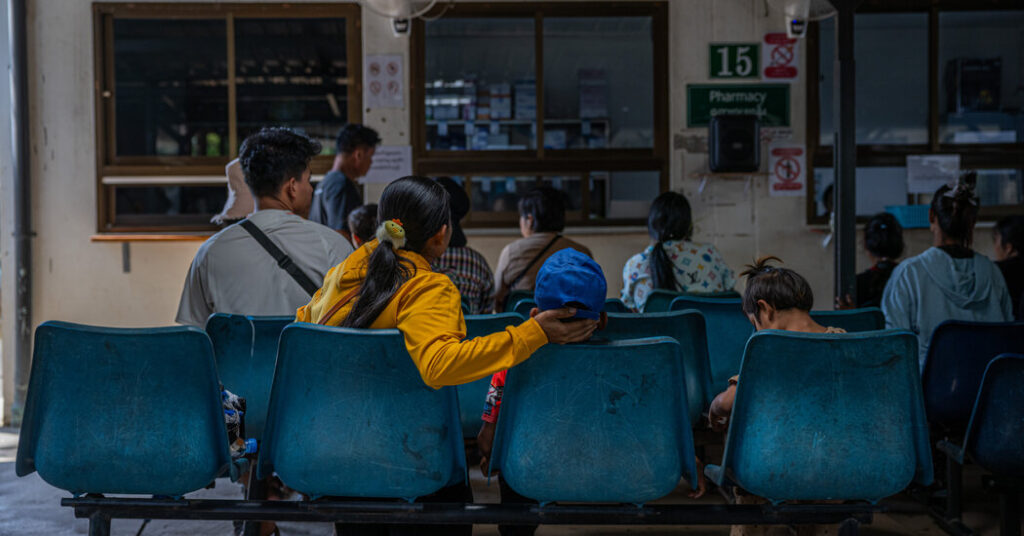
On a recent Monday at the hospital Burmese women cradled fussy babies, clutched plastic bags with their medical records and patiently waited their turn. The number of patients at the hospital has soared in recent years, as a coup in Myanmar ignited a civil war, which plunged the nation’s health system into collapse. Hospitals have been bombed, doctors have gone on strike, budgets have been cut and civilians have fled to neighboring nations.
The Myanmar border is so close to the Mae Tao Clinic that sometimes medical staff can hear the artillery and see smoke billowing in the sky.
Doctors there say they are trying to handle as many patients as they can, to reduce the burden on the Thai health system. On bad days, that can mean treating double the number of the sick than before the war.
Myanmar’s health care system has been hollowed out over decades by juntas that prioritized weapons over health budgets. While there was some progress on disease control during a civilian government, that was reversed when the military took back power in 2021.
Myanmar is among the countries with the largest number of children who have never been vaccinated, according to UNICEF. Preventable diseases such as whopping cough and diphtheria have been on the rise, according to doctors working in Myanmar.
The military is even targeting the health care system.
The World Health Organization has documented 67 military attacks on health facilities this year. An airstrike on a 300-bed hospital in a rebel stronghold near Myanmar’s border with Bangladesh killed at least 34 people this month.
Villagers and rebel forces are seeking shelter from airstrikes in Myanmar’s jungles, which are infested with mosquitoes that carry diseases like malaria. Incredulous doctors in Myanmar say they treat patients who have suffered from malaria up to 20 times.
Neighboring Thailand was on track to eradicate malaria by 2024, according to a W.H.O. report in 2021. But the coup in Myanmar that year derailed progress. With the escalating conflict, the numbers of malaria cases instead shot up again.
Uprooted by fighting, many of Myanmar’s more than three million displaced people are living in rebel-controlled areas on the periphery of the country, where their medical treatment is often disrupted. They also lose access to disease-prevention measures such as mosquito nets, condoms and masks.
“Many people die, not because of the fighting but because of illness,” said Aye Thida, who supports H.I.V. patients at the Mae Tao Clinic.
In the same Thai border town is Maesot General Hospital, a bustling facility that has been treating Myanmar citizens for decades. The war has driven up its caseload by around 50 percent, prompting burned-out doctors to resign.
But the hospital doesn’t have much of a choice but to treat Burmese patients, according to the deputy director, Dr. Rojanasak Thongkhamcharoen.
“If we don’t care about Myanmar’s health situation, we might face re-emerging diseases such as polio,” he said. A case of the disease, which can paralyze patients, was confirmed this summer in northeastern Myanmar.
“Communicable diseases know no borders,” he added.
Last year, cholera broke out in one of the many scam centers that thrive in Myanmar’s lawless conflict zone. Hundreds fell sick and Thailand sent medicines to stop the deadly disease from spilling across the border. Still, at least four people contracted it, including two Thai citizens.
“This crisis should keep people awake at night,” said Dr. Voravit Suwanvanichkij, an epidemiologist who has worked at the Thai-Myanmar border. “It’s not a huge stretch to say the vast majority of Burma is now an epidemiologic blind spot.”
Dr. Voravit feared that, without a functioning surveillance system, threats such as virus mutations might be detected too late. U.S. cuts to foreign aid earlier this year affected health programs and have “compounded the problem,” he said.
In a worst-case scenario, the situation in Myanmar could turn into a problem for global health security, experts say.
If malaria is not treated properly, drug resistance can build up, making the disease harder to treat. Researchers have previously documented a drug-resistant strain of the disease spreading from Southeast Asia to Africa.
.
“If Thailand didn’t control the situation, we would be dying here,” said Khin Nyein Nyein, one of four Burmese doctors at Maesot General Hospital, who used to be posted around the world for Doctors Without Borders.
Not long ago, she treated a cook, who was working in a scam center, for tuberculosis. “If this man decides to go back home to Nepal, he might infect everybody on the plane with TB,” she said.
In the wake of the 2021 coup, Dr. Khin Nyein Nyein was working on the Indian side of the border with Myanmar. The more the conflict escalated, the more H.I.V. and TB patients she had to treat. “A dentist was running their hospital. What can he do?” she said.In a settlement of bamboo cabins, among mango and jackfruit trees, No Zin Thant Zaw, 21, is counting the days until he can continue the education he came to Thailand for. He is quarantining with dozens of other Burmese tuberculosis patients at the so-called “TB village,” a clinic run by the Shoklo Malaria Research Unit.
The facility is reachable only by dirt roads, tucked away from fearful Thai communities.
Although the days at the village blur into each other and the isolation weighs heavily on him, No Zin Thant Zaw says he is grateful to be here. “In Myanmar, I could not get treatment like this,” he said.
The post Myanmar’s Civil War Pushes Infectious Disease Over Its Borders appeared first on New York Times.