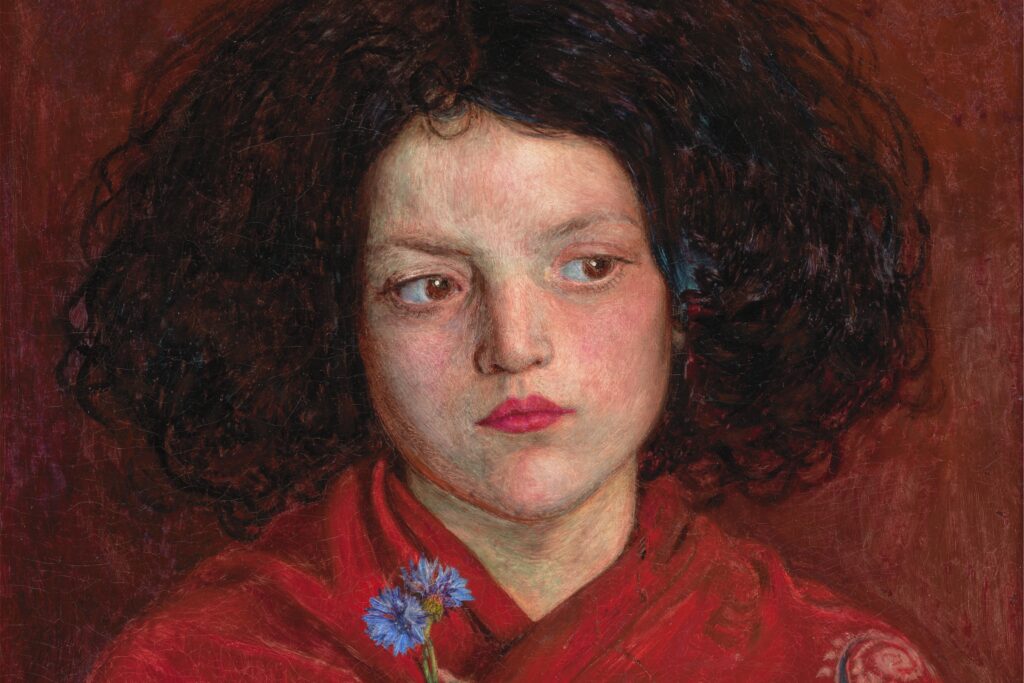
Watchful, assessing and faintly disgusted, this young Irish girl stares out of a tight frame, her own fiery interest in a world we can’t see burning through our voyeuristic interest in her.
She was painted in 1860 by Ford Madox Brown, who had encountered her selling oranges on a London street. He dressed her (unless she was already so dressed) in a shawl typical of impoverished Irish immigrants, then put a cornflower in her hand.
Brown was at that time nearing completion of his masterpiece, “Work,” a vast Victorian set-piece heroizing manual labor into which he put 13 years of his own labor. Although he was never a full member, he was associated with the Pre-Raphaelite Brotherhood, a band of young painters who, at mid-century, kicking against sterile academic tradition, packed their pictures with naturalistic detail, high-keyed color, heavy symbolism and high moral purpose.
“Work” was Brown’s attempt to grapple with Thomas Carlyle’s “Condition of England” problem — basically, what to do about the coexistence of England’s exploding material wealth and shocking conditions for a majority of the population, along with a widely felt crisis of spiritual purpose.
Carlyle, whose account of the French Revolution left the British recoiling from the prospect of class revolt, put all his faith in the idea of the heroic: He believed in “Great Men” and their great deeds.
In “Work,” which hangs in the Manchester Art Gallery, Brown painted a paean to the heroic nature of labor. The men at the center of the picture, armed with shovels or righteously glugging beer, are like gods who have deigned to install a modern sewerage. But Brown fills out his cast with members of the leisure class, orphans and effeminate street sellers — people (we are to surmise) who haven’t yet learned the value of labor.
Commissioned by Thomas Plint, a stockbroker who was also an evangelical lay preacher, “Work” (which features Carlyle himself in a vignette off to one side), is an astonishing production. But it’s also a painting you would use to demonstrate what’s so awful about a great deal of 19th-century British art: It’s moralistic, hypocritical and drenched in clichés.
“The Irish Girl,” on the other hand, is one of the glories of the Yale Center for British Art in New Haven, Connecticut. Brown met the girl while looking for subjects for “Work,” much of which he painted on location in London’s Hampstead neighborhood.
These were small studies of women or children, intended for domestic interiors. In the same year he painted “The Irish Girl,” which measures a little under a square foot, Brown made a related study — intended as a counterpoint to this disreputable girl — of an English boy (the artist’s own son Oliver) dressed in fine clothes, holding a toy whip and a spinning top.
If “The English Boy” recalls Hans Holbein, “The Irish Girl” harks back to the 17th-century Dutch tradition of “tronies” — head studies of anonymous sitters that were, for the artist, above all exercises in light, form and expression; Vermeer’s “Girl With a Pearl Earring” is the most celebrated example.
“The Irish Girl” could well be renamed — with a nod to Vermeer — “Girl With a Cornflower.” But she won’t be so easily turned into a male artist’s cipher.
In fact, Brown’s painting strikes me as a beautiful (and, no doubt, unintentional) rebuke to Victorian heroism.
Look at the subtle, questioning kink in her eyebrow: I’ve seen this expression on the faces of wives and girlfriends at dinner parties as the men at the table hold forth.
This girl is an intelligent skeptic, a gut-level doubter, profoundly unimpressed by opinionated, turgid prose stylists like Carlyle (if she were ever to read them) and by God-bothering stockbrokers like Plint, and disgusted, no doubt, by the Victorian gentlemen who, observing her poverty and the single flower she is holding, would have assumed she was also selling sex.
But credit to Brown. The mottled reds and creams of her face, captured in exquisitely aerated, multidirectional brushstrokes that flow across the contours of her face like magnetized iron filings; the subtle touches of blue in her exploding dark hair and in the whites of her eyes, both chiming with the cornflower; her meaty chin, her glossy brow and her electric, hazel eyes … they leave you in no doubt: This guy could really paint.
About this story
Image credit: Yale Center for British Art
The post Is this girl’s indelible expression a rebuke to male baloney? appeared first on Washington Post.