
This week Brown University scrambled to shield itself from blame in the aftermath of its deadly Dec. 13 campus shooting, placing its head of public safety on “administrative leave.”
But the facts are undeniable — and damning.
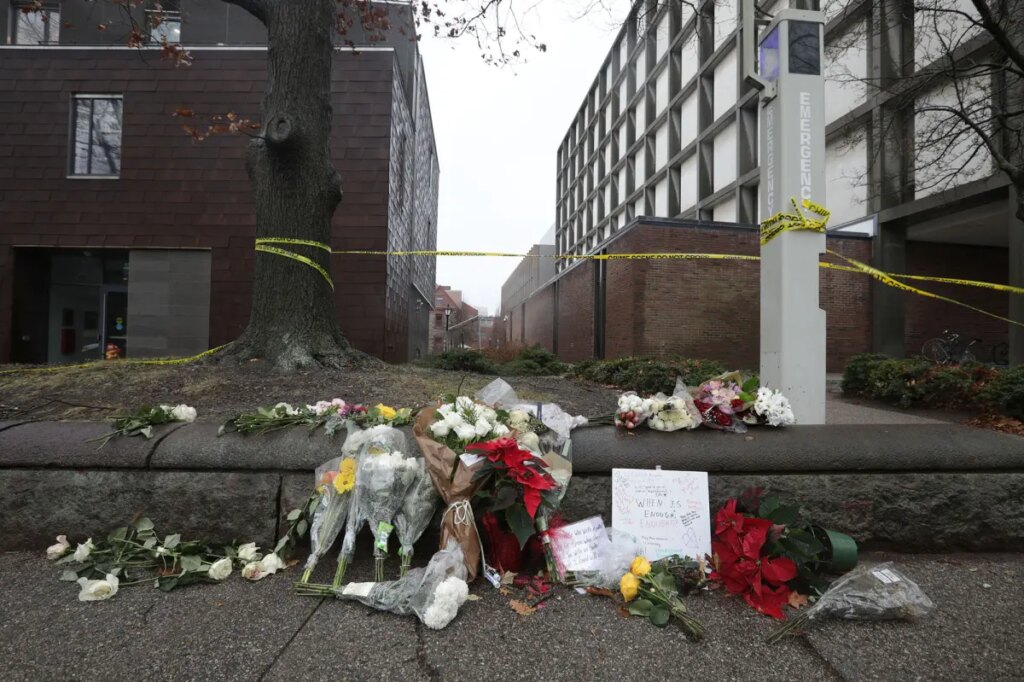
That Saturday, at 4:03 pm, a gunman wearing a partial face mask walked into the Barus & Holley Engineering Building on the Brown campus in Providence, RI, during finals study sessions.
He entered Room 166 and fired approximately 40 rounds, murdering two students, 19-year-old Ella Cook and Mukhammad Aziz Umurzokov, 18.
Nine others were shot, seven of them critically wounded.
Then the shooter calmly walked out, exited onto a public street and vanished like a ghost.
Here’s the first hard truth: That building had only two exterior cameras.
Room 166 had zero. Same with the building’s hallways and exits.
No camera was there to capture the shooter entering or leaving.
No camera caught his face head-on.
Now consider this: Brown’s president has lived since 2012 in the official presidential residence —protected by dozens of exterior security cameras.
That is not an accident. It’s a statement of priorities.
For comparison, a 400,000-square-foot Walmart store typically deploys about 300 cameras — to protect shampoo, razors and laundry detergent.
Brown University, an Ivy League college with an $8 billion endowment, operates roughly 1,200 cameras across 146 acres.
That means your average Walmart has roughly four times the camera density trained on its toothpaste than Brown has protecting its students.
Cameras don’t stop violence in the instant it happens. They stop the next act of violence — because shooters are not ghosts.
Someone always knows them.
Brown’s leadership made four unforgivable decisions that made this horror exponentially worse.
First, they did not circulate photos of the shooter for nearly 48 hours.
Second, they failed to send an emergency alert to students for roughly 20 minutes after the shooting.
Third, they did not immediately activate campus sirens that exist for just such an emergency.
Fourth and most damning, they chose not to integrate their campus camera system with the Providence Police Department’s Real-Time Crime Center, one of the most powerful crime-fighting tools in modern law enforcement.
RTCCs create what professionals call identity convergence: a single operational brain pulling in city cameras, traffic cameras, license-plate readers, transit feeds and private-sector video in real time.
New York City has used such a system for years through the Lower Manhattan Security Initiative and the Domain Awareness System — with extraordinary results.
Brown rejected it. Its leaders chose blindness.
Had Brown opted in, investigators would not have been reviewing footage of the shooter hours later, as if it were 1995.
They would have had immediate image extraction and rapid multi-agency analytics.
They could have put out an instant be-on-the-lookout notice and had public recognition within minutes.
Because in this case, modern video systems would have made all the difference — if experts had been able to perform gait analysis, a tool few outside law enforcement understand.
Gait — arm swing, hip rotation, posture — is a biometric signature, as unique as a fingerprint.
You can hide your face, change your clothes and wear a mask, but you cannot hide how you walk.
A campus custodian saw the shooter casing the engineering building more than a dozen times prior to the attack.
According to this witness, the shooter walked with a very distinctive limp.
That limp is a massive identifier — if cameras exist to capture it.
At Brown, they did not.
Then there’s the drone — or rather, the absence of one.
It took three minutes for police to arrive after the shooting.
But a basic first-responder drone could have been airborne in under 90 seconds, tracking the shooter live, confirming his direction of travel and feeding real-time intelligence to responding units.
Brown had none.
Two days later, that same killer drove roughly 75 miles to Brookline, Mass., where he murdered MIT professor Nuno Loureiro at his home.
Loureiro is dead because the shooter remained unidentified and free.
Brown could have changed that.
This was not about money.
It was about mindset.
For years, Brown has embraced an anti-surveillance, anti-evidence, “privacy-first” culture — treating cameras as political statements instead of life-saving tools.
Michael Greco, an 18-year veteran of the Brown University Police Department turned whistleblower, says the security program under now-suspended Chief Ronald Chatman was called the “Queen’s Army” — a system built around so-called “perception-sensitive enforcement.”
Whatever that means, it did not mean protecting students.
The cost of that mindset is now measured in bodies.
And when Brown University failed to identify a masked, limping shooter in real time, it didn’t just miss a suspect — it signed a death warrant for another man 75 miles away.
Patrick J. Brosnan is a former NYPD detective and founder of Brosnan Risk Consultants, the nation’s largest privately held security company.
The post How Brown University’s leftist lapses set innocents up for death appeared first on New York Post.