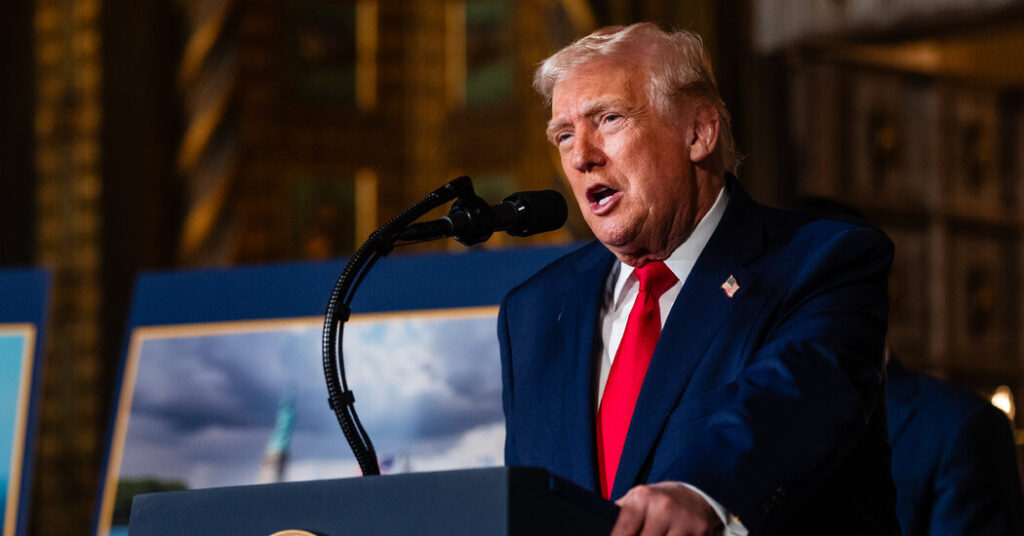
After the U.S. military launched airstrikes on sites in northwestern Nigeria on Thursday, President Trump said the targets were Islamic State terrorists “who have been targeting and viciously killing, primarily, innocent Christians.”
But analysts say that the situation on the ground is far more complicated.
Sokoto State, which was hit by more than 12 Tomahawk missiles Thursday night, is populated overwhelmingly by Muslims, who bear the brunt of terrorist attacks there, according to analysts and groups that monitor conflict. Bishop Matthew Hassan Kukah of Sokoto said recently that the area does “not have a problem with persecution” of Christians.
And analysts are divided over the existence of ties between insurgent groups in Sokoto and the Islamic State.
Some analysts say that the violent attackers in Sokoto, which are colloquially known as the Lakurawa, have links to the Islamic State’s Sahel Province branch, which is mostly farther north and west, in Mali, Niger and Burkina Faso.
But other analysts say evidence of those links is inconclusive, as the identity of the Lakurawa group remains very murky. Its militants have operated in Sokoto and other Nigerian states for years, winning popularity by fighting local bandits at first and then turning on the rural population.
“There’s a lot of fluidity and not a lot of ideological alliances,” Alkasim Abdulkadir, a spokesman for Nigeria’s foreign minister, Yusuf Tuggar, said of the Lakurawa.
Even as the Nigerian authorities have disputed Mr. Trump’s claims about a Christian “genocide,” they have chosen to respond to his threats by cooperating with his administration. Nigeria has taken the opportunity to use U.S. firepower against insurgents that have plagued rural communities in the country’s northwest.
The Nigerian government made it clear on Friday that it was on board with the airstrikes, which came after a phone call between Secretary of State Marco Rubio and Mr. Tuggar “around bilateral issues and military cooperation,” according to Mr. Abdulkadir.
Mr. Tuggar relayed the conversation to Nigeria’s president, Bola Ahmed Tinubu, who approved the strikes, Mr. Abdulkadir said. He added that Nigeria had provided American forces with intelligence for the airstrikes.
The strikes were “meant to deter further operations of bandits in that area,” he said. “Air power is something that they can’t fight against.”
Mr. Abdulkadir said there were ongoing conversations with the U.S. authorities about possible further military action.
What the strikes immediately achieved is not clear, though reports emerged on Friday morning that one of the areas that was hit was the outskirts of Jabo, a town in Sokoto that analysts said was not known to harbor any terrorist or bandit groups.
Shafi’u Aliyu Jabo, 35, a resident of Jabo, described in an interview hearing a strike in the middle of the night.
“We heard a booming sound like that of an aircraft, coming from the western part of the town and going east,” he said. “Then a sound like a siren, followed by a powerful air force that nearly shifted the roofs of our houses.”
He said that nearby residents, thinking an aircraft had crashed, rushed to a nearby farm, where they found pieces of ordnance. A farmer’s hut had been set on fire, but nobody was hurt, he said. He added that he did not know of any terrorist camps in the area.
Nigeria is a deeply religious nation home to hundreds of millions of Muslims and Christians, and Sokoto State is home to the sultan of Sokoto, the spiritual leader of Nigeria’s Muslim population.
Last month, Mr. Trump threatened to strike Nigeria or send troops there if the government did not “move fast” to stop what he has called a “genocide” against Christians in the country.
Nigeria, Africa’s most populous nation, is racked by widespread, complex violence against Muslims and Christians alike, and the Nigerian government has rejected Mr. Trump’s characterization. But it also sent a delegation to Washington, D.C., to speak with American officials about security cooperation.
Vincent Foucher, a research fellow with the National Center for Scientific Research in France, said that the strikes would be likely to resonate with some American Christians and political allies of Mr. Trump who have amplified the narrative that Christians in Nigeria are being singled out for persecution.
“It’s a good way for the U.S., for Trump, to show to the American evangelical right that he’s doing something about Nigeria,” Mr. Foucher said. For the United States, he added, the strikes address both “Trump’s desire for publicity and the American security establishment’s concern about the Islamic State.”
Still, some in Nigeria were puzzled by the choice to strike Sokoto State.
Analysts say that the terrorist group in Nigeria with the best documented links to the Islamic State is in northeastern Nigeria, on the other side of the country from Sokoto State. That group, Islamic State West Africa Province, or ISWAP, splintered off from Boko Haram, another jihadist group.
“If the bomb had been dropped in Sambisa Forest, nobody would be surprised,” said Kabir Adamu, a security analyst, referring to an area of northeastern Nigeria that was taken over by Boko Haram and later by ISWAP. “Because everybody kind of knows that’s one of the strongholds of the target group.”
Terrorist groups operating in the Sahel, an enormous region across north-central Africa, have been moving down into Nigeria’s northern border area and to neighboring coastal countries like Benin and Togo, but that is a recent phenomenon, analysts say.
The groups have been operating mainly in Mali, Niger and Burkina Faso, turning the Sahel into a global terrorism hot spot responsible for over half of all terrorism-related deaths last year, according to the United Nations. Analysts say their encroachment farther south reflects an ambition to recruit and secure new logistical hubs, not to persecute Christians, as the Trump administration has claimed.
Ruth Maclean is the West Africa bureau chief for The Times, covering 25 countries including Nigeria, Congo, the countries in the Sahel region as well as Central Africa.
The post Facts Clash With Trump Claim of Hitting ISIS and Shielding Nigerian Christians appeared first on New York Times.