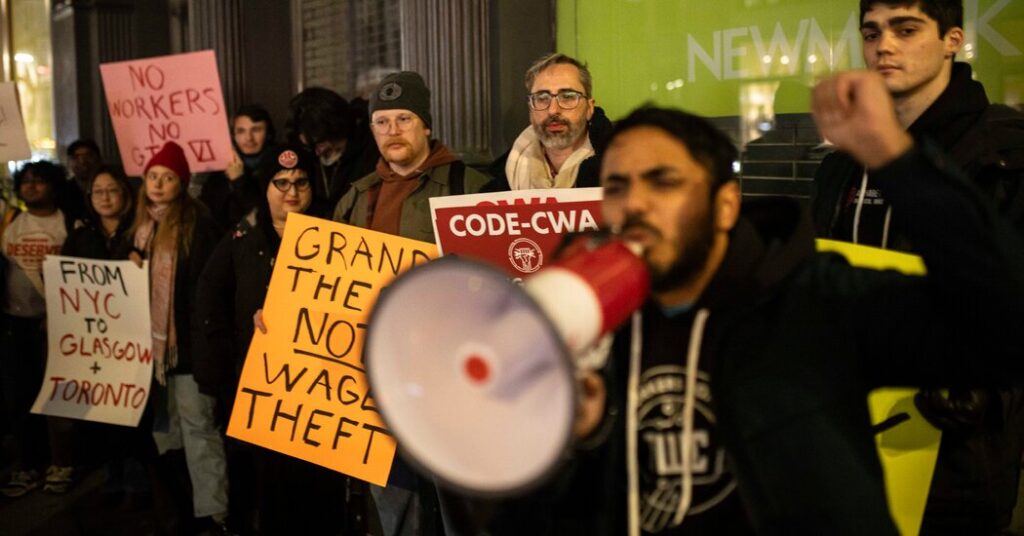
Five weeks into a strike at the crowdfunding site Kickstarter this fall, employees were getting anxious. Their union’s strike fund was dwindling, making it harder for some to cover living expenses, and they were unsure if the company would make more concessions.
In a sign of their desperation, some employees redoubled their efforts to raise money for the fund through QR codes on their phones. A Kickstarter engineer, Dannel Jurado, collected a few hundred dollars at a victory party for Zohran Mamdani, the New York City mayor-elect.
But the next week, Kickstarter made offers the union would accept, creating a new minimum-salary formula and helping to preserve a beloved four-day workweek. The shift caught striking employees by surprise and brought an end to the work stoppage.
“Once we had an agreement on the last article, it was like, ‘OK, so what do we do now?’” Mr. Jurado said. “Does that mean we have work on Thursday?”
Over the past few years, U.S. tech companies have laid off hundreds of thousands of employees in a retreat from a pandemic-era hiring spree and an effort to free up cash to invest in artificial intelligence. Many executives have applauded the ruthless management style of entrepreneurs like Elon Musk.
Even tech companies once thought of as relatively progressive, like Google and Microsoft, have fired employees who have protested over political causes. The companies said the protests were disruptive and potentially unsafe.
But tech worker activism has continued amid the crackdown, albeit more cautiously. “It’s driving the organizing underground, but people are organizing,” said Emily Mazo, a Ph.D. student at Columbia University who studies tech work and tech worker activism.
Google offered thousands of voluntary exit packages this year after the Alphabet Workers Union, named for Google’s parent company, launched a campaign calling for improvements in job security, like a shift away from involuntary layoffs. A Google spokesperson said that the campaign had not influenced the company and that it had listened to employees directly through internal channels.
After Amazon laid off 14,000 workers this fall, hundreds of employees signed an open letter to management seeking a bigger say in how to carry out layoffs that may result from A.I.
And over the past two years, a wave of unionizing in the video game industry that began with low-paid testers spread to designers and engineers, who joined unions at the Microsoft-owned studios that make games like Fallout, Doom and World of Warcraft. A group called the Tech Workers Coalition saw the number of subscribers to its newsletter grow to nearly 7,000, from about 4,000, during the same period, according to data shared by an organizer. The list includes many current and former employees of big tech companies.
This persistent activism has to do with a longer-term shift in how engineers and other tech workers see themselves. For decades, they identified as high-skilled professionals who stood apart from the usual management-labor divide. They were well compensated, could change jobs easily and had the freedom to allocate their time as they saw fit. Because of generous stock grants, many thought of themselves as co-owners of their companies, even future founders and investors, making them unlikely candidates to join labor unions.
But these days, with the notable exception of those atop the A.I. wave, more and more tech employees see themselves as rank-and-file workers stuck in a conventional conflict with management, according to interviews with workers and organizers. And few companies epitomize that shift more than Kickstarter.
The Tech Worker Awakening
Like many white-collar workers who end up in a labor dispute, the Kickstarter employees didn’t start off wanting a union. What they wanted was to beat up Nazis, in a manner of speaking.
In 2018, an artist began raising money on the platform for a satirical comic book called “Always Punch Nazis,” which included drawings of the antifascist deed in question.
Kickstarter was relatively small, employing about 150 people, and had made modest profits for several years. But it attracted idealistic workers who liked its mission of helping creative people get projects off the ground.
After Kickstarter decided to pull the “punch Nazis” campaign amid complaints from the right that it encouraged violence, employees argued that the company shouldn’t cave to right-wing critics and asked that the post stay up.
The employees got their way, but it was one of a handful of incidents that prompted them to organize a union. (Nearly 90 employees were eligible to join the union at the time, but layoffs helped reduce the number to around 60 today.)
“It’s easy for management to paint a picture of a mission-driven company until they actually have to live up to that,” said Clarissa Redwine, then a Kickstarter employee who now helps organize other tech workers. “Those are defining moments.”
A similar pattern was playing out across the tech world. Many people enter the industry for idealistic reasons — an ambition nurtured with company mottos like “Don’t Be Evil” — only to become disillusioned when they speak up for a principle and management responds harshly, said Ms. Mazo, the doctoral student.
In a recent academic paper, she and two co-authors analyzed dozens of instances of activism at tech companies like Google and Microsoft — over issues like whether a technology would be used for military purposes or immigration enforcement — and found that labor organizing often followed. They hypothesized that it was because employers had cracked down.
“We saw professionals going, ‘Oh, I’m actually in a worker-boss relationship,” Ms. Mazo said.
Prominent tech executives and investors reacted to these developments in different ways. A few, including Microsoft’s president, Brad Smith, decided their companies had more to gain than to lose by staying neutral when employees tried to unionize. Others regarded years of activism and organizing as evidence of left-wing radicalism.
“The kids turned on capitalism in a very fundamental way,” the tech investor Marc Andreessen told The New York Times’s Ross Douthat this year.
Beginning in late 2022, tech and video game companies reinforced this worker identity as they began to lay off tens of thousands of employees. They often pressured those who remained to use a variety of A.I. tools to meet ever-increasing output goals. And they began monitoring them more closely, sometimes making them feel more like factory workers than highly paid professionals.
Among the exceptions are artificial intelligence researchers, who have been the beneficiaries of billions of dollars of investment and spending by tech companies. JS Tan, a former Microsoft engineer who is now a Ph.D. student at M.I.T. and wrote the paper with Ms. Mazo, said that those researchers had effectively displaced app and web developers as some of the most sought-after tech workers, and that many software developers increasingly feared downward mobility.
Meghan Day, a Google software engineer who was recently elected treasurer of the Alphabet Workers Union, said workers were demoralized by layoffs at the company in 2023 and 2024 and frequently raised concerns about job security when the group later held employee forums. This year, more than 2,000 employees signed a petition calling for better severance packages and demanding that the company exhaust voluntary buyouts before turning to layoffs.
“The narrative was that as tech workers we were in a privileged position,” said Ms. Day, who is based in Pittsburgh. The layoffs “showed that we are workers, we are vulnerable, that we don’t have that much leverage as individuals in our workplace.”
The union is what is known as a pre-majority union that the company isn’t obligated to bargain with. Google declined to comment.
Two Amazon engineers who requested anonymity to protect their jobs said the company’s recent layoffs were one reason they had signed the open letter to management, which also criticized the company for disregarding its climate goals.
A spokesperson for the group that wrote the letter, Amazon Employees for Climate Justice, said more than half the roughly 1,200 signers hadn’t been involved with the group before October. (Employees signed anonymously by indicating their job title, but the group verified their identities.)
The Amazon engineers said they felt Amazon was laying off workers so it could free up money for A.I. infrastructure, the value of which they questioned. They added that Amazon had pushed the remaining employees to pick up the tasks of ousted co-workers.
Amazon said that it continued to make progress toward its climate goals and that the main reason for its layoffs was not A.I. but the need to reduce bureaucracy.
A New Precedent for Striking
Kickstarter employees also said rising insecurity and inequality across the industry had weighed on them.
“I have a lot more in common with someone who’s working in a whole other industry, who does something completely different than I do, than I do with the technocrat billionaires,” said Arleigh Atkinson, a software engineer at Kickstarter involved in organizing the strike there.
With their first contract expiring this summer, Ms. Atkinson and her colleagues sought to preserve their four-day schedule.
Back in 2022, the progressive-minded company had shifted to a standard workweek of four eight-hour days with no loss of pay, an idea popular in some academic and left-wing circles. Proponents argue that it can lower turnover and raise morale without sacrificing productivity. The company piloted the schedule before adopting it indefinitely, and employees quickly became attached to it.
They were generally paid less than workers at large tech companies, whose compensation can include valuable stock grants, and felt it was fair to expect additional leisure in return. Many engineers at the company earn between $150,000 and $250,000 a year, according to employees and the job review website Glassdoor. Kickstarter said it paid above the median for the industry.
When the company would not commit to sticking with the four-day schedule, employees in the union decided they were willing to strike over the issue, and to win a new pay scale for lower-paid employees.
Some workers began saving up money — Mr. Jurado pared back his subscriptions on the video game streaming platform Twitch. Their union, Office and Professional Employees International Union Local 153, kicked in nearly $400 a week per striking worker after they walked off the job in early October.
Once the two sides reached a deal the next month, the workers called the gains “historic.” Kickstarter said that the “overwhelming majority” of its employees had already made more than what a new minimum-salary formula required and noted that the company retained the right to amend the four-day schedule but agreed to bargain over changes. Workers can strike over the schedule if there is no agreement, but must wait 12 weeks to do so.
Organizers elsewhere in the tech industry said the Kickstarter strike was a potential model. The lesson for employers is that “you need those people showing up every day or you evaporate,” said Skye Knighton, a game security analyst at Blizzard, a video game company owned by Microsoft. Mr. Knighton recently helped unionize a group of his co-workers.
The Kickstarter workers had some advantages that may not be available to other tech workers. In late October, the striking employees pleaded with management to voluntarily pay their next month’s health insurance coverage, and the company agreed — a gesture that most employers are unlikely to make in those circumstances.
Still, Ms. Redwine, the Kickstarter employee turned labor organizer, said layoffs and pressure from management had made many tech workers sympathetic to steps they would have previously regarded as unimaginable, even if they aren’t in a position to strike.
“They’re more interested in solutions like collective action and unions, but they’re also more precarious, more afraid,” she said.
Noam Scheiber is a Times reporter covering white-collar workers, focusing on issues such as pay, artificial intelligence, downward mobility and discrimination. He has been a journalist for more than two decades.
The post Despite Crackdown on Activism, Tech Employees Are Still Picking Fights appeared first on New York Times.