Many thousands of Venezuelans have found themselves stranded abroad or alone at home this holiday, prevented from gathering with relatives after President Trump declared the airspace around Venezuela closed more than three weeks ago.
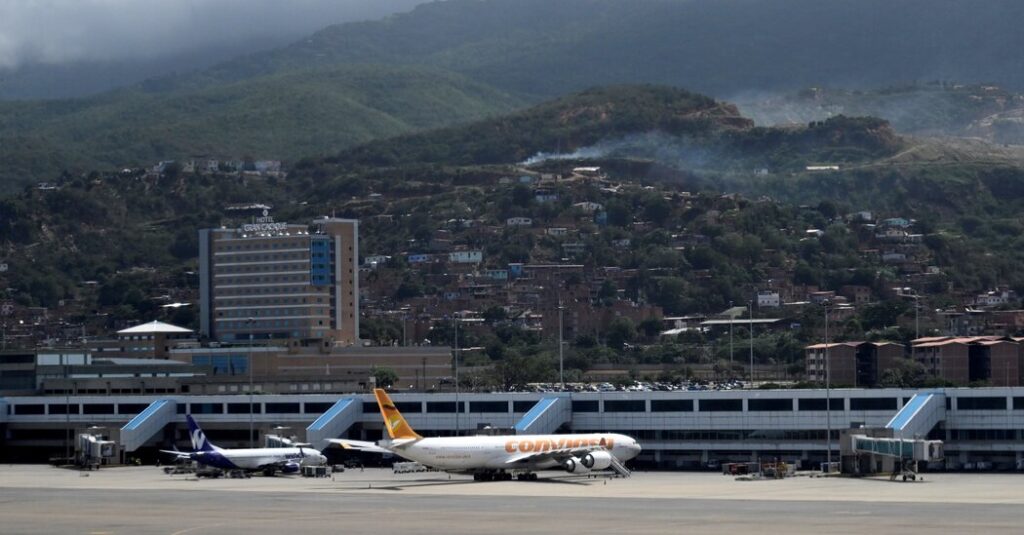
International airlines have almost entirely halted service, leaving only a few dozen aging aircraft from Venezuela’s own carriers to take people in and out of the country of nearly 30 million. People have thronged the remaining flights, causing prices to rise.
Many in Venezuela’s vast diaspora, some of whom fled amid economic collapse, abandoned their return plans after their flights home were canceled.
“That day, I cried a lot,” said Vanessa Rojas, a 37-year-old Venezuelan who lives in Argentina. She had saved for two years to buy tickets for herself and her young daughter, she said, to return home for Christmas.
The difficulty of going home for the holidays comes at a tense moment for Venezuelans both in and outside the country.
Many have been watching anxiously as the Trump administration has ramped up pressure on the country’s autocratic leader, Nicolás Maduro, whom many blame for the economic and humanitarian crisis — deepened by U.S. sanctions — that has driven millions to migrate over the last decade.
In recent months, the Trump administration has zeroed in on Mr. Maduro, accusing him of supporting drug-trafficking groups designated as terrorist organizations; bombing small boats it says are carrying illicit narcotics; amassing troops, aircraft and warships in the Caribbean; and seizing or attempting to seize oil tankers intending to transport sanctioned Venezuelan oil.
The Venezuelan government denounced Mr. Trump’s declared closure of the airspace on Nov. 29 as a “colonialist threat.” Within days, many major international carriers suspended Venezuela flights after the U.S. Federal Aviation Administration issued warnings of “heightened military activity” and safety risks. Venezuela then revoked operating permits for several foreign airlines that had suspended service.
Two Venezuelans involved in the country’s air industry who said they were not authorized to speak publicly on the matter said that the number of air passengers entering Venezuela’s main international airport, which serves Caracas, had dropped to around 2,000 people a week, a fraction of its usual number. They said a few thousand more passengers were arriving at other airports and included people on charter flights to Margarita Island from places like Russia and Poland.
Noemi Gómez, 34, had found not only her Christmas plans spoiled — but her wedding. She and her husband-to-be, who both work in marketing in Madrid, had planned to get married in Venezuela on Dec. 20. But their flight home, which had been scheduled for Dec. 11, was canceled.
So rather than being married and catching up with their parents in Venezuela on Christmas Eve, Ms. Gómez said, the couple had traveled to the Dominican Republic. They said they were hoping to celebrate their nuptials, and the end of Mr. Maduro’s reign, soon.
She blamed the botched plans on Mr. Maduro, not Mr. Trump, noting that Venezuela’s leader was the reason so many had to live far from family in the first place.
“It’s because of that government, that man — they’re illegitimate and they shouldn’t be there,” Ms. Gómez said. Mr. Maduro claimed victory in the 2024 presidential election, an outcome election experts widely regard as fraudulent.
In cities around the world home to large Venezuelan populations, like Miami, Madrid, New York, and Mexico City, the same question was being asked: Whose fault was it that their country had become even more isolated? What would happen next?
In Mexico City, Antonio Balassone, 35, whose first trip home in three years had been called off, said he also wanted to see a change in government but did not support military intervention. “I don’t want war,” he said.
Many Venezuelans took circuitous routes to get home despite the new obstacles.
María Acosta, 28, flew from Bogotá, Colombia, where she lives, to the coastal city of Riohacha, Colombia. She crossed into Venezuela, then shared a taxi to her hometown, Valencia.
“I try to spend Christmas with those few still there,” said Ms. Acosta, an environmental engineer, who said her family had been “disintegrated” and was scattered among the United States, Colombia and Spain.
The looming threat of military action had cast a pall over the holidays even for those who managed to make it home.
“You come to Venezuela and you want to taste the flavors, breathe the air and sun, hug your loved ones,” she said. “Now I just think about how I want to get back to Bogotá in peace.”
While some tearful reunions took place in Caracas’s airport in recent days, the international arrivals area, usually thronged with happy families, has been relatively quiet.
Tourism was down to a trickle on Margarita Island, said a hotel operator who asked that his name not be used for fear of retribution from the Maduro government. “We lost all our reservations,” he said.
But he wasn’t too worried about 2026. “For those of us in Venezuela, these blows are normal by now,” he said. “We pick ourselves up, we shake ourselves off and we keep going.”
Reporting was contributed bySheyla Urdaneta, Jorge Valencia, Carlos Prieto,Patricia Sulbarán and Alejandro Cegarra.
Annie Correal is a Times reporter covering Mexico, Central America and the Caribbean.
The post With Airspace Closed, a Lonely Christmas for Many Venezuelans appeared first on New York Times.