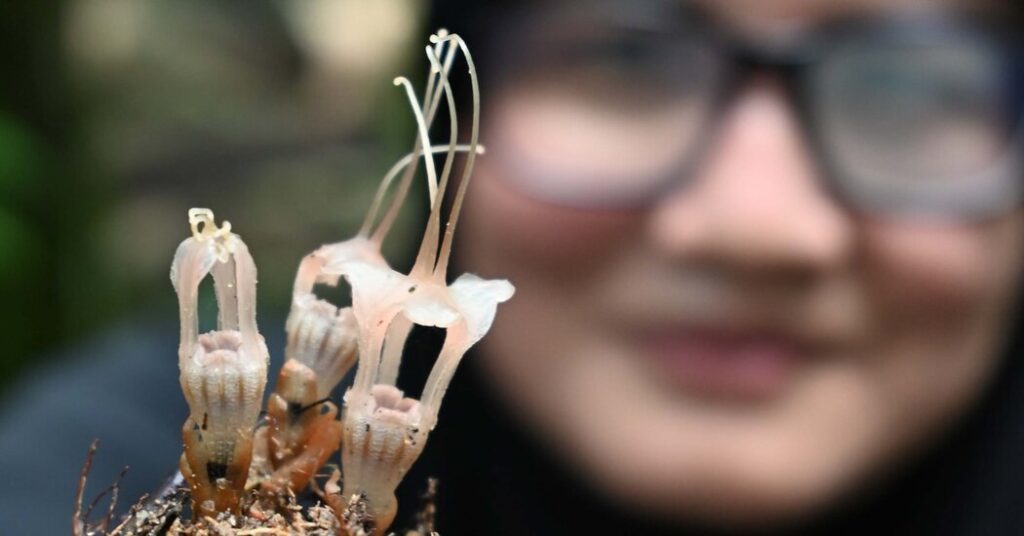
A bizarre plant was discovered near Kuala Lumpur, Malaysia, on the periphery of a forest preserve’s picnic area.
This plant, called a fairy lantern, is a parasite that steals all its energy and nutrients from mycorrhizal fungi that dwell within the soil. Usually hidden underground, the fairy lantern periodically produces a pinkish flower with a domed top, shaped like an umbrella, from which three tentacle-like structures extend.
Gim Siew Tan, a naturalist and photographer, stumbled upon the flower in November 2023 poking out of leaves on the ground. She posted photos to iNaturalist, a platform for identifying plants, animals and fungi.
“So pretty and unique,” she remembered thinking. “Then came: ‘What is this?’”
The photos found their way to Siti Munirah, a botanist with Forest Research Institute Malaysia, who said she could immediately tell she was looking at an undiscovered species. Ms. Tan, Ms. Siti Munirah and colleagues described the plant in a study published last month in the journal PhytoKeys, naming it Thismia selangorensis.
After the discovery beside a stream in Sungai Congkak Recreational Forest, the researchers conducted several surveys nearby. They have only found 20 individuals to date, including some that lived within tree hollows. Given the plant’s rarity and apparently tiny range, it should be considered critically endangered, Ms. Siti Munirah said.
The fairy lantern is a mycoheterotroph, the general term for a plant that parasitizes fungi. There are only around 550 known species of mycoheterotrophs worldwide, such as waxy white ghost pipes, said Vincent Merckx, a biologist at the Naturalis Biodiversity Center in the Netherlands, who was not involved in the paper. That is a small fraction of the estimated 435,000 plant species on Earth.
The fairy lantern’s most notable feature is its “extraordinarily wide,” umbrella-shaped dome atop the flower, known as a mitre, said Michal Sochor, a botanist at Palacký University in the Czech Republic.
That shape may help keep detritus or rainwater out of the flower’s internal structure, said Dr. Sochor, who was not involved in the study. The function of the plant’s tentacle-like extensions is unknown, but they may emit chemicals to signal the presence of the flower as it pokes up through leaf litter, he said.
Like many mycoheterotrophs, these newfound organisms are difficult to find. They spend most of their lives underground, and they are only seen aboveground during unpredictable flowering intervals.
Most plants form a symbiotic partnership with mycorrhizal fungi, a relationship that stretches back in time about 500 million years, to when plants first made their way onto land. Plants provide the fungi sugars, harnessed via photosynthesis; the fungi help provide water and nutrients from the soil.
Mycohetertrophs cheat this system by taking without giving anything in return, which is only possible because the mycorrhizal fungi are connected to other green, solar-powered plants, Dr. Merckx said. Like many parasites, these plants tend to be quite specialized, usually exploiting only a single species of fungi. (Most trees partner with more than a dozen species, and sometimes many more.)
Thismia selangorensis has short, stumpy roots that the researchers describe as “coral-like,” wherein fungi are likely housed and manipulated.
When Ms. Tan found the new plant, she was actually looking to photograph slime molds — bizarre organisms that can coalesce to form blobs, move around and produce stalk-like fruit bodies.
“Spending time looking for slime molds trained me to notice the tiniest things on the forest floor,” she said, such as this new plant. “But I like to think that it found me.”
There are currently more than 110 known species in the genus Thismia, mostly in tropical parts of Asia and South America, Dr. Merckx said, with new species reported every year; many dozens of species probably remain undescribed. The group is absent from Africa and Europe.
Strangely, a single species, Thismia americana, was found at the edge of a prairie in North America, outside Chicago, in 1912, thousands of miles from any known close relative. The delicate, pale plant was re-collected for a couple of years in the same area. But then a barn was built in the field, and it was never found again.
How it arrived there, so far removed from any kin, is a mystery — as are the function and inner workings of these newfound flowers, and which fungus the plant exploits.
“The strangest interactions can evolve,” Dr. Merckx said. “Nature is very inventive.”
The post Who’s the Parasite Now? This Newly Discovered ‘Fairy Lantern’ Flower. appeared first on New York Times.