Don Adkins was walking along the Sunset Strip in Los Angeles late one night this month when he heard a plea for help.
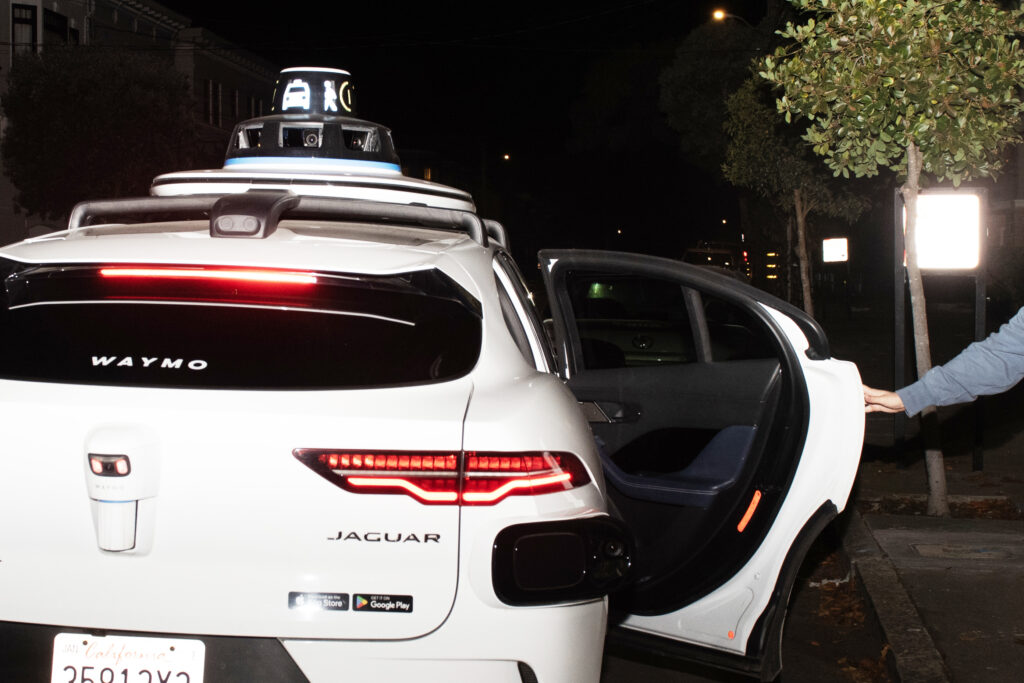
“Please close the right-side rear door, thanks,” Adkins recalled a synthetic voice calling out. It came from a Jaguar SUV stopped in the street with its lights flashing. One of the hundreds of Waymo robotaxis in Los Angeles operated by Alphabet was in trouble.
From where Adkins stood on the sidewalk, the door appeared closed, and he was initially going to ignore the robotaxi, he said in a phone interview. But he decided to act after a human driver stuck behind the Waymo started honking. Adkins stepped into the street and pushed the autonomous vehicle’s rear door until it was fully closed. Then he watched as the robotaxi rolled away.
Adkins had witnessed an Achilles’ heel of the Waymo robotaxis that ferry thousands of riders in Los Angeles, San Francisco and other cities each week. The vehicles can navigate city streets and compete with taxi drivers without anyone behind the wheel — but become stranded if a human doesn’t close the door behind them at the end of a ride.
Because riders and passersby can be unreliable, Waymo pays workers in Los Angeles $20 or more for rescuing a robotaxi by closing a door, summoning help through an app called Honk that is like an Uber for towing companies.
This is why Wyamos get Stuck #California #waymo #roadsideassistance
Cesar Marenco, owner of Milagro Towing in Inglewood, California, has become a regular Waymo door-closer. He recently freed a robotaxi by removing a seat belt caught in its rear door, an operation he captured with his Meta smart glasses and shared on TikTok.
“Goodbye, Waymo,” Marenco said in the video, which has more than 400,000 views.
“There’s always going to be human errors when someone’s riding in a vehicle and there’s no one to tell them close the door, or put your seat belt right,” he said in a phone interview. Marenco estimates that he completes up to three jobs a week for Waymo via Honk, either closing doors or towing autonomous vehicles that have powered down because they didn’t make it to a charging station in time.
The door-closing and towing gigs being picked up by Marenco and others in Los Angeles are examples of how as automation advances, it can create new work for humans pressed into service to patch over its shortcomings. More people will be needed to fulfill that role as Waymo expands. The company said in November that it would start offering rides in Miami, Dallas, Houston, San Antonio and Orlando next year.
Last weekend, tow-truck companies in San Francisco received a flurry of requests to retrieve Waymo vehicles after a power outage caused severe gridlock throughout the city, multiple operators told The Washington Post. Residents shared images on social media of autonomous vehicles blocking intersections and rolling by on flatbed trucks.
Waymo vehicles are designed to treat traffic signals that aren’t working as four-way stops, just like human drivers do, Waymo spokesman Ethan Teicher said. But “the sheer scale of the outage led to instances where vehicles remained stationary longer than usual to confirm the state of the affected intersections,” he wrote in an email Monday.
Behind the scenes, the company’s vehicles in San Francisco sent a “concentrated spike” of requests for help to remote human workers, the company said in a Tuesday blog post. A Waymo robotaxi can navigate defunct traffic signals but sometimes needs to check in with fleet response agents to “ensure it makes the safest choice,” the blog post said. The power outage triggered a “backlog” in those requests, causing the vehicles to block traffic.
“We are focused on rapidly integrating the lessons learned from this event, and are committed to earning and maintaining the trust of the communities we serve every day,” Teicher added. San Francisco Supervisor Bilal Mahmood called for a hearing into Waymo’s operations, saying the traffic disruptions were “dangerous and unacceptable.”
Incidents of humans rescuing robotaxis show how the tasks and skills the transportation industry needs from workers are changing, said Georgios Petropoulos, a professor of data sciences and operations at the University of Southern California. “Humans are needed to interact with automated systems to make sure that service is provided in an efficient and safe way,” he said.
Waymo spokeswoman Katherine Barna said in an email that door problems are “not too common” and that the company is “continually looking at ways to improve pickups and departures.” The company focuses “on educating and informing our riders” to prevent doors from being left open, she said.
Marenco and a second L.A. tow operator said they are also called via Honk to pick up Waymo vehicles that have run out of battery. Barna said it is “rare” for the company’s vehicles to lose charge outside one of its depots. The company’s robotaxis can be seen driving to dedicated charging lots in Los Angeles and other cities, where human workers plug them in.
JJK Towing’s owner Evangelica Cuevas said that when she and her workers respond to rescue requests, they aren’t always provided with the stuck vehicle’s precise location. That can force them to walk around looking for the stalled robot on foot, she said, because some L.A. streets are too narrow to navigate with the full towing rig needed to move an all-wheel-drive vehicle such as one of Waymo’s Jaguar I-Paces.
“We can spend anywhere from 10 minutes to an hour just looking for the vehicle,” Cuevas said.
Barna said Waymo has a redundant GPS source to ensure a vehicle’s location is still trackable.
Cuevas said she gets paid about $22 to $24 through Honk for closing an open Waymo door and $60 to $80 for a tow. Those rates aren’t always profitable after factoring in the fuel and labor required to retrieve a car, she added. Honk did not respond to a request for comment.
Jesus Ajuiñiga, manager of Alpha Towing and Recovery in San Francisco, said he declined Waymo’s tow requests during last weekend’s power outage because the rate offered was lower than the $250 he would normally charge to send a flatbed rig for an all-wheel-drive vehicle.
“It’s not fair,” Ajuiñiga said in a phone interview, adding that “we’re not going to get reimbursed for what we deserve.” He said he was also concerned about the risk of damaging a Waymo vehicle, which are festooned with bulky sensors, and being liable for repair costs.
Philip Koopman, a retired engineering professor from Carnegie Mellon University who studied autonomous vehicles for nearly 30 years, said paying humans to close doors and retrieve stalled cars “is an expensive thing” for Waymo to be doing. The company will need to minimize those incidents as it attempts to scale up and compete with Uber and Lyft, he said.
“Drivers have two jobs: Don’t hit stuff and be the captain of the ship,” Koopman said. “Making the sure the doors are closed is part of being the captain of the ship.”
Keith Chen, who was head of economic research at Uber and is now a professor of behavioral economics at UCLA, said the company might be able to save money and minimize downtime for its vehicles by tapping Uber and Lyft drivers to close some of these errant doors.
It is unclear how many ride-hailing drivers would want to actively help their robotic competition, but Waymo already partners with Uber to let people hail robotaxi rides in Austin and Atlanta. The company could also add a feature to its own app that asks riders to close doors on nearby vehicles in return for a discount, Chen said.
As more autonomous vehicles hit the streets, people who work as professional drivers may be forced to adapt. Government and the private sector may need to provide job retraining and short-term financial support to help workers transition to roles where they are interacting with automated vehicles, USC’s Petropoulos said.
Robotaxi door closers will have to adapt, too. Waymo is testing its next generation of vehicles in San Francisco, custom-made for the company by China’s Zeekr. Its minivan-style doors can slide open and close automatically.
The post When robot taxis get stuck, a secret army of humans comes to the rescue appeared first on Washington Post.