The title “Sixties Surreal” is redundant. What wasn’t surreal about the decade that drove popular music to its least commercial conclusions, ceded birthrates to women and armed the Black Panthers so visibly that the NRA cried for gun control?
It is the first provocation of this fascinating and revisionist exhibition, which is closing Jan. 19 at the Whitney Museum of American Art. The show argues that many artists of that decade, both well known and obscure, share a devotion to the human body, and to the body politic, that merits a whole new art-historical movement: the Sixties Surreal.
The show guides you part of the way through its big terrain — American studio art from 1958 to 1972 — but leaves you to your own interpretive devices, feeling sometimes stood-up but also caffeinated in a way no other show in New York currently leaves you.
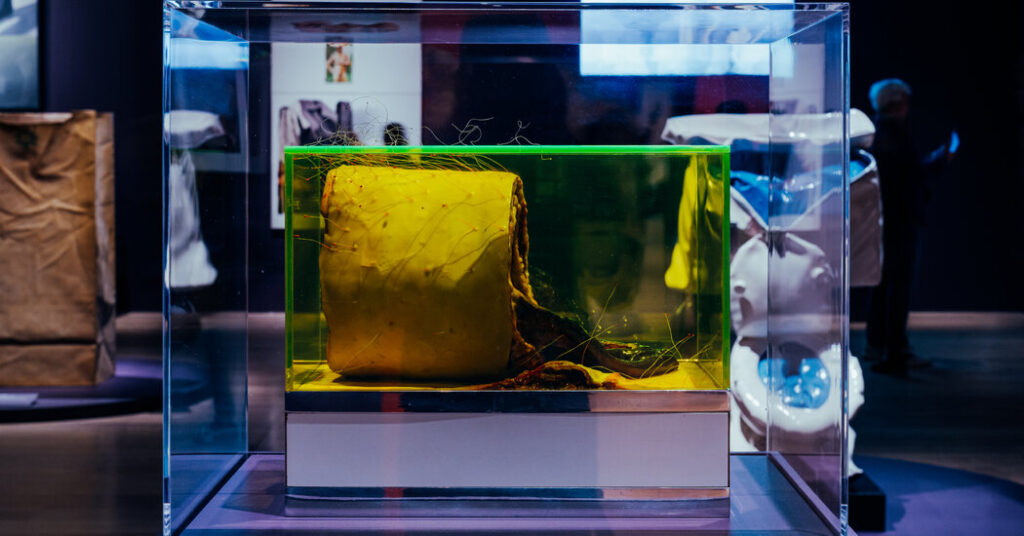
The show leans on big statement pieces that defy indifference: Paul Thek’s photo-real bucket of gore, the proudly erect overhand knot that H.C. Westermann sanded from layers of marine plywood, Peter Saul’s Day-Glo canvas of cartoon G.I.’s assaulting civilians in Vietnam, which could be the least comfortable painting in the city right now.
With these and 150 other works, the four curators (all Whitney) argue that the real look of art in the ’60s — or at least a gravely neglected current — was not the slick Pop or Minimalism that the color magazines sold, but was instead a kind of return to classical Surrealism, the European movement of the 1920s that encouraged conscious grotesquerie as a way to cope with the intrusive but authentic thoughts that society exists to suppress. (Just how consciously these younger artists were responding to Magritte and Dali’s generation, the original Surrealists, goes unevenly answered.)
Thek in an Art News interview from 1966: “I choose this subject matter because it violates my sensibilities, but that’s not the same thing as shock. I work with it to detach myself from it, like learning to control a heartbeat.”
This is beautifully put. But how to exhibit such detachment?
The section “Body Ego” states the theme loudly. A platform of undulating offal-like works — an armchair of puffy white pustules by Yayoi Kusama, a sort of hanging plaster epiglottis by Louise Bourgeois, one of Lee Bontecou’s canvases of gaping and sutured orifices are honest about a certain fidgeting unease with their inner life, in a way that their more formalist (often more visually beautiful) colleagues are not.
The nylon filament chandelier by Kay Sekimachi could be a suave Ruth Asawa except it’s all busted in the bottom half, as if returning from a weekend bender to brush its hair. Ken Price’s ceramic egg is as sensual as a Barbara Hepworth, except it is radium-green and hatching something.
These implied contrasts are the point, I think. They suggest that the so-called Sixties Surrealists were not just a counterculture but a counter-counterculture. They embody a sigh of collective collapse after modern art had narrowed itself, for some 50 years, into an activity overly concerned with coldness, elegance or cynicism.
“Sixties Surreal” originated 25 years ago, as the undergraduate thesis of the Whitney’s director, Scott Rothkopf, one of the curators. With its many art world subplots, it raises questions — and its own rebuttals — about art history. These will appeal primarily to specialists. Didn’t the Abstract Expressionists read Freud and Jung, too? What does “Post-Minimal” mean, really?
But the gist of this show cuts through the noise: The art of the 1960s was so unruly, so varied, that no exhibition as revisionist as this can hope to do it total justice. From curators as able as these, even the inevitable shortcomings instruct.
Such as the almost exclusive focus on artists with gallery ambitions. This means that — unlike the Whitney’s huge “Summer of Love” show in 2007 — we get almost nothing from the D.I.Y. catch-and-release of zines, handbills, posters and buttons that did more than any exhibition to coax the average American back from material standards of success and toward her inner animal. You feel the absence here. The formidable Dan Nadel, the comix expert who helped curate the show — he’s now the museum’s curator of drawings and prints — feels underused.
The art-world focus also manifests as an allergy to stereotypes about the period. (As Tariq Ali prefaced his book on the Sixties: “This is a political memoir. It is not, be warned, an account of miniskirts on the steps of the Sorbonne.”)
Psychedelics, for instance. A section on spirituality and consciousness boasts Carlos Villa’s quilt of pheasant feathers, a pulsating color video on 16-millimeter film by Jordan Belson, and other works that come close to visualizing the innermost and antique realms of thought.
Drugs are a stereotype of the Sixties. But they also unleashed an intimacy with consciousness. Searching for a deeper way to understand the decade, the show’s curators — who also include Laura Phipps and Elisabeth Sussman — refer only obliquely to those substances. In a show this big, it is both refreshing and unfair.
The thematic organization of the show, too, imposes a subject-based way of seeing that doesn’t always reward the visual subterfuge of its best works.
The ambiguities of identity and restraint within Nancy Grossman’s BDSM-style leather mask, for instance, or the humor and puzzling contentment of Marisol’s sculptural take on the nuclear family, don’t neatly hurl themselves into a box labeled “feminism,” as their inclusion in the all-female section of the show would suggest.
Elsewhere the work is too literal for the theme. In a section on politics called “Show of Force,” the density of American flags — even the exquisite woodblock printing of Barbara Jones-Hogu’s Black Power memento mori — remind us just how easy the symbols of Nixon and Vietnam could be in the workshop of a figurative artist. Ralph Arnold’s collage on political assassinations is true to the tragedy of King and Kennedy. As art, it is dull.
Does outrage narrow the imagination of an artist? Is edge like Saul’s the only way to stir a citizen who’s been dunned by news? The Tet offensive, Manson, Kent State …
Artworks before 1967 or so, before a consensus had arrived on America’s most shameful war, seem more withholding. Both Daniel LaRue Johnson’s assemblage drenched in tar, “Freedom Now, Number 1,” and a green-on-gray Jasper Johns flag, both seem to stare back at you on behalf of an uncertain society.
Would chronological arrangement have allowed the work more space? The show’s remarkable brick of a catalog, a timeline of the dealers, curators and critics who helped push these artists, kept me glued.
The inclusion of household names makes the absences known: Rauschenberg, Guston, Ted Joans, Honoré Sharrer, Renate Druks. But the density of little-shown legends equips you to run with this new genre. That’s what good shows do.
And if you’ll imbibe some of the attitude, some interesting associations just sort of impose themselves.
Take cars. Jeremy Anderson’s sculptural box of internal organs, assembled like a rotary shaft in a crankcase, and Don Potts’s almost pelvically sensual wooden chassis of 1970, on display between large phalluses by Westermann and Harold Stevenson, had me considering the anatomical possibilities of “Little Deuce Coupe,” Brian Wilson’s ode to the national symbol of freedom. “You don’t know what I’ve got …”
The biggest gift is a glimpse of the body politic, of a collective unconscious that since World War II had been threatening to erupt from the American veneer.
In the section on society and media, a beautifully chosen trio of photos reveal, with the clarity of a Marshall McLuhan chapter, the very different realms of experience that the television was only beginning to melt together, as the country’s first generation of television viewers were entering adulthood.
Those images are a Diane Arbus of Bela Lugosi as Dracula, photographed from TV; another Arbus of a drive-in screen, displaying artificial clouds against the night sky; and then a Shawn Walker shot of a Tiffany’s window framed by its storefront, a screen to itself.
Private screen, public screen, real life — all visually one. How could a single body expect to inhabit them sanely? It couldn’t. And still can’t. Ever play Twister?
In the smartphone century, how prophetic this little trio of shots seems. It’s one of many reasons to see this show. Like the meddling teens in Scooby-Doo, its curators do us the favor, if also the occasional over-favor, of insisting on the human realities behind all the ghouls of this country’s crackup.
Sixties Surreal
Through Jan. 19 at the Whitney Museum of American Art, 99 Gansevoort Street, Manhattan. (212) 570-3600; whitney.org.
The post Turn On, Tune In … Cop Out? ‘Sixties Surreal’ Teases at the Whitney. appeared first on New York Times.