As President Trump and his Republican allies scramble to address affordability concerns, they have touted the giant tax-cut bill that was signed into law this summer.
Mr. Trump and his advisers have promised Americans that they will see bigger tax refunds next year, in part because of new tax breaks that were included in the bill. One of those — a deduction that the law calls “no tax on car loan interest” — is likely to be popular. But it may yield only marginal savings for consumers.
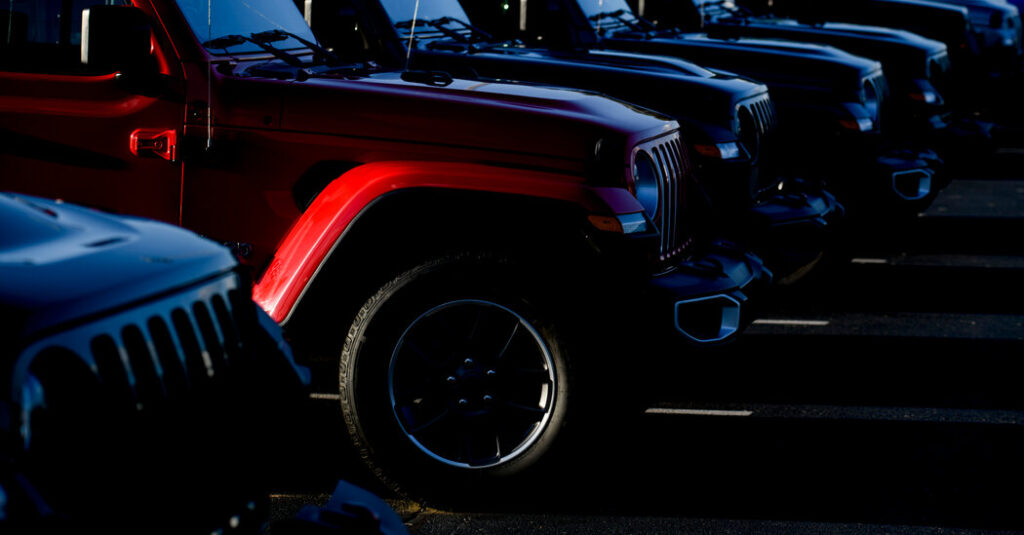
The deduction has its origins in a campaign pledge that Mr. Trump made in October 2024 to stimulate the domestic auto industry and make cars more affordable. Mr. Trump’s domestic policy bill, which he signed in July, has enacted the deduction. But tax and auto experts are uncertain about whether the policy will be a boon to the auto industry or will deliver on affordability.
The deduction is part of a broader policy push by the Trump administration to walk back subsidies on electric vehicles and realign the auto industry to ensure that more cars are built in the United States. In the pen stroke that established the tax deduction for auto loan interest, Mr. Trump also canceled subsidies for electric vehicles, a signature policy under President Joseph R. Biden Jr.
Senator Bernie Moreno, Republican of Ohio and a chief architect of the tax deduction, called the policy an “immediate relief” from high auto prices, for which he blamed Mr. Biden’s electric vehicle subsidies, among other Democratic policies.
“People are financing cars today, they financed cars yesterday and they’ll finance cars tomorrow, and the ability to write off that interest is a big deal,” he said.
But the deduction comes at a time when the auto industry is struggling to adapt to Mr. Trump’s tariffs, which analysts expect to eventually raise car prices. As a result, the deduction may provide only a modest salve for consumers.
“To the extent that these tariffs actually go into effect and they increase prices for cars, that will offset any benefit you get from this deduction,” said Adam N. Michel, the tax policy director at the Cato Institute, a libertarian-leaning think tank.
The tax break is expected to save taxpayers a few hundred dollars a year, according to industry analyses. Individuals whose adjusted annual income is no more than $100,000 — it’s $200,000 for joint filers — can deduct the interest on an auto loan for a new car with final assembly in the United States. The benefit, which can be taken in addition to the standard tax deduction, will apply only between 2025 and 2028. And because it is a deduction, not a refundable tax credit, anyone who wants to claim the tax break must have taxable income.
“While all savings are a benefit to consumers, this amount is not likely a big motivator to new-car buyers, nor will it drive higher levels of U.S. vehicle manufacturing,” Jonathan Smoke, a senior economist at Cox Automotive, said in a statement.
Still, of all of Mr. Trump’s populist tax changes — like no taxes on tips and overtime — the auto loan interest deduction is likely to be the most widely used. And upper-middle-class Americans stand to benefit the most.
“It offers a benefit to over 100 million people, many of whom are going to buy a car sometime in the next five years,” said Patrick L. Anderson, the chief executive of Anderson Economic Group, an automotive consulting firm.
But lower-income households, which predominantly buy used cars, will not see any benefit, said Sarah Austin, a senior analyst at the Institute on Taxation and Economic Policy, a left-leaning think tank.
“If you want to say that this is about affordability and improving affordability of cars,” she said, “then it makes it really hard to feel like you’ve done your job well if most of the market is out of reach of this deduction and not actually able to use it.”
Mr. Moreno, who spent nearly 40 years in the retail auto industry before becoming a senator, defended the decision to exclude used cars, maintaining that replacing America’s aging commercial vehicle fleet with new cars would be safer and better for the environment.
Still, Mr. Moreno regrets that the policy excludes anyone who leases a car.
“We only really provided relief for the 50 percent that finance,” he said. “We didn’t provide any relief for the 50 percent that lease, So that’s teed up next to get done.” As with any tax deduction, even those who qualify may not benefit if they are not savvy when filing their tax returns.
Richard Pon, an accountant in San Francisco, predicts that some people may not know how to figure out the place of their car’s final assembly or how much interest they paid. “People will miss it, so people have to be on the lookout for this,” he said.
One surprise that Mr. Pon noticed in the draft tax form is that people who use their personal vehicle for work, like someone who drives for Uber on weekends, will still qualify even though the I.R.S. says on its website that the policy applies to “a personal use vehicle (not for business or commercial use).”
Some auto dealers support the change. Amy Hunter Wright, a spokeswoman for the National Automobile Dealers Association, said the savings from this deduction would make cars more affordable, which she described as a “good thing from a dealer’s perspective.”
Tax experts and accountants pointed out that the deduction would add complexity on the dealer side, with sellers needing to provide statements to consumers about their interest in subsequent years.
Mr. Michel, from the Cato Institute, understands why the deduction on auto loan interest is good politics. “You can sell it as benefiting the domestic, American, heartland auto manufacturer, blue-collar stories, so there’s lots of mood affiliation that you can make with a provision like this,” he said.
But he does not believe that it will move the needle when it comes to Mr. Trump’s goals for affordability and the domestic auto industry. “I don’t think that the effects match the story that’s being told,” Mr. Michel said, “but to the extent that politics is just telling good stories, I think there is lots of political reasons for folks to lean into stuff like this.”
Adam Sella covers breaking news for The Times in Washington.
The post Trump Has a New Auto Loan Tax Break. Here’s Who Could Benefit. appeared first on New York Times.