One group paid its leader more than $500,000 a year while shipping foreign trainees to American jobs where they said they felt like slaves.
Another put the wife, daughters and son-in-law of the chief executive on the payroll, netting the family more than $1 million in the past two years alone.
A third sent young people to work at a farm owned by the family of one of its executives and a winery owned by a board member.
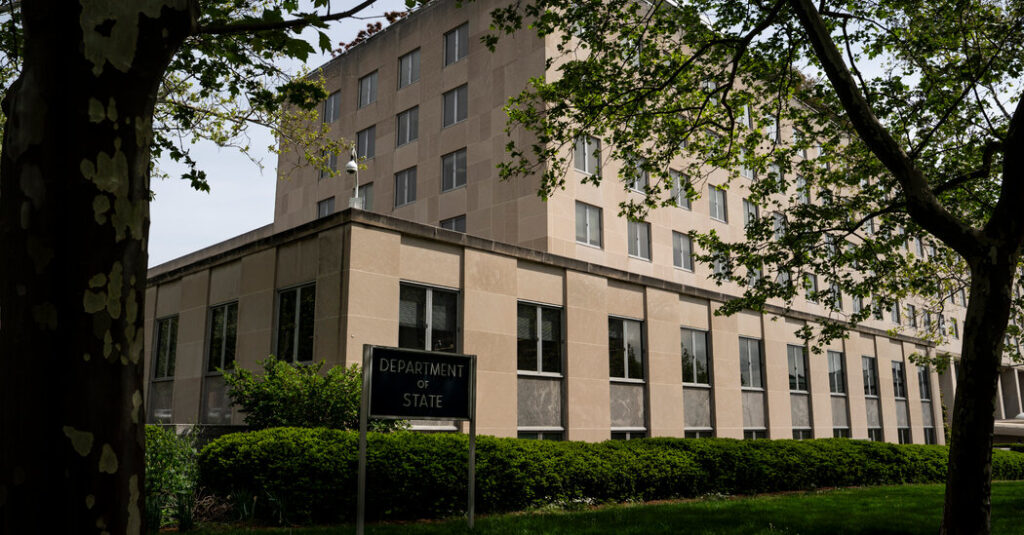
All of them cashed in on a State Department cultural exchange program, the J-1 visa, that has become plagued with profiteering and conflicts of interest — because the U.S. government has failed to rein it in.
The groups, known as sponsors, are tasked with helping to advance diplomacy and spread the virtues of American culture. They are supposed to serve as guides and protectors for the more than 150,000 young people they bring in from overseas every year, placing them with reputable employers and ensuring they are safe while in the United States.
Instead, a New York Times investigation has found, some sponsors have charged unwitting visa-seekers steep fees, struck deals with employers they were supposed to oversee and ignored evidence of unsafe or abusive working conditions.
The executive of one group was paid more than $1 million a year, nonprofit tax filings show. Other sponsors have created health insurance companies and other side businesses and then required young people to purchase services from them, squeezing more revenue from the program.
Still others have sent the employers who hire their workers on free international recruiting trips.
None of this broke any rules. Sponsor groups have been allowed to exercise enormous amounts of control over everything from how much they charge in fees to how they vet prospective employers.
Even a private equity firm was permitted to take a stake in one large sponsor group, describing the investment as “expanding market presence and creating sustainable value for all stakeholders.”
The State Department itself has repeatedly flagged profiteering within the program but failed to respond to its own warnings. A 2000 audit from its inspector general said that some sponsors exist primarily “to make money” and that parts of the program were “out of control.”
There are more than 120 entities that are approved to act as sponsors in the program, from universities to large companies to boutique nonprofits, and many of the groups are highly regarded. Representatives of the sponsor industry said that the vast majority of participants were grateful for the business connections and had positive experiences in the United States.
“I can’t think of a more brilliant government program,” said James P. Pellow, the chief executive of the Council on International Educational Exchange, one of the largest sponsor organizations in the program. “If it didn’t exist, you would not have international students come to America to embrace our values, or to help our local businesses.”
But in interviews, lawsuits and complaints to the government, dozens of those participants described going into debt to pay sponsors who brought them in on false promises.
Dongho Kang, a college student from South Korea, said he paid nearly $5,000 in fees to a sponsor, J-1 Visa Exchanges, and its representative in 2023 after reading promotional materials that promised a “once-in-a-lifetime opportunity.”
Instead, he was sent to a steel plant in Indiana, where he got little training and was forced to clean septic tanks, according to a lawsuit he filed his year. When he complained, the sponsor did little to help him, and he was ultimately fired, he said in the lawsuit, which is still pending.
The sponsor declined to comment, citing the litigation.
Even as the cultural exchange program has morphed to often resemble a guest worker program, the government has shielded it from rules imposed on other such programs.
H-2B visa workers, for example, who take on low-wage temporary jobs across the United States, are barred from paying recruitment fees to prevent labor brokers from trapping them in forced labor situations.
But there has been no such prohibition for the J-1 program, and there are no limits on what sponsors can charge. Some collected nearly $5,000 per application.
Even so, many sponsors have ignored workers’ pleas for help when things went wrong at their jobs.
“It’s a huge conflict of interest that sponsors are supposed to be labor recruiters and then employment law enforcers,” said Daniel Costa, the director of Immigration Law and Policy Research at the Economic Policy Institute. “Sponsors have a financial incentive to take the side of the employer. The young people come and go, but the employers are a relationship the sponsors have to keep forever.”
He added: “It’s a recipe for disaster.”
A State Department representative said that the agency has made reforms over the years and has closely overseen sponsors, including by removing those who did not comply with regulations from the program.
“Dredging up years-old, out-of-date complaints to attack the department’s current operations is a desperate reach,” the representative said. “This isn’t journalism, it’s a hatchet job. Under the Trump administration, the Department of State is ensuring this program, along with every other program, is carried out in accordance with the law and with America’s national interests.”
Over the years, the sponsors have lobbied aggressively to expand the J-1 visa and maintain control over it. Today, more than 300,000 people come to the United States on J-1 visas each year, up from 65,000 in the 1980s.
One of those visa holders, a college student from Kosovo named Ema Kurshumlija, paid about $2,000 in fees to secure an internship in New York in 2018.
“We were promised this beautiful experience,” said Ms. Kurshumlija, who received no advanced training and spent 60-hour weeks doing manual labor. “When we saw what was waiting for us, it was a big surprise.”
Birth of a business
In 1990, a former college wrestling coach named David Dahl founded a nonprofit, the Foundation for Worldwide International Student Exchange, and soon began recruiting international students for jobs in the United States.
In the years that followed, his business would boom — and be accused of putting young people in abusive situations.
His business strategy relied on making contacts at recruiter conferences overseas and going directly to American employers, whether they were livestock operations, hotels or amusement parks, to ask about the types of workers they were seeking.
At the beginning, he said in an interview, his group was barely breaking even. But by 2007, tax filings show, his nonprofit, known as the WISE Foundation, was bringing in $3.5 million annually and paying him $134,000 a year.
Within two years, he and his family had sold their modest home in Dyersburg, Tenn. They moved into a colonnaded 7,900-square-foot mansion in farm country nearby, property records show.
By 2023, the nonprofit was recruiting more than 3,300 visa workers a year and bringing in $4.9 million, records show. It had increased Mr. Dahl’s compensation to more than $520,000.
He seemed unlikely to face pushback from the nonprofit’s board: Records show that most of its seats over the years have been occupied by his family members, including his wife, father, stepmother, aunt and two cousins.
But the nonprofit’s ascent was not without incident.
In 2012, a whistle-blower reported to the government that the WISE Foundation was recruiting international students to work grueling overnight shifts, sometimes 19 hours a day, at an industrial seafood processing facility in Kenai, Alaska.
The sponsor and employer were exploiting the rules and “undermining the true purpose” of the program, the whistle-blower told the State Department, according to a copy of the complaint.
It was not clear whether anyone from the State Department reached out to Mr. Dahl’s nonprofit. But the practices continued.
In 2018, foreign students paid the WISE Foundation and its agent about $2,000 apiece for internships only to be shipped to an industrial greenhouse in New York where they said they were sexually harassed and seriously injured on the job.
In 2019, another group of international trainees said the foundation sent them to a Nebraska hog farm where they toiled for 12 hours a day, got no training and were threatened with deportation, according to internal State Department emails obtained by The Times.
“I had problems with working hours, with getting injured while working and couldn’t go to the hospital,” one participant was quoted as saying.
The heavy workload and threats made another person feel “like a slave,” the emails said.
The trainees said that they had told the foundation to investigate, but WISE simply went to the employer’s office to talk and never inspected the working conditions, the emails said.
State Department officials were so alarmed by the feedback that they confronted Mr. Dahl about his group’s oversight.
Mr. Dahl said his group would counsel the farm about the cultural purpose of the program and “review program requirements,” the emails said.
It sent more students there the following year.
In the interview, Mr. Dahl said his group was not unduly profiting. He said its recruitment fees were lower than those of other sponsors, and that his salary in recent years was a way to make up for the low amounts he earned in the group’s early years.
He strongly defended his business practices and said the WISE Foundation had consistently followed all government regulations.
He added that his organization did its best to be honest with the applicants about what their experiences would be, and that some had idealistic views of America that did not comport with reality.
“It’s a great program for young people to get experience coming to the U.S. and to gain skills,” he said. “Is it perfect? No. But anytime you’re working with human beings, it’s not going to be perfect.”
Cashing in
To analyze how sponsors have operated, The Times zeroed in on the more than 120 groups involved with some of the biggest categories of the J-1 visa — the summer work travel, intern and trainee programs.
The review, which also drew on hundreds of pages of tax filings, regulatory documents and legal records, found that profiteering and conflicts of interest were commonplace.
At the Council on International Educational Exchange, a large sponsor that brought in more than 28,000 students and trainees last year, the group’s chief executive, Mr. Pellow, made more than $1.2 million in compensation last year, and another $182,000 from related organizations, tax filings show.
The council also sends the hiring managers of 10 to 20 of the largest companies it works with on all-expenses-paid trips to places like Thailand and the Philippines, Mr. Pellow said in an interview.
He said the trips allow the employers to meet and hire students at in-person job fairs.
“I don’t sense it’s a junket of any sort,” Mr. Pellow said. “We’re helping the State Department find really good partners to take good care of the international students, and to make sure we have the very best hosts.”
At another sponsor, ASSE International, an executive named Fei Jiang earned $326,000 in compensation while also owning a stake in a for-profit company that was paid more than $200,000 by the nonprofit to help recruit J-1 students, tax filings show.
A representative for ASSE said the firm Ms. Jiang was involved in was wound down in 2019.
The husband of another ASSE executive ran a separate company that was also paid more than $2 million in recent years by the nonprofit to recruit participants.
When yet another sponsor, a for-profit company called Alliance Abroad, wanted to “accelerate growth,” it sold a stake in the company to a Texas private equity firm, Platform Partners. That firm’s other investments included a natural gas-fired power plant, an online payments company and a manufacturer of “specialty chemicals and lubricant additives.”
Other sponsors created lucrative side businesses.
The American Institute For Foreign Study created a separate for-profit business providing accident and travel insurance and requires its participants to purchase the insurance at a cost of up to $100 a month, on top of recruitment fees. A spokeswoman for the sponsor said the company provides better quality coverage at lower rates than are available on the open market.
All sponsors are supposed to monitor employers with an eye toward safeguarding the workers’ well-being. But several groups identified by The Times regularly accepted money from the companies they were overseeing, arrangements that might have created a disincentive for cracking down on bad behavior.
One group, C.A.E.P., charged employers a $100 placement fee per international trainee hired, according to the group’s website. It also charged hundreds of dollars more for the privilege of working with those trainees.
In 2024, one of the foreign workers, a German agricultural engineering student named Leander Weig, was hired to work on a farm in Oklahoma. He was fixing a truck when one of its tires burst, and he smashed his head against a steel table with enough force to punch in his skull, records show.
Mr. Weig, who paid the sponsor $900 for an internship that promised career elevation, sustained a traumatic brain injury and returned home severely impaired. He still has hearing loss and difficulty speaking, his lawyer said.
“I trusted C.A.E.P.,” Mr. Weig said. “It was a horrible experience on that farm. We were only cheap workers.”
The sponsor did not respond to requests for comment.
‘Out of control’
In 2000, the State Department’s inspector general visited a number of sponsors and found that they were failing to do the basics of their jobs.
The watchdog questioned “the increased profit making” of the sponsors and whether those that solely acted as labor brokers should be involved in the cultural exchange program at all.
In 2012, the inspector general raised more alarms, noting that sponsors were allowed to charge participants whatever fees they deemed appropriate.
Still, little changed.
In 2013, Congress began considering an immigration reform bill that would have banned recruitment fees for a number of foreign labor programs, including the J-1 visa.
Sponsors saw this as an existential threat and launched an aggressive campaign to kill the regulation.
“Without program fees, sponsors simply cannot operate,” one lobbying group wrote to members of Congress.
In the end, the visa sponsors won carve outs in the proposal, which ultimately failed in the House.
Sponsors still face no limits on how much they can charge. All that is currently required of them is to disclose those recruitment costs to the government.
But that information has been of little help to visa applicants who might hope to ensure they are not being taken advantage of: The government has kept it hidden from the public.
More than a year ago, The Times filed a Freedom of Information Act request to try to pry those figures free.
The State Department has yet to provide them.
Susan C. Beachy contributed research. Bianca Pallaro contributed reporting.
Amy Julia Harris has been an investigative reporter for more than a decade and joined The Times in 2019. Her coverage focuses on New York.
The post They Were Supposed to Protect Young Workers. Instead, They Cashed In. appeared first on New York Times.