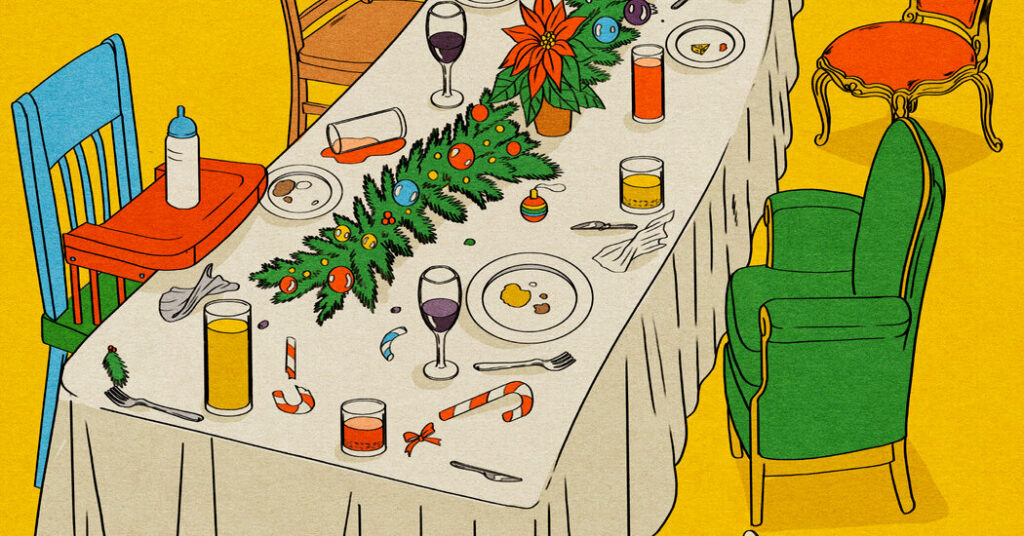
Things being what they are in the world today, get-togethers with the relatives are often fraught with pick-your-side political debates. Sometimes it might feel as if your family dinner would last forever.
If only we could be so lucky.
That unexpected viewpoint — that the best family dinner might be one that lasts a lifetime or even longer — comes from the great American novelist and playwright Thornton Wilder. He may be remembered best for his 1938 play “Our Town” or his novel “The Bridge of San Luis Rey.” But it’s his one-act play “The Long Christmas Dinner” that’s particularly well suited to this time of year, when days get short and tables get long.
When the play premiered in 1931, this newspaper described it as “startlingly original,” despite a seemingly mundane premise, in which a bunch of characters sit down at center stage to share a meal. In less than 40 minutes of stage time — in the course of a single, unbroken Christmas dinner — 90 years of a family’s history fly by. Older characters carry the past, with its lessons and regrets, while youngsters carry the future, with all its hopes and unanswered questions. All of the family members are bound by traditions that endure through the trivialities of the present.
I can’t remember how many holiday seasons ago I first fell in love with Wilder’s play, but it’s been long enough to encompass major changes in my family’s Christmas dinners — beloved grandparents departing, new kids arriving. Amid those transitions, his cosmic perspective has helped me to see that a family meal at the holidays functions as a kind of time machine. But unlike Doc Brown’s DeLorean, which whisks people to different eras, a multigenerational dinner assembles those eras at a single table.
Wilder, using ingeniously simple means, lets the dinner setting represent the entire architecture of life and death. On one side of the stage, there’s an arch, wreathed in flowers, representing birth; on the other, there’s an arch, draped in black, where older characters make their final exits (and, tragically, a few younger characters, too). Between those arches, at a long table, four successive generations of the family eat their dinners (with invisible props and food, per the stage directions) while keeping up a constant and highly relatable stream of conversation. They bicker, joke, pray, reminisce and, very frequently, resort to talking about the weather — you know, just like a typical family dinner.
Wilder dramatizes all of this with his usual blend of acuity and generosity. There are characters who regret what they said or failed to say and parents who pass beloved names on to their children, as we see certain roles in the family filled again and again. (Each generation has a matriarch figure whom family members call Mother Bayard.)
But the true subject of Wilder’s play is more sweeping than the dynamics of one family or even of all families. It’s really about time with a capital T. By compressing 90 years of history into a play that lasts less than half as many minutes, Wilder lets us see with astonishing clarity the way that time works both on us and through us, mostly without our realizing it. The result is revelatory: Imagine fish starting to grasp that there’s such a thing as water.
Wilder teaches us how the compounding effects of time make families what they are, which goes a long way toward making people do what they do. We watch time as it corrodes bodies, spirits and the Bayard house itself. In the wake of a devastating loss, a woman tells her daughter that “only time, only the passing of time can help in these things” — and it’s typical of the play that the daughter will, years later, pass that consoling advice along to her niece, verbatim. More than once, somebody says, “It’ll all be the same in a hundred years.” We in the audience know that can’t be true, because we see how much changes during the play. Yet at the same time, in some ways, it’s unassailably true; look how much between the characters barely changes at all, an insight that might resonate with your own holiday table.
So how best to share the play’s insights at your family gatherings? Theater companies rarely produce one-act plays, so good luck finding a nearby production. I suggest getting your relatives to read the play out loud with you. Having directed a half-dozen readings of “The Long Christmas Dinner” over the years, I’ve found the play has an extraordinary capacity to get us to move beyond our quotidian bickering and spark real — and delightfully long — conversations.
Jeremy McCarter is the literary executor of Thornton Wilder and wrote the foreword for the book “Our Town and the Cosmic One-Acts.”
The Times is committed to publishing a diversity of letters to the editor. We’d like to hear what you think about this or any of our articles. Here are some tips. And here’s our email: [email protected].
Follow the New York Times Opinion section on Facebook, Instagram, TikTok, Bluesky, WhatsApp and Threads.
The post The One-Act Play My Family Reads Together Each Christmas appeared first on New York Times.