The suburban movie theater was packed and brimming with anticipation on a recent Tuesday night. The buzz was not for some new blockbuster, but for a 35-millimeter film presentation of “American Psycho,” the 25-year-old black comedy.
Way up front was John Vachris, 69, known to his friends as Front Row John, who goes to hundreds of movies a year and watches, always, from the front row.
Sipping soda in the back was Gerry Sciascia, 27, whose Gen Z friend group shares an appreciation for the retro pleasures of projected film.
And somewhere in the middle were Webb and Jack Wilcoxen, a father-son duo whose previous movie outing was for an almost-five-hour screening of the “Kill Bill” trilogy. Jack is 12.
“He likes dark things,” said Mr. Wilcoxen, laughing, before the lights went down.
The intergenerational crowd had assembled at the Alamo Drafthouse in Yonkers, N.Y., to watch a beloved movie in its intended form. They shared a belief that nothing looks quite as good as the light of a projector passing through a film reel and gratitude for the owner of the reel itself, Brian Darwas.
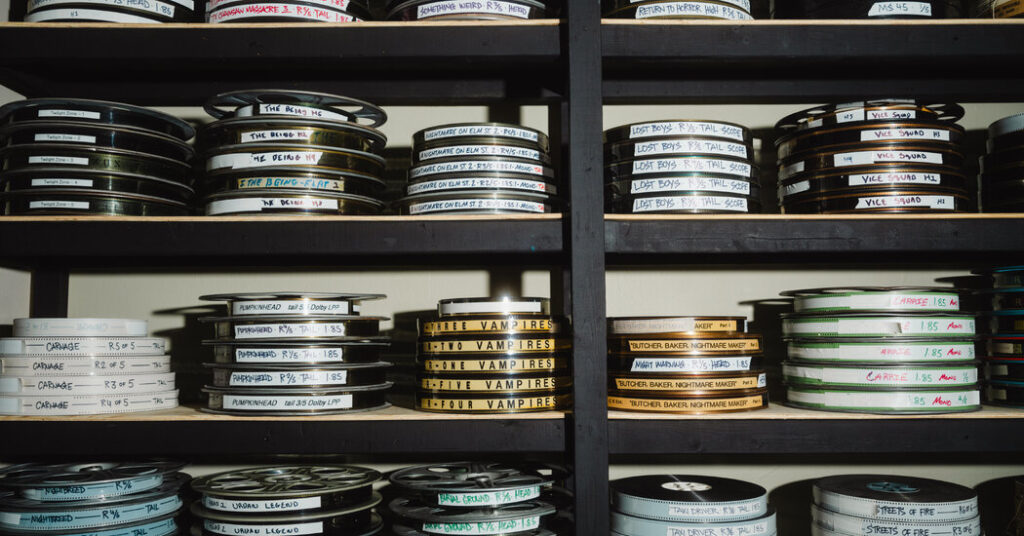
The artifacts of 20th-century cinema are being preserved in museums, archives and other august institutions. But they are surviving, too, in the care of private film collectors like Mr. Darwas, who has amassed hundreds of movie prints at his home in Westchester County.
Mr. Darwas, 48, is among a small cadre of hobbyists whose passion for film — the dominant moviemaking format for a century before digital technologies started taking over in the early 2000s — has nudged them into increasingly vital roles as amateur preservationists and evangelists for physical media.
“I do consider these people heroes,” said Cristina Cacioppo, 47, a programmer for Nitehawk Cinema, who has depended more and more on private collectors in recent years to source movies. “It can be thankless, and they can be unheralded in some ways.”
Mr. Darwas, a documentarian and writer, began collecting reels after moving to the suburbs roughly 15 years ago and noticing he had far more space than before — and far fewer options for entertainment.
“Westchester’s a little uncool for some reason,” said Mr. Darwas, who grew up in the Bronx skateboarding and doing graffiti.
His first acquisition was a print of a 1964 splatter film, “Two Thousand Maniacs!,” from one of his favorite directors, Herschell Gordon Lewis. He found himself drawn to the careful act of preparing the reels, the ticking of the projector, the intentionality of the whole thing.
He immediately hunted for more, trawling message boards, Facebook groups, estate sales and wherever else the old prints might turn up.
“I’ve gotten prints for free, for three bucks, for 3,000 bucks,” said Mr. Darwas, who favors horror movies but collects omnivorously. “If I think too much about the money, I won’t want to do it anymore.”
He and his wife, Jennifer Carchietta, do not like to play favorites, but they do have a few: cult classics like “Creepshow,” a 1982 horror comedy directed by George A. Romero; “The Candy Snatchers,” an exploitation flick that Ms. Carchietta gave her husband as a birthday gift; unimpeachable masterpieces like “Taxi Driver”; and notoriously hard-to-acquire prints like “Pulp Fiction,” “Jackie Brown” and “Reservoir Dogs” — all from the director Quentin Tarantino.
Ms. Carchietta called these keystone pieces “our Rembrandts,” playfully adopting the tone of an art collector.
“We have a “Manhunter!,” she said, laughing, referring to the 1986 thriller from Michael Mann.
Film is a dying medium, both figuratively and literally. Movie prints are delicate, susceptible to decay and cursed with a limited shelf life.
Mr. Darwas keeps his “climate-controlled vault” — actually just a spare room in the rear of his house — at a steady temperature and humidity. He is unnerved by the prospect of prints out in the world deteriorating from neglect.
“If I get offered a film I know is rare, I’ll get it just to make sure someone is looking after it properly,” he said.
For people like Mr. Darwas, film is an inherently social medium. So while his collection is the byproduct of a tireless, private obsession, it would all be meaningless to him if he did not share it.
He has an agreement with the theater in Yonkers to screen one movie from his collection each month. He has lent movies all over New York — Nitehawk Cinema, Metrograph, the Museum of the Moving Image and the Museum of Modern Art — and to theaters across the country, like the New Beverly Cinema in Los Angeles.
Every Halloween, he has between 50 to 100 prints from his extensive horror library out on loan.
Mr. Darwas and others feel some hope about the state of physical media, especially when they notice young people seeking out film screenings. But their world feels tenuous.
Only a few hundred theaters in the country still have the capability to project a 35-millimeter film. The biggest print collections are within federal institutions, university archives and Hollywood studios, but the commercial irrelevance of the medium has engendered a general indifference toward its care in some quarters.
Private collectors have thus taken on greater responsibility as custodians of history, often at great expense. And a handful of prominent ones — like Harry Guerro, who maintains a collection of thousands of prints in the Philadelphia area, and Mr. Tarantino, who has described his own library as “huge” — have emerged as both preservationists and exhibitors in this landscape.
So while some cinephiles compare film prints to vinyl records, others think their participatory nature makes them something more.
“To me, 35 millimeter is less vinyl than ‘This band is coming to town,’ said Jake Isgar, head of alternative programming for Alamo Drafthouse. “The print has a physical life. Someone is presenting it to you.”
Shortly before the screening of “American Psycho,” Mr. Darwas grabbed a microphone and asked whether anyone was seeing the movie for the first time. A few hands went up. He asked if anyone was seeing it for the first time on film. A few more were raised.
“Anyone care that it’s on film?” he then asked.
The room rippled with whoops and applause.
The screening was lively. An original release print from Europe, it had a single word — a colorful profanity — that did not appear in the American release and an extended sex scene.
The audience laughed together through the scene in which Patrick Bateman, the unhinged main character, sweats over the subtleties of his colleagues’ business cards: “Look at that subtle off-white coloring, the tasteful thickness of it. Oh, my God — it even has a watermark.”
It was not hard to imagine the moviegoers similarly swooning over Mr. Darwas’s print. He described the polyester film stock as “flawless.” The images pulsed softly on the screen. Connoisseurs often say that light passing through film gives the resulting picture an element of visual depth.
“It’s like looking at a painting versus looking at a photograph of a painting,” said Mr. Darwas, who believes the 24-frames-per-second rhythm of film is subconsciously pleasurable to humans.
Mr. Wilcoxen said his son, Jack, was still learning the idiosyncrasies of film. He asked his father afterward why the early frames had looked “crusty.” (It was most likely dust sitting on the print’s outer layer.)
“But he does understand how seeing a movie on a big, towering screen with the audience’s reactions bouncing off of each other makes movies feel bigger and more alive,” Mr. Wilcoxen said. “He also understands that the only reason he gets to see some of these films on the big screen at all is because someone owns a print and is willing to share it.”
For Mr. Wilcoxen and others, film presentations can be an antidote for both the atomization of modern life and the brain-melting scroll of streaming, short-form content. Mr. Darwas is not overly fixated on such encroaching technologies. But he has sensed the relentless assault of artificial intelligence on visual culture and can picture a bleak future when the notion of humans acting in front of a camera becomes obsolete.
“Hopefully I’m dead before that happens,” he said.
Mr. Darwas has not planned that far into the future. He joked that he considered adopting a child, just to install as a future caretaker for the library. But he does have a will and has already assigned certain movies to specific friends.
“I see myself as the steward who’s caring for them now until the next generation cares for it,” he said of his collection. “Half the prints I own I wouldn’t have been able to own if someone else didn’t look after them before me, so it’s my obligation to look after them now, so the next generation gets to when I’m gone.”
Andrew Keh covers New York City and the surrounding region for The Times.
The post That Old Classic Film in the Theater? It Might Be From This Man’s House. appeared first on New York Times.