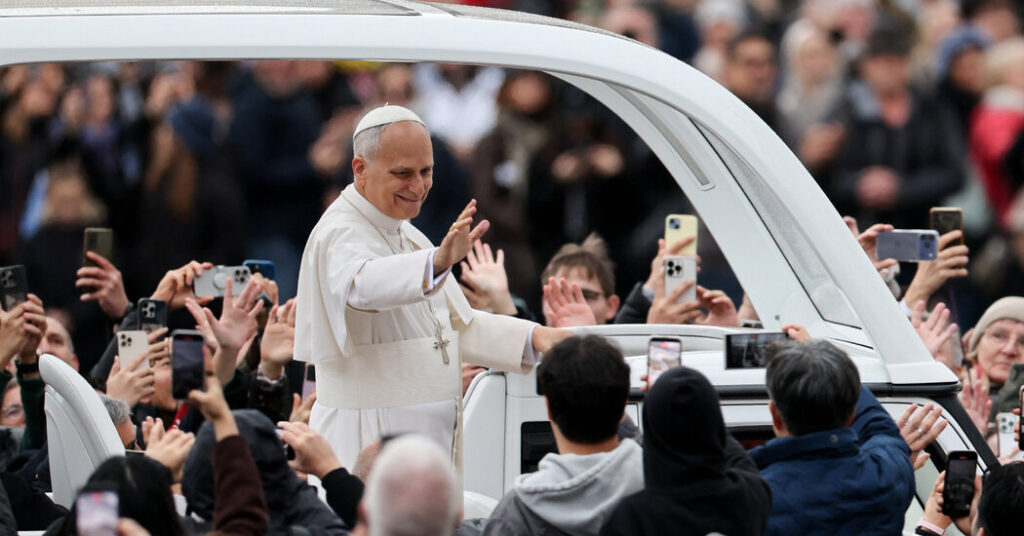
Pope Leo XIV on Thursday used his first Christmas message as pontiff to call for “peace and consolation for the victims of all current wars in the world” as well as for those suffering from “injustice, political instability, religious persecution and terrorism.”
Leo echoed many of the concerns of his predecessor, Pope Francis, demanding protection for refugees, victims of climate disasters, the unemployed and the exploited. Leo called for “dialogue” in Latin America amid an escalating U.S. naval campaign there and for better care for migrants who “traverse the American continent.” And he pushed for “respectful dialogue” in Europe as leaders seek peace in Ukraine.
Leo, speaking from the same central balcony of St. Peter’s Basilica where he appeared after being elected pope in May, also urged his audience to embrace a strong sense of personal responsibility.
“If all of us, at every level, would stop accusing others and instead acknowledge our own faults, asking God for forgiveness, and if we would truly enter into the suffering of others and stand in solidarity with the weak and the oppressed, then the world would change,” he said.
As with all his public utterances, Leo’s use of his influential pulpit was watched closely for comparisons with Francis, who died in April at the age of 88. As the first pontiff from the United States, Leo was also being scrutinized for how he related to his home country and its role as a global superpower.
Francis was a gregarious presence on the world stage, often tangling directly with those he believed had strayed from Roman Catholic principles. He was unafraid to openly criticize the policies of President Trump and drew fierce opposition from some American Catholics who identified as conservative.
By temperament, the new pope is more prudent and deliberate than Francis, analysts say, even as Leo has also challenged some of Mr. Trump’s policies and views.
In his Christmas address, speaking to the thousands gathered in the square below him in drizzling rain, Leo did not call out specific global leaders by name. But amid the Trump administration’s naval campaign off the Venezuelan coast, Leo said he hoped that “those in Latin America who hold political responsibilities” would find the space to engage in “dialogue for the common good, rather than to ideological and partisan prejudices.”
Leo also echoed Francis’ concerns about those most affected by the ravages of climate change, particularly those in South Asia and Oceania “who have been severely tested by recent, devastating natural disasters that have struck entire communities.”
Leo said that as Christians celebrated the birth of Jesus, they should remember, “He accepted poverty and rejection, identifying himself with those who are discarded and excluded.”
Earlier Thursday, during a Christmas Mass in St. Peter’s Basilica, the pope urged the crowd gathered inside not to turn away from “the tents in Gaza, exposed for weeks to rain, wind and cold; and of those of so many other refugees and displaced persons on every continent; or of the makeshift shelters of thousands of homeless people in our own cities.”
Leo spoke as war continues in Ukraine and a cease-fire remains out of reach. On Tuesday, the pope had told journalists that he felt “great sadness” because “apparently Russia refused the request for a Christmas cease-fire.”
The pope’s comments during Christmas week reflect a delicate balancing act, analysts said.
“He’s been trying to weigh carefully how much does he lean in” on decisions taken by American politicians, said Nicholas Hayes-Mota, a social ethicist and political theologian at Santa Clara College in California. Despite points of tension between Mr. Trump’s agenda and Leo’s positions on migration, on protection of the environment and on collaboration between nations, the pope “does not want to be read simply as an anti-Trump or a voice of opposition,” Mr. Hayes-Mota said.
Although Leo started his papacy more circumspectly, he has recently become more outspoken on issues that cross into politics. In October, during a private meeting with a group of Catholics from El Paso, Texas, the pope urged American bishops to strongly support immigrants as Mr. Trump escalated his deportation campaign. A month later, Roman Catholic bishops in the United States issued a strong statement opposing the Trump administration’s “indiscriminate” mass deportation campaign.
This week, Leo weighed in on a political decision in his home state when he expressed disappointment that Gov. JB Pritzker of Illinois, a Democrat, had signed a law allowing the terminally ill to end their lives with the assistance of physicians.
Among foreign critics who view Mr. Trump as an unpredictable player on the world stage, many are looking to the pope for an alternative American voice.
Europeans, whose leaders have watched with dismay as Mr. Trump has openly denigrated longtime allies, “have expectations for this pope from the United States to say something on where the Vatican stands on this radical restructuring of trans-Atlantic relations,” said Massimo Faggioli, a professor of theology at Trinity College Dublin.
Leo has started to show his hand. This month, when the Trump administration appeared to exclude Europe from negotiations for a peace plan for Ukraine, the pope made remarks to reporters suggesting that he did not approve. “Seeking a peace agreement without including Europe in the conversation, let’s say, is not realistic,” he said. He also seemed to address Mr. Trump’s derision of Europe, warning against “trying to break apart what I think needs to be a very important alliance today and in the future.”
And in his Christmas speech, Leo prayed that “the parties involved, with the support and commitment of the international community, find the courage to engage in sincere, direct and respectful dialogue” in negotiations for peace in Ukraine.
“Maybe I am over-interpreting this,” Professor Faggioli said, “but I think it’s a subtle message” to the Trump administration “and their envoys.”
Within the Vatican, Leo has taken a more congenial approach. In his first Christmas message to the leaders of the Vatican’s various departments this week, Leo showed himself to be a less pointed boss than Francis. The previous pope was known to accuse the Vatican hierarchy of a narcissistic “pathology of power” and to warn that those who spread gossip “are really the enemies of peace.”
In remarks on Monday, Leo, too, acknowledged that “certain dynamics — linked to the exercise of power, the desire to prevail or the pursuit of personal interests — are slow to change.” But he also expressed “deep gratitude” and said “the work of each is important for the whole.”
Leo “buys all of Francis’ messages,” said Bradford Hinze, a theologian at Fordham University in New York. “But he’s trying to say it in a way that’s more persuasive to the people that he wants to persuade.”
Josephine de La Bruyère contributed reporting from Rome.
Motoko Rich is the Times bureau chief in Rome, where she covers Italy, the Vatican and Greece.
The post On Christmas, Pope Leo Tells World’s Leaders to Talk Rather Than Make War appeared first on New York Times.