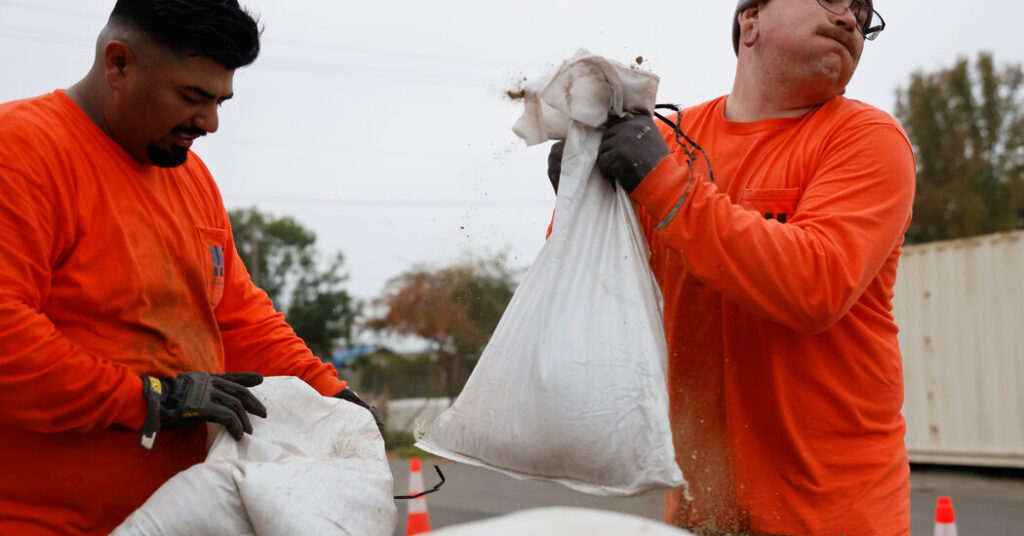
An intense winter storm drenched Southern California on Wednesday, triggering flash floods, mudslides and debris flows, and forcing residents to evacuate in parts of the Los Angeles region.
The storm is part of a weather system that could bring record rainfall over the holidays. Much of Southern California — including Santa Barbara, Ventura and Los Angeles — was under a flash flood warning for most of the day. But forecasters later downgraded the warning to a flash flood advisory for parts of the southwestern region of the state, which is in effect through 6 a.m. Pacific time on Thursday.
On Wednesday, fire crews were evacuating homes in San Bernardino County, and rushing debris flows shut down Highway 2 in the area east of Los Angeles. Heavy rains also flooded portions of Interstate 5 in the San Fernando Valley in Los Angeles, prompting officials to close northbound lanes. There were water rescues in at least two counties, Los Angeles and San Bernardino, and reports of mudslides and rock slides in the Los Angeles area.
In Wrightwood, a ski resort town of about 5,000 in the mountains of San Bernardino County, crews were going door to door to evacuate people from homes and vehicles, as the rain and debris flow overwhelmed roadways. The entire town was under a shelter-in-place warning, and Christopher Prater, a spokesman for the San Bernardino County Fire Department, said the agency had received dozens of rescue calls starting at 7:30 a.m.
“Our primary function right now is life safety,” he said.
The heavy rain has raised concern among officials about disastrous mudslides and even worse flooding, particularly in places where the ground is still scarred from wildfires in January.
“I am urging all Angelenos to stay safe and be extremely careful on the roads if you absolutely must travel,” Mayor Karen Bass of Los Angeles said in a statement on Wednesday. “Please do not take this storm lightly.”
Gov. Gavin Newsom has declared a state of emergency in six counties, including Los Angeles, Orange and San Diego. The National Weather Service reported six to eight inches of rain and flash flooding in San Diego as of Wednesday afternoon, with more rain expected.
Sarah Bailey, who has lived in the Wrightwood area for more than two decades, said, “This is the worst flooding I’ve seen.”
Ms. Bailey, who runs vacation rental cabins, said she has been fielding calls all morning from customers canceling their reservations because of the floods. Some of the renters who were already there were unable to evacuate because of closed roads.
“It’s an economic nightmare because Christmas and New Year’s are the biggest two weeks for Wrightwood,” said Ms. Bailey, 33. “That’s where the majority of people in this town make their money.”
The rain deepened the misery for the region’s thousands of homeless residents. Matthew Alexander Consolato, who left a shelter because he said it was too crowded, was brushing his teeth at a bus stop in Little Tokyo in downtown Los Angeles on Wednesday afternoon. It was his birthday.
“Pretty horrendous,” he said, trying to stay dry under the bus-stop awning. “It kind of caught me by surprise. I didn’t think it would be this bad.”
The neighborhood of Skid Row was nearby, and one of its residents, Christavis Tillman, said there was nowhere for him to stay. “I’m going to go under the overpass, where the bridge is, and hope I’ll stay dry,” he said.
The heavy rains are coming from a series of atmospheric rivers, or large plumes of moisture in the sky, that have been flowing over California. Climate change is also a factor: Rainstorms and flooding are becoming more common because of global warming.
The National Weather Service took the rare step of issuing a “high risk” alert for excessive rainfall for Los Angeles and areas to the north. Over the last decade, some of the nation’s deadliest and most destructive floods have occurred under this specific warning level.
“This is the type of storm system that affects the area approximately every five to 10 years or so,” Ariel Cohen, a meteorologist with the National Weather Service, said at the Tuesday news conference. “There will almost certainly be numerous rockslides and mudslides, along with areas of severe flooding, in urban locations and along freeways, which is why being out on the road will be exceptionally dangerous.”
Mandatory evacuation orders were in place for parts of Orange County that were burned in the Airport fire last year, as well as for a recreational vehicle resort in Ventura County and parts of Los Angeles County, including the Pacific Palisades. In Trabuco Canyon in Orange County, mail service was halted, the U.S. Postal Service said.
The holiday presents its own challenge. According to the Los Angeles Police, many residents have resisted orders to evacuate during Christmas.
Jim McDonnell, chief of the Los Angeles Police, said on Tuesday that officers had visited 126 properties within the Palisades burn zone to share evacuation information.
“Many of the people — probably most of the people — in the evacuation area have thanked us for the notification but chosen not to leave,” Chief McDonnell said. “I would ask you to seriously reconsider that.”
By Wednesday evening, the rain had subsided in some areas, including parts of Los Angeles. As the sun shined over Santa Monica beach, people began to emerge from their apartments and hotel rooms. One young boy said he had ventured into the water for a swim.
Wednesday’s rain is the first of what forecasters said would be two main waves of downpour. Even though it has died down, Joe Sirard, a meteorologist with the Weather Service, said the precipitation would probably intensify again on Thursday night, bringing a couple more inches.
The storm is part of a broader system that has already soaked Northern and Central California since the weekend and is set to dump snow across the Sierra Nevada.
There has been at least one fatality in Northern California attributed to the storm: A 74-year-old man died on Sunday after he drove his pickup truck onto a flooded roadway in Redding, according to the police there.
Jacey Fortin, Nazaneen Ghaffar, Jenny Gross, Judson Jones, John Keefe and Francesca Regalado contributed reporting.
Tim Arango is a correspondent covering national news. He is based in Los Angeles.
The post Intense California Storm Brings Flash Floods and Mudslides, Forcing Evacuations appeared first on New York Times.