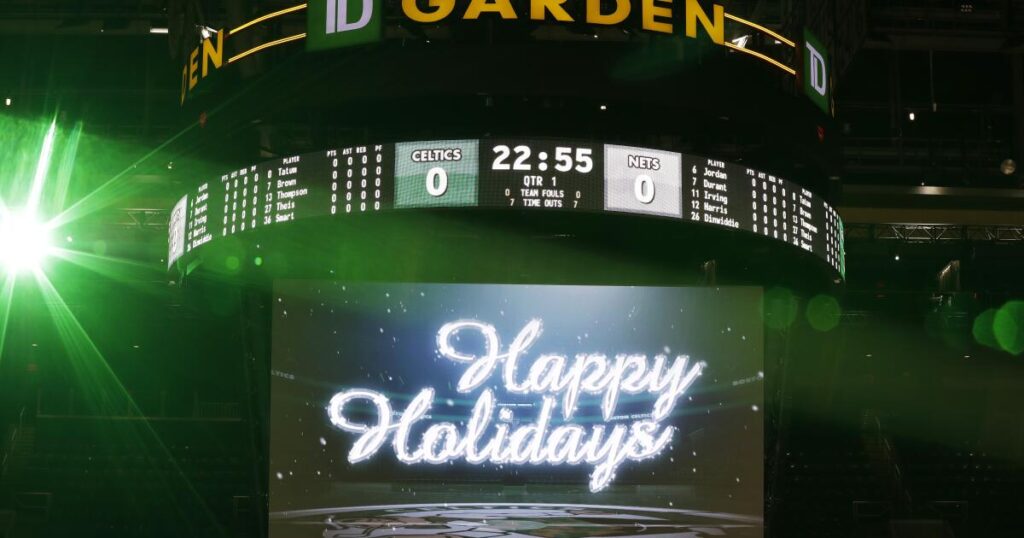
Happy holidays!
I really mean that, for everyone reading this. My season’s greeting isn’t a political statement, nor — in keeping with the spirit of the season — should it be. And yet … too many folks from the preternaturally divisive president on down insist on making it so. As soon as Thanksgiving ends, the culture war of words begins.
A friend, shopping for his family’s Christmas dinner, was leaving a Washington-area grocery store when he saw a man pass a Salvation Army bell-ringer who was wishing shoppers “Merry Christmas.” The man reached his SUV, then spun around and returned to the woman.
“Because you said ‘Merry Christmas’ and not ‘Happy Holidays,’ I’m giving you money,” he told her, adding, “America’s back!”
A small victory in the counteroffensive against the purported war on Christmas! I hope the man’s donation was commensurate with the big point he apparently wanted to make, but I doubt it was. Because that would be a lot of money.
If people like him really want everyone to have a merry Christmas, they’d stop the culture-warring about a nonexistent war on Christmas.
Until I was 18, each December I said “Merry Christmas” exclusively. But nearly everyone I knew in my working-class world was Catholic — relatives, classmates at the local Catholic school and most of our neighbors in the closely built houses of our community. A number of Protestants lived on the block, but just one Jewish family, next door. I envied that family’s four kids at the holidays because they got Hanukkah and Christmas gifts (one parent was raised Christian). I was sorry they didn’t get to enjoy the other traditions of a religious Christmas — the centuries-old hymns, the large crèche, a church sanctuary brimming with flowers, garlands and candles, the wafting incense — but I knew they had their own cherished rituals through the year.
The priests and nuns so prominent in my childhood endured the commercialization of Christmas, but they fought back nonetheless. Annually I’d enter a contest sponsored by the Knights of Columbus, a Catholic men’s group, that asked students from parochial elementary schools citywide to design a poster with the theme “Keep Christ in Christmas.” I never received glad tidings that I’d won.
And then, when I went away to college in a big city, suddenly I had Jewish and nonreligious friends and one who was Muslim. I came to appreciate firsthand the country’s diversity (another term that’s become a fighting word in these polarized times). I started saying “Happy Holidays” at Christmastime, as a gesture of inclusiveness and respect for others of different faiths or no faith. I reserved “Merry Christmas” for individuals and groups that I knew or assumed to be fellow Christians.
That’s been my practice for decades. My career has been in mass media, which by definition serves a large, diverse audience, including people of varied or no religions. It makes sense for broadcasters, newspapers, news sites and other media outlets, as well as other corporations, to favor an inclusive phrase such as “Happy holidays” or “Season’s greetings.”
Besides, given the happy confluence of religious holidays in December, along with New Year’s Eve, ecumenical greetings shouldn’t be objectionable. Seems pretty Christian-like to me. Jesus Christ was Jewish, after all (and a poor refugee for a time, having fled with his family to escape violence in their homeland). I hardly think that Christ would care whether someone said “Merry Christmas” or “Happy holidays.” (The root of “holiday” is “holy day.” Just sayin’.)
Happy holidays, Merry Christmas: They aren’t political statements. Unless you want them to be.
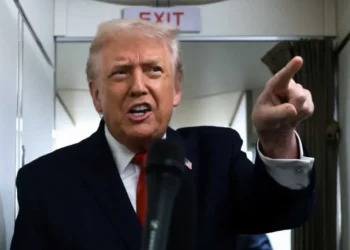
President Trump wants them to be. He’s not the first to exploit the matter for political gain. Some on the right have been doing so for my entire life, though the claims of a societal war on Christmas really picked up only in the past two decades, “thanks” especially to Bill O’Reilly and Fox News and to Republican politicians eager to score points among their evangelical voters. In 2005, President George W. Bush, despite calling himself a born-again Christian, got lots of lumps of coal from conservative Christians when he sent out cards wishing more than a million supporters a happy “holiday season.”
Ten years later, Trump — who rarely darkens the door of a church — took his escalator ride toward the presidency and soon made clear that he wouldn’t make Bush’s mistake. Even at summertime MAGA rallies, Trump rails against those who don’t say “Merry Christmas.” In 2015, he told appreciative rally-goers, “If I become president, we’re all going to be saying ‘Merry Christmas’ again, that I can tell you.”
He’s still telling us. Last week, Jimmy Kimmel ran video clips of Trump doing so every year since 2015, including this month. For the panderer in chief, it’s the gift that keeps on giving. “You weren’t allowed to say ‘Merry Christmas,’” he claimed last year. “I got it back.”
Once again Trump claims to have solved a problem that existed only in his mind.
For a guy who’s so censorious about holiday greetings, however, Trump’s own annual messages on social media are about as un-Christ-like as you could devise. What would Jesus do? He wouldn’t come up with doozies like those Trump posted on Christmas in 2024 assailing President Obama, “Radical Left Lunatics” and “Sleepy Joe Biden” and wishing the people Biden had just pardoned to “GO TO HELL!” He’d wished the same for Biden on Christmas in 2023.
The sentiment behind “Happy holidays,” much like what most of those who say “Merry Christmas” intend, is kind and heartfelt — a spirit we should all aspire to embrace and extend to strangers through the other 11 months of the year as well.
Which is why I feel sorry for the president and for that man at the suburban grocery who conditioned his contribution for the needy on whether a bell-ringer said “Merry Christmas.” Their carping at Christmas suggests something un-merry within them. Let the rest of us be happy at the holidays and wish the same to one and all.
Bluesky: @jackiecalmes Threads: @jkcalmes X: @jackiekcalmes
The post ‘Happy holidays’ is how we embrace the Christmas spirit of generosity appeared first on Los Angeles Times.